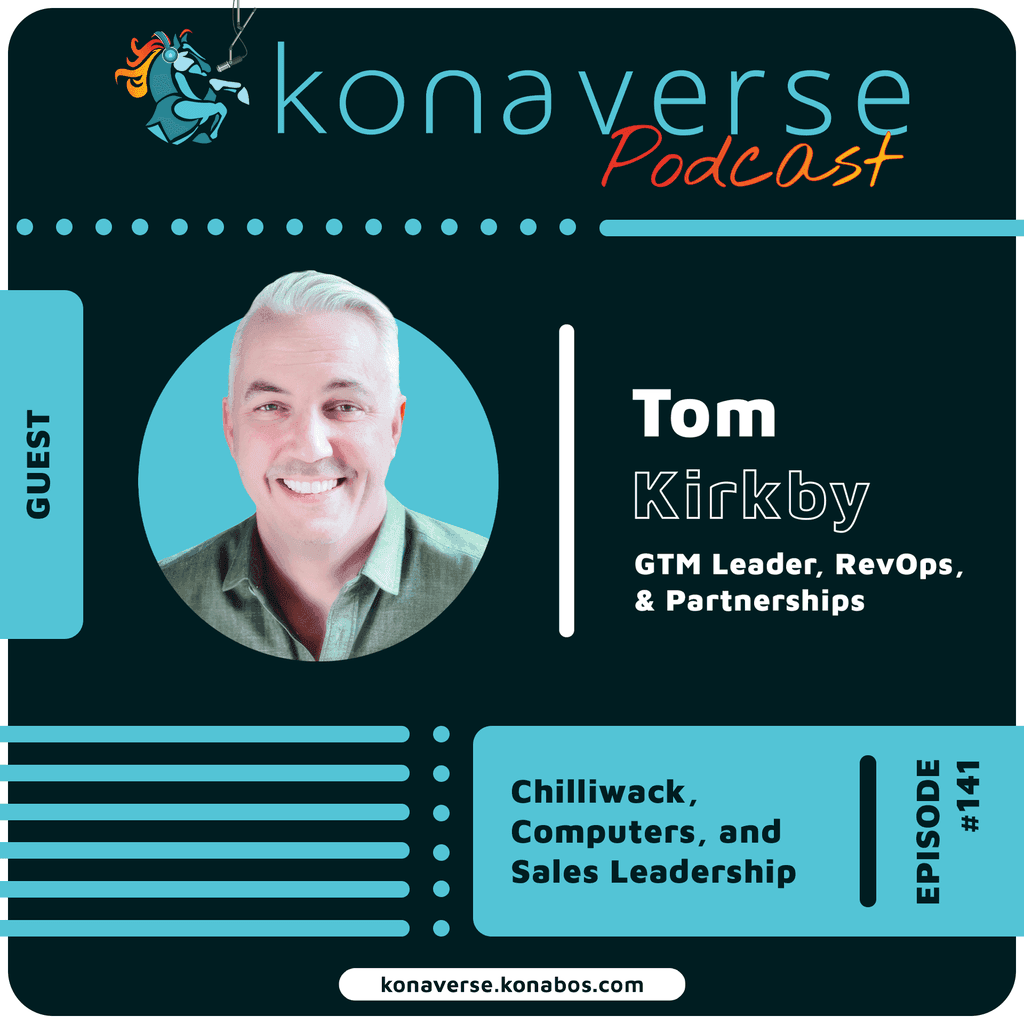
Tom Kirkby is a GTM (Go-to-market) Leader with great experience in Sales, Partnerships, and RevOps. Tom has worked with companies like Squiz, Sitecore, Avanade, and Microsoft. In this episode, Tom talks about growing up in Chilliwack, British Columbia, family, early experiences with and building a passion for technology, navigating education, career, Seattle, moving into sales, Phoenix, his next moves, and so much more!
[00:00:00] Welcome to Konabos, a conversation experience platform hosted and curated by Konabos Consulting.
[00:00:06] Konabos is a global technology leader and while this podcast will be connected by technology,
[00:00:12] the glue is human stories and narrative. Technology can bring us together. It can make our lives better
[00:00:18] and more efficient in myriad ways. But it cannot replace human discourse and the magic that can
[00:00:23] happen by the interchange of ideas. Hope you enjoy our podcast.
[00:00:30] Welcome to the Koniverse. This is Akshay Sura.
[00:00:33] And this is Matt McQueenie.
[00:00:34] Today we have with us our friend Tom. Hey Tom, welcome to the show.
[00:00:39] Thanks for having me.
[00:00:41] Yes. So Tom, we know we know you from now, from our adult selves, but we always go back to the
[00:00:48] beginning here on the Koniverse. Where were you born? Where did you grow up, Tom?
[00:00:54] Hello. I was born in a small town called Chilliwack, which is just on the outside,
[00:01:00] outskirts of Vancouver, British Columbia. And yeah, we, it's, we remember this town as like this,
[00:01:12] this one that like, you always know when you're getting close because you can smell the cows,
[00:01:16] right? It's one of those small towns. I'm sure it's not like that anymore, but yeah,
[00:01:22] fond memories of that.
[00:01:24] What did your parents do when you were growing up, Tom?
[00:01:28] You know, my, my mom and dad were divorced pretty, pretty early on. So my mom was one of those like
[00:01:35] really scrappy single mothers, right? Like she did everything. She worked, my youngest memories,
[00:01:44] she worked in a bar as a bartender. Then she moved up to like managing them, managing restaurants.
[00:01:53] She managed a hotel. She opened her own restaurants. She had a cleaning company, just
[00:01:58] really scrappy. She sold cars at one point. Like everything. One of those women that,
[00:02:07] you know, just absolutely focused on improving the lives of her children.
[00:02:16] Wow. And what does, uh, what brings one to Chile? Was it Chile? What?
[00:02:22] Yeah.
[00:02:23] What brings them there?
[00:02:26] There's an old band with that name, actually. Um, what brings someone there? Well, I was born there.
[00:02:31] So that's, you know, Stork brought me, um, what brought her there? Uh, my father had a job working
[00:02:41] at Canada, had this thing really progressive. Like, so I was born in 74, uh, really progressive back
[00:02:48] then. They would take at-risk teams, like ones that have been convicted of crimes of whatever.
[00:02:55] And they had this old, uh, army camp where they would take them and let them live there and teach
[00:03:02] them outdoor skills. And he was one of their officers. So, uh, he would, you know, it's, it's
[00:03:09] close to nature, right? Um, you know, he would teach them rappelling, canoeing, you know, climbing,
[00:03:15] uh, all the sort of outdoor life skills stuff. And so it was close to that.
[00:03:21] Sounds like a pretty place to live in. Um, do you have, do you have any siblings Tom?
[00:03:28] I do. Yep. Um, I've got an older brother and older sister and a younger half brother. Uh,
[00:03:35] so I was kind of grew up as a baby of the family, even though younger half brother, um, there,
[00:03:41] everyone's still up in Canada. Uh, I was the only one to move down here south of the border.
[00:03:47] Wow. And this is one of those stats that I always hear. I've never validated it, but it sounds right
[00:03:53] that something like 75% of the Canadian population lives within 100 miles of the U S border. And I did
[00:04:02] look up Chilliwack boy, it's pretty, it seems pretty close. What was life like growing up there? Did,
[00:04:09] was there a pull to the border? Like what, what were the local kind of, uh, delicacies activities,
[00:04:15] you know, other than the military camp for kids? Yeah, this is interesting. Yeah. So when I did get
[00:04:22] to see my dad, it was, uh, we were eating a lot of military rations, like they would have these MRE
[00:04:28] things. We'd go hiking and camping all the time. Uh, his favorite thing to do was, you know, take us
[00:04:35] away in the summertime, go for like a two week canoe trip from the interior of British Columbia,
[00:04:39] all the way down to the river, to the ocean. Um, or we go, you know, we literally just, uh, go to,
[00:04:47] there's a lake called Harrison Lake. It's a pretty big lake. We just literally go up it until there's
[00:04:53] no more people. Then go a little bit further. And he would build a camp. Uh, he built like a little
[00:04:58] kitchen. We'd have a dock we'd have, uh, he'd make saunas and literally he'd just go out there with an
[00:05:04] axe, sheet of plastic, maybe some rope, uh, you know, some fishing gear. And, uh, you know, we would
[00:05:12] just survive out there for a couple of weeks at a time. Um, my, my mom, uh, you know, we would go down
[00:05:19] to the local lake. Uh, I think it's called cultus lake. We do a lot of, uh, fishing for lake trout,
[00:05:25] which I absolutely cannot stand the taste of anymore. Um, but you know, as a kid, like it was
[00:05:33] idyllic, right? Like it was one of those places where, you know, my brother and I would just go
[00:05:39] wandering off into the neighborhoods. There was like, you know, an old farm where we would, you know,
[00:05:46] jump from the hay loft. There was a pond where we collect duck eggs and try and hatch them back at
[00:05:52] the house. There was like, uh, fruits and vegetables. We always knew where to find those
[00:05:58] and pick those and eat those. We would go up blackberry picking and you know, summers were just
[00:06:02] filled with stuff like that. Growing up. Did you have a career in mind? What did you want to be?
[00:06:10] Yeah, absolutely. 100%. Um, when I was 14, I was gifted, uh, an apple to see computer
[00:06:20] computer and, um, virtually no software on it. So very quickly I got like little magazines or books
[00:06:29] from the library for how to write code on these things. And we do a little bit of in school and
[00:06:35] that sort of stuff too. And I just fell in love with computers, um, constantly writing games. If I
[00:06:42] could, you know, dream them up on my own. Eventually I, uh, friend introduced me to bulletin boards,
[00:06:48] which were like pre internet for anyone who doesn't know what that is. I had a 300 baud modem where I
[00:06:54] had to stick the receiver on top of the thing, like in the old movies and, you know, dial up and, you
[00:07:02] know, explore the world that way. And so like, I got hooked on computers really, really early,
[00:07:08] um, all my way through school writing software, uh, took little side gigs wherever I could find them
[00:07:14] to write software for people. I wrote software for law firms, accountant, uh, accountants, uh, insurance
[00:07:22] agencies, you know, eventually got my way working in a software company, then a finance firm writing like
[00:07:31] AI stuff in, this is back in the, uh, early nineties, mid nineties, stuff like that. Just totally fell in love
[00:07:41] with, uh, the world that you could imagine and you could make happen with computers.
[00:07:50] Now, when you're doing that, it's kind of like your own secret, right? Cause it's not like school
[00:07:55] can really deliver on a lot of this, these pathways that you're going on. How did you make, or did you
[00:08:02] not make school worth your time? Like, how did you balance those two when you fell in love with the
[00:08:07] computers and then, you know, there's still some things to get out of school, but it's, it's,
[00:08:11] they're probably not able to service that interest as hard as you're going after it.
[00:08:17] That's a really good question. I love this story. Um, I was a horrible student. They, I, I failed
[00:08:24] multiple grades. I had to do summer school multiple times. I was one of these people who
[00:08:30] I got the ideas for how things worked and to the point that I could actually teach people,
[00:08:34] but I never did my homework. I never did tests very well. I would show up completely shocked.
[00:08:41] There was an exam that day and just do it all from the hip. Um, and you know, like I was like one of
[00:08:48] those, you know, risky teams. And I had this one, actually there are two, but one, especially one
[00:08:57] instructor who discovered this about me that I was always in the computer lab constantly, right?
[00:09:04] I had lunch before school, after school pounding away on a keyboard, but my grades were the worst.
[00:09:11] And he sat me down and, you know, asked me, you know, what I was up to. And, you know, at the time
[00:09:18] I was trying to teach myself how to write a paint program on a, uh, original Macintosh computer, right?
[00:09:27] Yeah. Cause I couldn't afford one. And, you know, it seemed like a fun thing to do. And it was, this is all in Pascal. If anyone remembers that language.
[00:09:36] And, uh, he, you know, I don't know how he saw fit to do this, but he said, he struck a deal with me. He said, I'll make you a deal. You have to come in here once a week, show me everything you're working on.
[00:09:50] Just talk me through it. And then if you do that, you won't have to do another assignment. You won't have to do another exam for computer science.
[00:09:58] And I don't know if word got around, but like my English teacher also gave me a bit of a special deal, took a real liking to me. Like, I don't know how I, uh, earned this in life. Like the, the, the, the kindness. There was another one too, like in college. This is a funny story. So, um, I didn't finish my degree.
[00:10:24] I took this business computing program at what's now called Caplano university. And I was like one credit short because I found a job. I was teaching on the side, how to use, uh, Microsoft office to a couple, you know, small companies.
[00:10:39] And then I found this job at the financial management company. And, uh, I was like, well, I don't need school now. I got the job. This is all I needed. Um, but then I got a job offer to go down to Microsoft.
[00:10:52] Microsoft. And the week before I was supposed to start there, I was just wrapping up work at the financial management company. And one of my coworkers said to me, Hey, Tom, how did you get past the degree requirement to get a visa to work in the U S and.
[00:11:13] And, you know, pale, pale face, you know, blood rushing from my head. Oh, wasn't a problem. I figured that out. Um, I went back to one of those instructors at Caplano university. Uh, Steven Ibaraki is his name. He's still around, not there, but he's still around.
[00:11:30] And, uh, he struck a deal with me. He said, listen, I've got a C plus plus class writing. It's final exam here on Monday. You've got the weekend to study. If you can get a B plus or better, I'll work with the Dean and I'll get to your degree.
[00:11:45] So I spent three days cramming from scratch, never seen C plus plus code in my life, how to do this stuff and showed up and powered through. And just, you know, I think I was actually the first person to finish in the class, the exam, like just, I was so.
[00:12:05] Motivated. So crystallized on, this is what I needed to do to save my life and, uh, got through and they gave me the degree. So like all these instructors, there's, you know, have really been so kind and took like such good care of me. I, I, I wouldn't be anywhere in life without them.
[00:12:26] Oh my God. You would have almost thought you're an athlete.
[00:12:31] I felt like one. Uh, yeah. Okay. It's this big, big book. It had to be like five inches thick on how, you know, for the entire course. I was just like, okay, every chapter, right. Learn it, write it, do it, repeat over and over again.
[00:12:48] Yeah. You're fortunate enough that they saw the passion in you, I guess. And then they, they decided to not penalize you, but give you like the, the right way for you to get to where you got to.
[00:13:01] Yeah. I don't know if it was a different time. Um, you know, I don't know if that still happens today that you find so much fortune and people caring for you. Right. But it's something that as I get further along in my career, I try and like stay present and thoughtful about and how to like, uh, express my gratitude by paying that back to other people whenever I can.
[00:13:26] Yeah. It's funny. You were, your mom in many ways was entrepreneurial, right? Just in a different kind of way, a hustler, an entrepreneur. Your dad was this kind of mountain man. Let's go past where society is and build saunas and our own thing. How did they, how did they come to terms with this? You were feeling it where people are helping you out, but it must've been kind of weird that you were like really into this newfangled computer thing. And then the schooling is tough. Like what, how were they making sense of this?
[00:13:57] I wasn't a good kid to, to, you know, I, I wasn't like an easy kid to, to parent. Um, you know, I, I still to this day, I don't have good relationships with them. Um, I think I, you know, I was very introverted and I, I would do these things, just lock myself in a room. And that's all I did. I did that all the way through my twenties as well. Like I had no social life. I just like evenings and weekends.
[00:14:26] I'd be at a coffee shop studying something. And then, uh, you know, eventually a switch flipped and I realized that I needed people and, you know, did more sales, more, um, consulting because that's what the world demanded of me.
[00:14:43] I don't know if that answers the question, but like I was, I was weird.
[00:14:49] Um, Tom, do you remember your first interview? Was there anything interesting about the first interview ever had in a professional job?
[00:14:58] Um, um, one of the first ones was when I was working for Avanade, um, in, in the early days of Avanade, I don't know if you know who Avanade is. It was this joint venture between Microsoft and Accenture.
[00:15:16] Uh, so the story goes, you know, they collectively put a billion dollars together in 2000 to go and create this consultancy world-class thing, right?
[00:15:26] All focused on Microsoft technology.
[00:15:29] And, um, um, we took a lot of investment funds from Microsoft to go and show technology.
[00:15:39] Uh, you know, basically Microsoft would come up with a new product, maybe it was something new in office or, um, yeah, these are early days.
[00:15:47] So like related technologies, they would give us, you know, some amount of money, like 50 to $80,000 to go and build something with it for a customer.
[00:15:56] And I, one of the first interviews I had was I had just built a integration of office with, Ooh, I want to say it was EDW, like a backend, um, uh, you know, inventory management system for cascade reports.
[00:16:17] Or just sort of cascade designs.
[00:16:19] It's a mountaineering company in Seattle.
[00:16:23] And, uh, they did a, uh, Microsoft did like a fluff piece video and interview on me.
[00:16:30] And they had me with glasses, not dissimilar to the ones I'm wearing right now, taking them off and going in and out and doing like really sort of thoughtful, pensive stuff.
[00:16:39] It's probably still on the internet somewhere.
[00:16:41] I think I have at least one photo of that, but like, um, for whatever reason, I kept getting, uh, projects like that over and over again, where I'd have to do interviews.
[00:16:53] I got to speak at, uh, uh, what was it called?
[00:16:57] TechEd at the time, uh, which was Microsoft's big conference for technical people.
[00:17:03] And yeah, so things like that.
[00:17:06] Um, I haven't done a lot of interviews just, you know, when the world required it.
[00:17:12] Yeah.
[00:17:13] Um, so where you grew up looks like Seattle's the big city, right?
[00:17:18] I mean, I'm sure Vancouver too, when you're in British Columbia, but how did the, how did the Microsoft thing happen?
[00:17:26] I mean, that seems like, uh, winning Willy Wonka's ticket or something, right from where you were based, the industry you were building on.
[00:17:33] And then there's, you know, the shining company in Seattle.
[00:17:38] Yeah.
[00:17:39] Um, yeah, I did feel at the time, like I, I had the golden ticket, like that was mind blowing.
[00:17:46] Right.
[00:17:46] Like I was fine.
[00:17:47] I was making it to the big leagues.
[00:17:49] This is incredible.
[00:17:50] Um, and either I misunderstood or they misrepresented.
[00:17:55] It wasn't actually, it was a, it was a contract role through a vendor.
[00:18:01] I thought it was writing software for those really cool thing.
[00:18:04] Turned out I was doing testing for an internal IT system, uh, with a really unfortunate name.
[00:18:12] Uh, and, uh, you know, you get down there, you've given up everything.
[00:18:18] Like I, when I, when I finally got the diploma and I moved down there, um, one of the things
[00:18:24] I didn't research until I got there was where I was going to live, how I was going to live.
[00:18:31] So I, you know, stayed at a motel six.
[00:18:33] I actually stayed in that motel six for like six months in Issaquah, which is not a fun place,
[00:18:41] uh, at the time anyway.
[00:18:42] So it wasn't bad.
[00:18:43] It wasn't risky, but a little sad living in a motel six.
[00:18:47] Uh, so yeah, I, you know, I took that and like, like everything, anytime I saw an opportunity,
[00:18:54] I would jump for it.
[00:18:56] So started doing that thing quickly moved over to another role where, um, I don't know if
[00:19:02] you guys remember any of this stuff, but it was building the AI dev studio for Microsoft
[00:19:09] troubleshooters, which doesn't mean anything to anyone.
[00:19:12] So you have to describe it a little bit differently.
[00:19:15] It, it was basically the, uh, the knowledge maps with all the AI probabilities and whatnot
[00:19:22] that fed Clippy and other sort of, you know, power pop or the wizard guy or stuff like that.
[00:19:29] Um, I fast talked my way into it, just like I fast talked my way into all of my roles and
[00:19:35] learned everything I needed, you know, five minutes before the person, you know, who was
[00:19:42] checking that I knew what I was doing, got to talk to me.
[00:19:46] Um, ran a team there doing, doing that.
[00:19:50] Um, yeah, you know, this is the, you know, the late nineties.
[00:19:55] So there was a lot of opportunity for anyone who could do anything with computers.
[00:20:00] Yeah.
[00:20:00] So at what point did you pivot from something you were so passionate about, which is writing
[00:20:07] software and computers into more of a sales, selling yourself role?
[00:20:15] You know, you can ask some people and they tell you that I still haven't fully pivoted.
[00:20:19] Um, like I, I love technology.
[00:20:23] Um, I love understanding how it works.
[00:20:25] I love explaining it to people, uh, who don't necessarily have the, you know, experience with
[00:20:34] it.
[00:20:34] Um, I think, you know, the, the biggest, biggest pivot came, uh, working for Avanade.
[00:20:43] Uh, they, you know, you, you kind of, uh, top out in technology, right?
[00:20:52] Like you can either be a Jack of all trades and know everything quite well, or you can
[00:20:58] know one narrow thing very, very well.
[00:21:02] And I quickly found myself being the Jack of all trades.
[00:21:05] And then, um, you know, there wasn't really anywhere to go from there.
[00:21:11] Um, part of the reason I think I didn't get along with my parents was, uh, I don't take,
[00:21:16] uh, direction well, you know?
[00:21:20] So in order to, to have less people giving me, telling me what to do, I had to keep going
[00:21:26] up and the only way to go up was to learn how to take the skill of explaining complex technical
[00:21:33] things to not so technical people.
[00:21:37] And then that quickly let its way into sales and sales leadership and, uh, whatnot.
[00:21:44] But I like, if, if you saw my office, you'd recognize that I am probably within arm's reach
[00:21:51] surrounded by at least seven computers.
[00:21:55] Um, I, I, you don't get away from that.
[00:21:58] I mean, you guys must as well.
[00:22:00] I, you know, I've seen your LinkedIn profiles.
[00:22:02] You guys have been in this industry for a little while.
[00:22:06] Yeah.
[00:22:07] I mean, the interesting part, which to, to have that understanding that there's a ceiling,
[00:22:12] no matter how great you are at being a tactician of a technology to get to the next level,
[00:22:18] you have to almost bring the business with you and you have to get the, you have to sell
[00:22:25] the promise.
[00:22:26] And like the revenue generation becomes almost the, the Thanos ring in some ways, right?
[00:22:32] Like it's just, it's the, I'm interested in how, I mean, the fact that you came to that
[00:22:39] realization was really good, especially for an introvert.
[00:22:43] Right.
[00:22:43] But how you've, how you evolved, what you, how you learned this, um, this sales thing.
[00:22:52] It's so, it's so different.
[00:22:53] It's like software as opposed to hardware, right?
[00:22:56] Like it's very, uh, you know, how, how did you, how did that evolution work for you internally?
[00:23:02] We saw externally how it's worked, but how did you do that internally?
[00:23:07] Um, yeah, I, I guess that is strange for people.
[00:23:11] I think like in my naivety, you know, uh, at the time, you know, I just thought of it
[00:23:20] as another software, another problem to decode.
[00:23:24] Okay.
[00:23:24] This is what people need.
[00:23:26] If you're talking to someone, ask them questions about themselves.
[00:23:29] They like that, uh, you know, get to know them and, you know, try and smile more.
[00:23:35] Right.
[00:23:35] It sounds really silly, but if you just build from being, uh, an approachable person, I was
[00:23:43] wholly unapproachable for much of my life, by the way, no one liked me.
[00:23:47] Um, but if you can, if you can build from that, just make yourself a little more approachable,
[00:23:54] lots of different things open up.
[00:23:55] Um, I think, you know, coming from where I grew up and the situation I came from, I was
[00:24:03] always, uh, looking for seeking security in my life.
[00:24:08] And the only way I could find security was to, um, you know, make myself useful.
[00:24:17] And so it was just the next way to be useful.
[00:24:21] I wasn't especially great any longer at the technical stuff.
[00:24:27] You, you top out at that and you can keep going at that pace, but it's like technical
[00:24:33] is always hard.
[00:24:35] Every year there's new exams, new certifications, new technology.
[00:24:38] Just when you get good at something, it's no longer relevant.
[00:24:44] Um, so I think that's kind of been my driving force of just, you know, like assuring that
[00:24:50] my life will be secure with where I came from.
[00:24:53] Um, not to be like really vulnerable.
[00:24:55] Right.
[00:24:56] But that's, that's what drove me.
[00:24:57] So I didn't have a choice.
[00:25:00] You know, I had to figure out how to get along better with people, how to be nicer, how to
[00:25:04] be someone that people wanted to spend time talking to and tell their challenges to and
[00:25:10] listen.
[00:25:12] I had a great instructor that taught me active listening.
[00:25:15] It was part of a database design class.
[00:25:18] If you can believe it, um, just the act of active listening, right?
[00:25:23] Like being able to repeat back to people, what you heard, confirm it, make note of it, move
[00:25:28] on to the next topic really does wonders for making people feel that you care and you do
[00:25:36] start to care.
[00:25:36] Right.
[00:25:37] I don't mean to sound like a sociopath, but you do, right.
[00:25:40] Um, paying attention.
[00:25:43] I was going to ask you, did you end up taking any other classes for this more of a salesy
[00:25:49] kind of transition over a period of time?
[00:25:51] Probably something that you built upon, uh, over time.
[00:25:54] I would imagine.
[00:25:56] Um, geez, I don't think I took any classes.
[00:26:00] Um, so when I really got into doing sales, uh, so consulting sales, as you guys know, it's
[00:26:07] a little different than product sales, right?
[00:26:09] Consulting sales is really about, you know, creative thinking around how to solve a business
[00:26:14] challenge that may pull from multiple different areas.
[00:26:17] It's not always the same thing that you're selling over and over again.
[00:26:21] When I left Avanade, it was to start my own startup.
[00:26:24] That was a technology platform.
[00:26:26] Um, and I was like really excited.
[00:26:29] I went and I built this thing.
[00:26:31] I, you know, got on a bunch of users and then I quickly realized I had no idea how to sell
[00:26:35] products.
[00:26:35] Uh, so the lesson for how to sell products was joining Sitecore.
[00:26:40] Uh, a good friend at the time brought me on to be a territory sales exec in the Northwest
[00:26:46] and, you know, use that to see how they all did it, how they were successful.
[00:26:51] I was miserable at it for the first, you know, six months to a year, but then very quickly
[00:26:57] picked up on how, how they approached people, uh, following up with people was a really,
[00:27:04] uh, big aha moment.
[00:27:06] Just like always being present, always thanking people, um, you know, always advancing through
[00:27:12] a sales cycle.
[00:27:13] Um, I, I think, you know, I owe a lot of thanks to the people that put up with me during
[00:27:21] that time and took a chance on me.
[00:27:23] Do you think that we always think that we're evolving towards some revolution at any point
[00:27:30] in time, right?
[00:27:30] And then you look back and it didn't seem as crazy as we always think it's in the moment,
[00:27:35] but it does seem like there's a lot of a, uh, a similarity, a commoditization across
[00:27:43] a lot of these platforms today.
[00:27:45] And do you find one that that's kind of the case and two, does it make selling product
[00:27:51] more consultative sales again, uh, now, because if there's a lot of similarities between them,
[00:27:58] it really becomes the, how you can catalyze, uh, experiences through these systems.
[00:28:06] Yeah.
[00:28:07] Um, my personal experience over the, especially in the last few years has been that I've
[00:28:13] seen that, like you said, there's very little significant product difference between various
[00:28:20] platforms.
[00:28:22] You can, you can accomplish it with any of them.
[00:28:25] Heck, I could probably still open up Notepad and write out an HTML page for you, you know,
[00:28:30] from memory.
[00:28:31] It'd be horrible, but I probably could.
[00:28:34] Um, what is driving sales in the digital experience space at the enterprise level is strictly relationships.
[00:28:43] In my view, other people may have another way of doing it, but, um, you know, people are betting their, their careers, their livelihood, their success on choosing option A, B, or C when they're not very different.
[00:28:58] Um, the only thing that really is different is who's going to be in the room with you and keep
[00:29:03] that relationship going.
[00:29:05] Uh, so, you know, my, my last role, we did, uh, some, some really wonderful things just honestly,
[00:29:13] by calling up people we've worked with in the past and asking them if they'd give us feedback.
[00:29:18] It's not a pitch, you know, I just really love it if you would just take a look at what this product is and tell me what you think.
[00:29:26] And then, uh, listen to their feedback and adapting to it.
[00:29:30] Uh, same thing, you know, it's set core and in other places, I think just listening and, you know, trying to be helpful and creating that bond that you're going to get people's results where it needs to be really makes the big, biggest difference for enterprises.
[00:29:47] Um, if you're talking about product led sales, that's a totally different game.
[00:29:53] Tom, switching it up just a tiny bit.
[00:29:56] What are your current hobbies?
[00:30:01] Oh, uh, if you ask my wife, she would say it's, uh, you know, constantly dreaming of the next thing that I want to do.
[00:30:12] Um, it's also playing fetch with the dog in the pool.
[00:30:15] Um, it is, uh, you know, travel, um, just got back from a wonderful trip with some, some old friends and some new friends in Alaska.
[00:30:26] Um, you know, I, I, I definitely want to, that's, that's probably my single biggest outside of work passion is just feeling like I've gotten to see as much of the world as possible.
[00:30:39] Yeah.
[00:30:40] Yeah.
[00:30:41] So the, uh, speaking of travel, just within where you've lived, we've heard, uh, how long did you stay in Seattle?
[00:30:48] Were you there mostly for the Pacific Northwest stuff?
[00:30:51] Did you move around the West much?
[00:30:53] I know you're in a different place now.
[00:30:56] Yeah.
[00:30:56] Um, no, I stayed in Seattle a little over 20 years.
[00:30:59] Um, moved down there when I was 22, um, just before the pandemic hit, uh, we picked up a home in, uh, Arizona that we were going to turn into an Airbnb.
[00:31:13] And, uh, when everyone got stuck in lockdown, the, the cold, rainy locked down Seattle didn't quite look as nice as the warm, sunny.
[00:31:24] Home with a pool.
[00:31:26] And so that, that was a failed Airbnb.
[00:31:28] We turned that one into, uh, you know, the primary home, but I definitely love the Northwest.
[00:31:35] I still go back there.
[00:31:35] My wife's from Eastern Washington.
[00:31:38] Um, yeah, I still have, uh, fantasies of spending more time around the Whistler area up in Vancouver as they get older.
[00:31:45] Um, if you've ever been in, uh, a stunning place, but yeah.
[00:31:51] Um, so we've been in Arizona now for, uh, what was that since 2019?
[00:31:57] So five years.
[00:31:59] Yeah.
[00:32:00] I never been to the North Northwest myself.
[00:32:03] It's, it's gorgeous.
[00:32:05] Uh, we have to make it a point.
[00:32:07] To get, um, this is Tom, a different question again.
[00:32:11] What does the word community mean to you?
[00:32:16] Just before I answer that, you can let me be your tour guide and take you around the Northwest when you go up there.
[00:32:21] Okay.
[00:32:22] If you, if you can share a fish with me any day.
[00:32:26] Oh, okay.
[00:32:27] Might be fried chicken.
[00:32:28] Well, you could eat all of it.
[00:32:30] You're still sharing it.
[00:32:31] Exactly.
[00:32:32] Yeah.
[00:32:33] Um, community.
[00:32:35] Yeah.
[00:32:36] That's a really good.
[00:32:36] Good question.
[00:32:39] I, you know, when I think back, uh, yeah, as, as one does, right.
[00:32:45] As you get sort of a little grayer, like I am, uh, you, you start to think back about your life and like, what's made the difference.
[00:32:54] What's helped you be, you know, who you are.
[00:32:58] It's always been community.
[00:32:59] It's always been, you know, the kindness of people willing to take a bit of a chance and help me out.
[00:33:07] I have been incredibly privileged.
[00:33:10] I've been incredibly privileged that every job that I've had.
[00:33:13] And I feel like I've had a lot, but maybe not, uh, had enough.
[00:33:17] They've always come from someone in my community, um, reaching out and saying, Hey, I could use your help here.
[00:33:24] Or what do you think about doing something like this?
[00:33:26] Um, every, um, every vacation.
[00:33:31] I'm, I'm thinking about bringing someone from my community with me, uh, because, you know, it's just more fun with people.
[00:33:39] Um, you know, but the neighborhood I'm in right now that I live in, in Arizona, uh, I've never felt a stronger sense of community than the people around here.
[00:33:48] They got me through COVID.
[00:33:49] We, you know, we take, uh, road trips down to Mexico together.
[00:33:54] Um, you know, this site core community that, you know, I was with site core, uh, what was that about eight years?
[00:34:03] That community is so strong and so vibrant and so wonderful.
[00:34:07] Like the, I call everyone my friend.
[00:34:11] There's, there's no other designation.
[00:34:14] Uh, my, my friends from my community means so much and helping them be successful, whatever role they're in, even if I'm, you know, pitching against them, uh, somewhere else, like there's, there's enough for everyone.
[00:34:27] Um, so I kind of feel like community is everything.
[00:34:32] I don't know if that's where you're going with the question, but you guys do that.
[00:34:37] I talk about it really, really well.
[00:34:39] I've seen your, your interviews with people who, you know, you could say that might be a competitor and that doesn't seem to phase you in any way, shape or form.
[00:34:48] I think that's something that strikes me about the organization you two have built.
[00:34:53] Uh, it's really special, uh, and something to be admired.
[00:34:58] Well, thank you.
[00:34:58] Well, uh, we can end it right here.
[00:35:00] No, I'm just kidding.
[00:35:01] Um, no, thank you for that.
[00:35:05] Very nice words.
[00:35:05] Really good community, uh, definition there.
[00:35:08] We tend to ask that in each, uh, interview because community is such a big part of Conobos.
[00:35:15] So we always love to hear people's definitions of that.
[00:35:19] Um, so living in the Seattle area for those 20 years, you were there, a lot of things happened there between Microsoft and Amazon.
[00:35:31] And even the way the, the waxing and waning of, of influence, even between those companies and coming back.
[00:35:38] And now we're in this generative AI thing where Microsoft's back on top, you know, we'll see, you know, you never know how long or, but they really seized it.
[00:35:47] What was it like just from the fan boy technology angle, working there, working around there, what was it like being near that innovation over 20 years?
[00:36:00] Being young and around that is, you know, um, it's, it's like a, a wonderland, you know, everyone is doing something really interesting.
[00:36:16] It's one of the things I miss the most of the Northwest people would typically say, Oh, I miss the, you know, the, the trees or the mountains or the fish.
[00:36:25] The thing I miss is the people there.
[00:36:27] Like, um, it's a little bit like being in a community where everyone, uh, is doing something tangential to what you're doing and you can start a conversation with anyone and find relevance.
[00:36:41] Um, it's, it's harder to find that in other places of the world.
[00:36:45] Right.
[00:36:46] So for me, anyhow, um, Phoenix is an amazing city to be in.
[00:36:50] Not a lot of software people here.
[00:36:52] Um, you know, a lot of, a lot of people, self-proclaimed technology phobes are, you know, self-proclaimed as people who are the worst at math or something like that.
[00:37:02] Seattle's funny that way.
[00:37:04] It's, it's full of these people who are brilliant, who are driven, who are, um, capable, but they're also, you know, horribly introverted at times.
[00:37:15] They're, uh, you know, stuck indoors and, you know, for eight months out of the year and don't, uh, uh, congregate quite the same way.
[00:37:28] It's, it's, it's peculiar.
[00:37:30] Um, which is something I really loved about it.
[00:37:32] When I moved there, they were still in the grunge scene and, you know, you could go downtown and find like either grunge or a punk music spot or something like that.
[00:37:42] It's changed, you know, completely from that, right?
[00:37:47] The, the city has grown up and it's now an adult corporate city in many ways with, you know, the benefits and the drawbacks to that.
[00:37:57] Isn't it amazing to how much it speaks to the serendipity of innovation?
[00:38:02] Whereas Bill Gates just happens to be from there.
[00:38:04] The university of Washington, I think just happened to have a great computer lab that he could go in and use.
[00:38:10] You look at on the other extreme, Jeff Bezos had nothing to do with it.
[00:38:14] He just decided when they left New York from that company, he was at him and his then wife, let's set out and let's find somewhere that makes random sense.
[00:38:24] And they chose there.
[00:38:24] I think because the population was smaller and the taxes would be lower to ship from there or something.
[00:38:30] Like it's, it just, it shows how kind of random a lot of this stuff can be.
[00:38:38] And now here it sits as like a, an epicenter.
[00:38:42] In the early days for me being there, not necessarily the early days of Microsoft, but you could walk around Redmond and Bellevue and, you know, go through these campuses.
[00:38:55] And it had a real feel to it that was unlike anything I've ever experienced.
[00:38:59] I went to a small community college.
[00:39:01] It didn't have that big campus feel to it.
[00:39:04] Microsoft had this, right?
[00:39:05] Like there were always people playing ping pong or Pac-Man or eating the popcorn that had been there for weeks and drinking endless diet sodas.
[00:39:17] It's, you know, if you're building a company there now, you absolutely, well, if you're building a company now in general, right?
[00:39:24] Like that is absolutely a source of, you know, a segment of the population that has a certain amount of degrees, a certain amount of business capability, right?
[00:39:35] Like there's a, it's a no brainer.
[00:39:38] Like Silicon Valley is if you're going to do a startup or, you know, LA is if you're going to get into movies.
[00:39:47] It wasn't that way though, to start, they made that right.
[00:39:50] And a last impression between Microsoft, Boeing, Starbucks, Amazon, you know, there was, there, there's a lot of big anchor companies in that area that just crafted it themselves.
[00:40:08] And they, they gave it its own feel.
[00:40:10] Yeah.
[00:40:11] No, a hundred percent.
[00:40:13] My, uh, my last question is around a lot of, I mean, you've been a part, um, of some of the dislocation of the industry in general, but it's been feels like two something years of just really a, uh, an untethering of, I think a lot of what you were talking about going to Arizona in COVID.
[00:40:36] I think COVID created this, uh, this could be our new reality.
[00:40:40] So let's, you know, we're going to be so digital.
[00:40:43] Let's pump, let's pump up the, the workforce with it.
[00:40:46] And then there was kind of a natural, um, deterioration of that.
[00:40:50] But I wonder if from the point of you, you seem very interested right now in what's that next idea.
[00:40:59] You have some enthusiasm.
[00:41:00] It's still hard to be out there though, and dislocated from the marketplace.
[00:41:04] Like, what would you say to a lot of the people who are going through this as like, uh, as advice?
[00:41:11] Cause I'm, I'm sure it wasn't the first time, uh, in, in general, but just, you have a really good, I think, frame of reference and, and, and, uh, some enthusiasm we feel with it.
[00:41:23] Like how, how do you move through that and, and come to the other side of feeling good about what's next and things like that.
[00:41:32] I remember early on in consulting, uh, someone said to me, all change is good change.
[00:41:37] Um, this is a moment of change we are in right now.
[00:41:42] Uh, it's hard to understate the impact that the world is going to see from AI over the next couple of years.
[00:41:52] From my personal view, I have some friends in the industry that tell me that I'm, I'm too far out there.
[00:41:59] I think it's going to happen faster than we think.
[00:42:02] I think digital marketing is going to be completely turned upside down here in a couple short years.
[00:42:09] It's, it does take time to unwind things, but nothing, no industry moves in my view, as fast as digital marketing does to a new idea.
[00:42:17] Um, you know, sales, which I have a lot of experience in, I guess now, I think, um, the fundamentals don't change, but, you know, like be a good person, be helpful, be kind, be responsive, be caring, listen.
[00:42:35] And that's always going to be there.
[00:42:36] And there were, there will be rules for people who, you know, get displaced in the near term shortly.
[00:42:43] Um, but, uh, everything changes.
[00:42:48] Um, and with change comes opportunity.
[00:42:52] It might, you know, to go a little further, a little bit more specific.
[00:42:56] I think what we're going to see is a democratization of knowledge, right?
[00:43:02] Uh, today it takes a ton of work to figure out how to do something the right way.
[00:43:09] There's a lot of different answers out there.
[00:43:11] You know, if you Googled how to do digital marketing, you find a lot.
[00:43:15] Um, but with AI, it's going to be giving us correct answers quickly to do a lot of things that changes how you engage with other people.
[00:43:26] And, you know, and I'm a little bit in awe of what you guys are doing with this sort of thing, because I think this is exactly the right direction.
[00:43:34] I think, um, what will come out of the AI revolution is, uh, you know, people won't need you for their knowledge, for your knowledge.
[00:43:46] They'll need you for you, uh, for the community, for the experience, for the trust, uh, for the results that, that you get them.
[00:43:55] And I think that's going to happen here in the next one to two years really, really rapidly.
[00:44:00] Um, it's going to be a fun, fun time.
[00:44:03] And I'm excited for it.
[00:44:06] Is that too big?
[00:44:09] No, no.
[00:44:10] That was a good answer.
[00:44:12] So last question, Tom, if you were to take all of your life learnings, go back in time to the 15 year old Tom and give him some life advice, what kind of advice would you give him?
[00:44:25] Oh, geez.
[00:44:26] Um, probably be kinder.
[00:44:29] You know, the, the years where I was the most technical and the most competitive, I wasn't as kind as I would want to be.
[00:44:39] You know, uh, don't have to give him stock tips.
[00:44:43] He'll be fine.
[00:44:44] Tell him to treat people better.
[00:44:46] Right.
[00:44:46] Um, because that's what it's all about is, you know, the relationships we make and the people we care for and they care for us.
[00:44:56] That was a great answer, Tom.
[00:44:58] Thank you so much for your time today.
[00:45:00] Thanks for having me.
[00:45:02] Appreciate it.
[00:45:03] Thank you for entering the Conoverse.
[00:45:05] We hope these discussions gave you something to think about, helped you learn something new.
[00:45:10] And provided a window into someone else's story.
[00:45:14] Everyone's story is worthy and important.
[00:45:17] Until next time, remember to be fair, be kind, and keep exploring.
[00:45:22] Thank you.

