Rodrigo Peplau on Florianópolis, Music, and Sitecore
KonaverseJuly 01, 202448:4544.66 MB

Rodrigo Peplau on Florianópolis, Music, and Sitecore

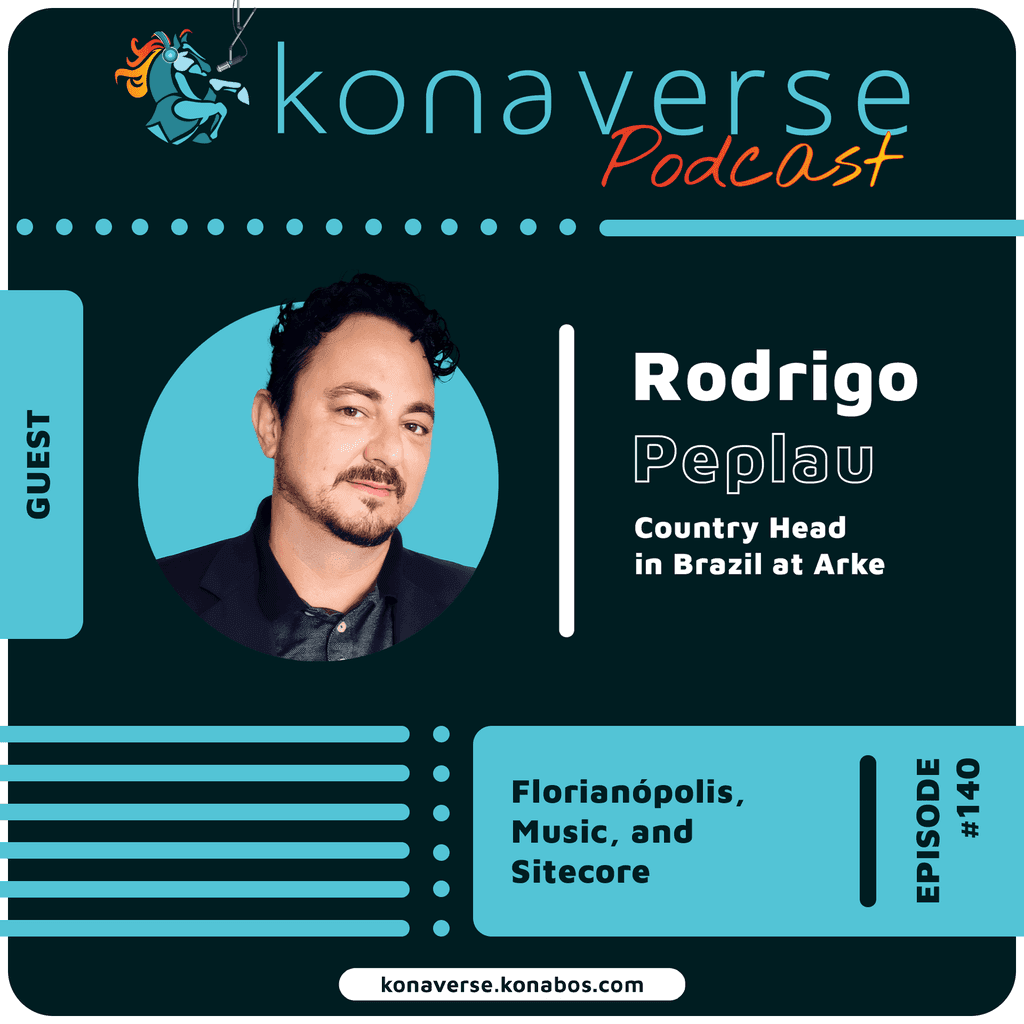
Rodrigo Peplau is Country Head in Brazil at Arke and a nine-time Sitecore MVP. In this episode, Rodrigo talks about growing up in Florianópolis and Brazil, family, childhood interests, his career in metal music and technology, Sitecore, engaging with American culture, community, and so much more!

[00:00:00] Welcome to Konaverse, a conversation experience platform hosted and curated by Konaverse Consulting. KonaBos is a global technology leader and while this podcast will be connected by technology, the glue is human stories and narrative. Technology can bring us together.

[00:00:17] It can make our lives better and more efficient in many ways. But it cannot replace human discourse and the magic that can happen by the interchange of ideas. Hope you enjoy our podcast. Welcome to the Konaverse.

[00:00:32] This is Matthew McQueenie and I'm so honored and pleased to be joined by Rodrigo Peplau. How are you, Rodrigo? I'm great, Matt. How are you? So glad to be here with the Konaverse. Absolutely. We're so glad to have you.

[00:00:50] You're a fixture of the Sitecore community and we have a couple things planned. We'll see if they release before this episode does or not but people will see that. Let's go back to the beginning with you. I know you're in Brazil now.

[00:01:03] Is this where you were born and where you grew up? Yes, I was born... I live in a city called Florianopolis. It's an island, beautiful island full of beaches and I've been born around not

[00:01:19] in here but in a city called Cristiúma which is less than 200 kilometers away. It's the challenging part of living in this place, especially in the 80s when I was a kid was that we're not exactly in the place to get high technology, advanced technologies.

[00:01:40] And that's where I think I have to always thank my father who decided he was a mechanic person and teach mechanic. At some point in the past, in the 80s, he was attended to a speech, a session presentation

[00:02:00] about the future, what the future brings to his career as a mechanic. And he noticed by the 80s that he was going to become deprecated as a mechanic for the technology and decided to sell his car and buy me a computer.

[00:02:21] I probably had the first 8-bits computer in the city or something close to that. And today when I compare my experience with people the same age but from the US, I can tell that we had pretty much the same start, the same kickoff in the technology.

[00:02:42] But I was in the middle of nothing down in the south in Brazil. So that was a big bet for my father. And how about your mom? My mother was, my father passed away when I was 12. And my mother is still around.

[00:03:00] She has almost eight years old, 79 now. And she was a professor. Later, she was part of the Education Ministry for a long time. Her career was in that area as a lawyer. Being a lawyer for educational purposes in Brazil means that you have to take

[00:03:21] care of the education is given appropriately to the population. And that you deal with cases where fathers are unhappy and things like that. And she is so my inspiration because she has, like I said, 79. And she's still very active, retired but very active.

[00:03:46] And she even has a karaoke group with elder people doing karaoke all the time. So this is where I took my artistic revenge, I guess. And do you have siblings? I do have, yeah. Ten years younger than my next sister, three ladies. OK, so yes.

[00:04:13] And one of them lives in Canada, Vancouver, Adriana. She's the middle one and the other two lives in Florianopolis. Yeah, but only myself followed the IT career. Wow. And so Florianopolis, what was it? Why were your parents based there?

[00:04:37] Like how far back does the family tree go in that area? What's the history there? Interesting question. In the place I live in Santa Catarina and also in the south, like Higurandusou in Paraná, those three states had during the first and second war

[00:04:59] that had been a lot of immigration to Brazil, especially people from Germany and Italy who were pretty much, you know, escaping, trying to escape from the struggles of the wars and poverty that was something takeover in Europe. And so they moved to Brazil in two waves.

[00:05:23] My family came in the second wave and I had one part of my family that is from Italy and the other part is from Germany. The Petlo is from Germany and Giddi, that is my middle name, is from Italy. Oh, wow.

[00:05:41] Yeah, they established around the place and never moved from here after that because it's really an amazing place. Wow. And was that your parents or their parents? No, we're talking about the fathers of my grandmother and grandfather. So that's third generation, third generation. Yeah. Wow.

[00:06:07] And so for you when you were growing up there, what does a young kid get themself into being around Florianopolis? Is it beach? Is it outdoors? What is the life like for a young man there? Not to speak as the old uncle, right?

[00:06:28] But things were very different in the 80s and 90s than today, right? It was also the city was less developed. There was more, I would say, less urban landscapes, especially when you go out from the downtown perimeter to where things are cheaper.

[00:06:51] And there in those kind of places, you have the chance, you used to have the chance to have a mixture of being like a boy, I'll say how do you say that, a stray boy, like a guy that is a boy that is always on streets,

[00:07:09] cleaning trees and getting downhill, when he skates and breaking a leg and things like that. But at the same time, I had the computer at home. So it was like a mixture of maybe I was the first nerd or geek in the neighborhood.

[00:07:27] And my friends and street friends used to see me as a weird guy who likes too much computer and doesn't leave the screen. But my father and mother was like, he's a genius, right? And in my mind, I was just a common boy, but things were different.

[00:07:48] You didn't have, things were more relaxed. You didn't have to stay close to your home. There was no mobile phones. So all you have is your mother screaming outside and I'll call your name and you have to be listening to go back home. It was a different reality.

[00:08:12] But I think the biggest thing that being in Brazil and even in South of Brazil by that time is that the only foreign people that you see is people from Argentina and Uruguay because they are tourists that come to Florianopolis.

[00:08:30] That is a touristic place to enjoy beaches and the summer. And you first start speaking Spanish for those who doesn't know we speak Portuguese in Brazil and they come and you have the chance to speak Spanish. Amazing story is that I have a former brother-in-law

[00:08:53] because he used to be married to my sister who was from Argentina. And I used to think on him like an extraterrestrial because he was so different, the culture, the manners and everything was different. But as much as I know more and more different cultures

[00:09:14] I can see how similar we are. And that makes me think on how strong the cultural differences can be enriching for everybody if you are open to understand the other culture. And at the same time, how challenging it can be to build a multicultural company as well.

[00:09:39] And learn from that. It's something that can help to progress in our career as well. There is always a way to take advantage of what you learn. So you raised the word culture.

[00:09:52] I'm going to put the word pop in front of it because you're kind of a pop culture person at least today with a lot of callbacks to the 80s. When you were growing up, how much of 80s culture got to you in Florianopolis?

[00:10:12] Like we didn't have phones, we didn't have all this. But how did you experience the 80s? Like if you think musically, the hair, all that stuff, did it make its way there as intensely as it did in other places? Yeah, that's an amazing question, buddy.

[00:10:27] See, we are in the 80s and 90s. There's no internet. We are dependent on the big TVs broadcasts and those companies, they used to buy from the US studios, the programs, the movies. And we got them pretty much quicker in the movie theaters than in the TV.

[00:10:54] But everything, the interesting part is that everything is translated in Brazil. There's no English and sometimes even the titles can be funny if you translate them. Some are straightforward, like back to the future. He is the same literally.

[00:11:14] But if you take like the chainsaw massacre, here we call that the electric chainsaw. And there's no point because it's not electrical. There's no power cord. It was a gasoline. So you have a different taste of culture from what you get from the US as well.

[00:11:36] Because our culture, the context is different. We will interpret in a different way. But as I got older and teenager, I started to become a fan of having metal songs, hard rock. And this is where I started to get like mullet hair, you know?

[00:11:56] And that was a thing people were dressing like the white snakers and like this hard rock bands. They would dress like that. And I think similar to the US, the rest of the common people will look to us as you are weird. Right?

[00:12:21] So that's a different taste on having the culture in Brazil interpreted by a TV broadcast, a Brazilian TV broadcast. You also have your own blend of your own part of culture. But it's at the same time, we were very vulnerable to your culture in the US. Right?

[00:12:40] So we have these two maybe even richer than you have because we have our culture and yours. Right? At the same time. So back to the future was here all the eighties movies are here. Ghostbusters, you know, all those movies, blackbusters are here, including the soundtrack.

[00:13:01] But at the same time, it's it's like being in Florida and speaking Portuguese all the time in a hotter place where sometimes the dress doesn't match the weather. Right? And you have all those struggles, but you have because you are in love with that culture.

[00:13:21] You end up dressing long hairs anyhow. Doesn't matter if you're sweating or not because you want to be in the shape and in the outfit. So I think that's it. Yeah, did did what was it about heavy metal that you really connected with?

[00:13:40] Well, I'm a big fan of Ozzy Osbourne, right? That I learned how to sing because of him, which is funny because he's not a fantastic singer. But I think he has so much attitude.

[00:13:53] Did you know the his voice is you can you can listen to his voice and you know it's Ozzy Osbourne. So I wanted to be like that. I just reflect so much on how he put his voice and because of he was from Black Sabbath, right?

[00:14:14] And his solo career was also heavy metal. I ended up going to very deep on heavy metal. But soon we started to have our heavy metal bands as well, like Sepultura, that is a very famous heavy metal band worldwide.

[00:14:32] And it increases our proud as well, our pride for the bands, their local bands. Later there was a band called Angra, Angra, which is a it's like a more prog and acoustic metal, melodic metal.

[00:14:54] But the singers are always so high and so technical that I forced myself to learn how to sing and to take classes. So I spent like five years learning with good teachers and singing in like churches, to practice. So that's around that.

[00:15:19] And later I got selected as the lead singer for a Brazilian band in Santa Catarina called Syndrome. And Syndrome had a bunch of crazy supporters. They're not big, but they are so in love, you know, in a point where we have a concert.

[00:15:43] Let's open to a bigger band like for instance, we open to Angra and Sepultura. Many times. And when we do that in our place, our people, our supporters, our fans would show up like

[00:15:58] even more crazy than normal with our shirts to demonstrate the support, you know, and show that our local band are better than them. You know, that's how crazy, how enthusiastic they were.

[00:16:11] And after that, that's when I noticed I gave up on being, I would say a rock star, literally speaking, you know. And I had my IT career in parallel with that. And I think that's an advice that I would like to give to anyone, right?

[00:16:33] Don't put all your eggs in the same basket. I didn't put all my trust in that thing. And I have this IT love for technology. So when one thing didn't, didn't went well, you know, because reality changed, you have now Spotify everywhere. It's so different.

[00:16:53] I got my IT and just like QMAT, you know, I'm not abandoning my artistic vein as well. I think it's just summing up and improving my career as a techie as well. Yeah, we're all very big mosaics, right?

[00:17:13] We're quilts with a whole lot of different squares on it. Did bands from, it's funny you brought up Ozzy Osbourne. I actually, when I was in high school, I saw a black Sabbath play at an arena here in New Jersey when they were on a comeback tour.

[00:17:30] Did bands that you loved from around the world, several tour? I remember that was a huge band, but I mean, North American bands, European bands, did they ever get close to where you live? Like or would you go see them in Brazil? Yeah, yes they come.

[00:17:49] The reason they come is the audience, they all stayed the same. The audience in Latin America are more engaged than in other places. And I think it's cultural. Some places like Japan, for instance, they pay whatever they want, whatever you ask for

[00:18:11] being the show in a concert, but they will be sit down in a chair, you know, and very behaving straight and not doing noise. And here is the opposite. It's like people are crazy and they will just jump on top of each other.

[00:18:29] And the energy is what brings these bands to here. So yeah, they got close. I have even the departure tour from Black Sabbath with Ozzy Osbourne in 2018. I think they came to Brazil and I was there with my nephew and he is a guitar player for Tonya Yomi.

[00:18:56] And they were saying goodbye, right? And just we left and the end of the show we left everybody just vanished from the place and stood around, stick around. And my nephew was crying because he was, you know, that was the last show.

[00:19:13] A guy from the backstage came to us speaking in English and telling us, you know, that they are also losing their jobs because they are breaking apart. And it's equally bad for them and sad for them. So they want to give him a prize like a gift.

[00:19:31] And they gave him a pick from Tonya Yomi signing up for Tonya Yomi. So it's not the same like I can go to their city and meet them on the streets, but we do have this exposition. Yeah.

[00:19:47] And I can guarantee we do the best to enjoy the time. Yeah. So the last thing on the music for the moment, but you were taught for five years or you went to learn to sing for five years. What did you?

[00:20:03] Did you have grand ambitions to be a musician? Or were you doing that to just be the best musician you could be for the band you were with? No, I did. Generally invested in the musical career.

[00:20:18] And that's why I was investing to become a better singer as well. The whole band had the professional infrastructure and we had, you know, managers and we had sign up to a seal. We had songs in the local radios. Even some songs were very well rated.

[00:20:41] People are dressing our shirts everywhere, but suddenly the whole being a heavy metal musician in Brazil is not easy by itself. But suddenly the whole industry changed and we decided that we didn't want to continue. You know, it's not worth.

[00:21:00] Some of us came like me, came to other areas and some of them, the rest of them just became like a teacher, professional musician, music teacher playing on small pubs and doing their job as a musician like that. It's not easy, but that's how it happened. Yeah.

[00:21:23] No, I was when I was in high school in early 20s, I was in a lot of local bands where we would play at, you know, like nights of Columbus halls and all kinds of things like that and made good music.

[00:21:36] And I always say you're probably a good person. Ask for this. Is there is there's probably not a better example of learning entrepreneurship than being in a band? Right? That's true. You have to learn how to deal with different mindsets and trace common goals.

[00:21:55] And you have to be able to delegate. Otherwise people will not, things will not move on. You have to track. You have to, yeah, that's a project. Yeah. And when the project is over, you have to renew it.

[00:22:10] There's a lot of things that are involved in that, but not just entrepreneurship, but dealing with people itself, you know, we are in the IT field and we tend to overestimate the human relationships.

[00:22:27] But in the end, we are all human beings relating to each other throughout a machine. The software we build is only there for serving us. And I've been speaking about this kind of mindset in the light of AI.

[00:22:44] And I think some people are thinking this is diminishing, is decreasing. I think it's the opposite, you know? As you have machines that are more and more capable to do what your intellectual capabilities can do, the bigger is the importance of human relationships. Right?

[00:23:04] Unless you are thinking about a future where only machines are relating to machines, which I hope is not close to our reality, at least now. So I feel that having a better taste or maybe a better sensibility to what people

[00:23:23] are talking, being open to listen, being open to read between lines and being open to art as a whole music, as a part of art, helps to increase your sensibility and helps you be a better listener, helps you learn when people are reacting to you emotionally or not.

[00:23:48] So those things are definitely important for anyone, even the architects, even a very tacky guy, you know? Yeah. Now, I think many people who aren't involved in music but who enjoy it, which is the majority of people, right? Most people enjoy listening to it.

[00:24:05] They would probably think that the majority of singers are born to sing. Now, there probably is a part of that. But having studied the art of singing for five years, what is something that coming on the other side of that that would surprise people about singing?

[00:24:24] Is it that it's almost like playing a guitar? Like it's as defined in some ways as playing other instruments? Or what would surprise people about learning about singing that much? Nice. I think there is the biological aspect, you know, the physiological aspects involved

[00:24:46] are stronger than dealing to a different kind of instrument. You don't need to be exceptionally healthy to play keyboards. You should be well to play drums, right? But you can be another person and play guitar pretty well.

[00:25:07] But singing with the same energy, with the same, you know, like Bruce Dickson does, now that he has more than 60 years old, it requires a lot of technique and also requires that you understand your biology, your body, right?

[00:25:25] So that's the biggest surprise for me when I master singing. Oh, master, when I learned how to sing minimally well was that how much the body has to be in sync more than in different instruments. But at the same time, I learned that you don't have to be...

[00:25:46] Just like a good guitar player doesn't necessarily sing as well, you don't have to be a good musician as a whole, right? You're to be a good singer. You can be pretty well stupid musically, let's put this way, and I will hook back to Ozzy Osbourne again.

[00:26:07] He is not a great musician but very sensitive on building melodies. It's an art to listen to a chord and build a melody on top of the chord, right? So there's a whole lot of different disciplines on building, being a singer.

[00:26:27] And those are the things that brings me more my attention, you know, cause my attention. But with becoming more mature as well as a vocal, as a leader, a singer, you will also see that you don't need to do that fancy, you know,

[00:26:47] singing techniques and melismas and be like an athlete to sing well to emotion someone. Is this like a music podcast? Yeah, right? Well, no, I always... I love it. I can go on. Yeah, I think there's an underlying aspect to any of our interests

[00:27:07] that don't directly relate to what we might be doing at the time, right? I mean, that's probably what helps you stand out in certain ways, right? I mean, but let's go to the... So you had to begrudgingly pivot out of being a full-time musician or trying to be.

[00:27:26] What was your first pivot there? Like what was the first job you got? Well, you were working in IT already, but what happened after you had to stop playing? Did your approach to your IT job changed? Did you take a new job, go more full-time? What'd you do?

[00:27:41] I was already formed as a bachelor in IT and I was already doing a... having my full-time job as a developer. In the past, before that, I was fixing computers and I was always involved with IT.

[00:27:59] So what I did was to get more time to investing teaching and learning new technologies. I didn't have to rehearse anymore during the weekends and I didn't have to do my concerts anymore. So I had time to invest and get better.

[00:28:17] And I was quite of park in my career in IT. And after that, I started to invest more and improve my IT skills as well as my English skills to focus on working with the international market. What IT were you doing at the time? Like what was it?

[00:28:39] I was doing Delphi. Delphi applications, which is Pascal, you know, beginning of 2006 or 2007, I think, and building accountant software. Very boring, you know, like a software to manage accountant, condos. You know, there was a module specifically for condos.

[00:29:05] A lot of mathematics, a lot of UI, UX as well, evolved. But it was a different timing in our industry as well. Things were more, I would say, more naive, you know? These were more romantic those days. Yeah. And so, I don't know, where did Sitecore come in?

[00:29:29] Was there a step before Sitecore? Before accounting or no, from accounting software to Sitecore. What was the move towards Sitecore like? Yeah. So, when I left the band, I stood in that city for a little longer, then I moved back

[00:29:43] to Florianopolis and I moved to working with the guys from Netherlands. They were just like a software, standard software, no CMSs, native.net implementation. And after that, I started with the company from Canada called Non-Linux Creations.

[00:30:04] They used to be called like that and after that, they were acquired by Vaultec. So I started by 2010 with Non-Linux as one of the first employees in Brazil for them. And my colleague was like John Sensor, you know, was one of my teachers, you know, Sitecore

[00:30:29] teachers was Jason Sensor. He's now in Sitecore. Amanda Sheiga, those old school guys and others like Glenn McKinney and other people who are there was no documentation around there and the internet was very important for me to have their help to start Graspy, you know, to start learning.

[00:30:55] And by 2012 they opened an office in Brazil and that's my, I was selected as the manager of the office. So that was my first experience as building teams. And I learned how I love to do that, you know, with building my first Sitecore team, learning

[00:31:14] myself and teaching all the time. And this is where my passion to share knowledge started to get a special bright. And it was just a consequence. And all the guys in Canada were becoming MVP.

[00:31:29] You start thinking, can I also do what should I do to become an MVP? And by 2016 I was, I got my first MVP title, which helped me enormously. When Vaultec acquired Noliner, I decided to leave the company was becoming too big.

[00:31:50] But at that point I had two MVPs and I was already champion in the hackathon. So I can tell I invested collectively in my career and I could become independent enough to tell I would move on to a different opportunity.

[00:32:08] So we have actually, we have had Jason since here on this podcast. We've had Randy Woods on this podcast. Randy Woods, yeah, he was the boss. How did you come in contact with Noliner? Like how does that, is there some Brazil? Canada connection?

[00:32:26] Like how did you guys get synced up originally? So the first guy who was hired by Noliner was a friend of mine, Victor Lee. He's not in site for anymore, but he was looking to migrate to Canada. So he was looking for Canadian companies and he found Noliner.

[00:32:50] So he got a job, but it's not instant. Like you got a job and you have to wait for months until you're able to migrate. And I was, during this time, I was also recommended by him and I got the job for Noliner.

[00:33:10] So they, it's pretty much the destiny coming. Wow. And so would you travel to Canada? A good deal or not really? No, those days I was pretty much in Brazil. I was to be realistic. I was forming my career.

[00:33:27] I was learning and I was available as a resource in Brazil after I became MVP and a speaker later as a speaker, it started justifies sending you shipping you to places in North America, Europe.

[00:33:46] So after that, I went to a company called NishTech, which is also a partner, a site core partner from Suresh Devanen that I consider a big friend still. And then I started to be more playing the architect role and going to US.

[00:34:06] So I've been in US many, many times, but in Canada, I only know the Toronto airport fortunately. Suresh has also been on the converse. You're like, we're promoting all of our guests here. Thank you. What, why is a site core MVP? Why are hackathons?

[00:34:32] Why are these things, you know, you have the naysayers who might say, oh, you're not getting paid for that. You're not doing this. You're not, you know, you're being community. Why are those activities, recording and creating songs to play at events? Why are those activities important?

[00:34:55] Because your career is bigger than the company you are. You know, so you have to invest in your brand. Even if you are planning to stay in the same company forever until your retirement becoming

[00:35:11] a better communicator, becoming a known and becoming a brand by yourself is going to be positive in any circumstances. Even if you are staying, you are doing your company richer by having yourself as someone who is taking as an exponent, who someone who is remembered, right?

[00:35:36] And at the same time, gives you something where if everything else goes wrong, you still have your reputation, right? And you know, normally I like to think about a job company being associated to a company, just like I think about being associated to a band as a marriage.

[00:36:01] And nobody gets into a marriage thinking about breaking in the next year or something, right? You always get there to be forever. And until everything is working well, you'll be forever right there.

[00:36:14] But if you just get to what you're paid for, you are, you know, the company will be happy with you, but you are not getting enriching your career. You're not growing yourself as a person as well.

[00:36:31] And, you know, you are becoming dependent and sometimes not so special for the company that you are, right? So if you are better, you enrich your relationship as well with the company that you are. And you make sure that you keep on growing, right?

[00:36:53] Between choosing between you and a person who is parked in the career, I had no doubt that the companies we always choose the one that is always growing, right? So that's why I feel those things helps to grow as a person with different levels of contribution, of course.

[00:37:15] So yeah, I had the chance last year that was like the first time I was a psycho MVP. And it is, it is pretty cool. Some of the things you can go to and the people you can be around. Now, you've had how many now? Nine. Nine.

[00:37:37] Nine MVP's. I'm going to guess you still feel just as good. And it still feels cool to get to go to these things, doesn't it, to be a part of this community? Absolutely. Yeah. And I merged, I changed my category in MVP from technical, being always a technical.

[00:37:59] Now I moved to ambassador and I was speaking to Jason Senceri himself and he said, you have to think if it still makes sense for you to be an MVP because I was changing, my role was changing. And my reply was remarkable.

[00:38:16] My reply was like, you know, Jason, even if I'm the king of the world, I will still want to be an MVP. You got that? Because like you said, it makes you feel special, makes you think it's a cycle

[00:38:31] that I'm already addicted, I guess, you know, on chasing the MVP title, enjoying the party, thinking about the next year, thinking about what you're going to speak, what your plans for the hackathon are. So the whole cycle is, I've been repeating that so many years in a row.

[00:38:52] And I don't think I can, you know, spend a year, a sabatic year without that anymore at this point. Yeah. And so right now you're ARC, right? ARKE. ARC systems. What is ARC? Is that your company? Is that a company or part of who is ARC?

[00:39:12] No, ARC is a partner, a side-core partner for like one of the oldest side-core partners. The company has more than almost 20 years and they always in the marketing, digital marketing area for like 15 years, they are around that time partner, side-core partners.

[00:39:34] And they planned to, they were planning to build an office in Latin America. And, you know, this is what I do more, you know, passionately on building teams and etc. So their plans for Brazil looked consistent, you know, they are planning

[00:39:53] to do a build a company here to become replacing their third party partners that they work traditionally selling contracts and doing maybe architecture in the US, but they used to bring 30 parties as a staff augmentation in the past.

[00:40:16] They are planning to get all that substituted with or pretty much the majority of that as much as possible with people in Brazil in-house people who they can call ARC employees. You know, so building that is something that caused my attention so

[00:40:36] highly and we are doing that together. I feel they're well doing amazingly because they have a special touch for human beings. They like to, you know, they are respectful and but at the same time they are chasing innovative solutions.

[00:40:59] They are chasing quality in the delivery, the two things all together and they are being very respectful, you know, mindful about the different cultural facets, how to merge these people together and as a single body. It's been interesting and to be part of that is great.

[00:41:22] So my part in the company is in Brazil only, you know, so everything related to Brazil is where I am having this part. Of the, I would say the stakeholder in Brazil and the rest like the US

[00:41:39] and it's all in the and even the biggest part of Brazil. It's in Eric's hands, which is our CEO, which is another amazing person, by the way. He has not been a guest yet so we'll have to maybe get him on but call him, call him.

[00:41:58] So you were saying that you went from strategy to ambassador and that maybe or not sorry tech technology to ambassador is your day to day less hands on programming and is it more what is your day to day now? Nice. Yeah.

[00:42:19] I don't do programming myself anymore only in hackathons or as a hobby. Every single person in the world has a roof of productivity, you know. So no matter how good you are, you can only produce and be productive until that roof as a one man band.

[00:42:42] So I early in my career, I noticed that to be better, to be more productive. I have to delegate and I have to make others produce and be productive as well. And my time now, my moment now, I'm not doing any programming unless if it's like for rescue

[00:43:03] missions and I'm doing more like counseling analysis, brainstorming, more like an architect. So I do a lot of interviews. I do a lot of meetings, resource gathering, the charts, diagrams, etc.

[00:43:24] But also as a specially in Brazil with the people in Brazil, I also do a lot of management tasks like HR, you know, being the counseling like making sure people are happy, planning your key hours, planning trainings, what is more important, what is less important, giving allocations.

[00:43:45] And it's pretty rushy to be honest, because I feel those two things are pushing me in different directions. And sometimes I have to be more than one person to handle everything together. But at the same time is so rewarding because there's nothing better than seeing

[00:44:06] from one side people starting to get better and better, technically speaking. And from the other side, seeing the office flourish, you know, being a scene, the operation becoming every time more mature, you know, those two things are very rewarding, I guess. Very nice.

[00:44:27] Well, we have two more questions that we always ask. The first one is what does the word community mean to you? It's pretty much everything beyond the business, right? In a platform like SitePort, now ecosystem like SitePort can only become successful if they have a

[00:44:51] strong community behind it. And I've seen other platforms becoming, you know, not succeeding because they like that. And I think in our community, we have two special things. First is people who are keen to help each other. There is friction everywhere in life.

[00:45:13] So I don't expect to be only angels relating to each other. We have our frictions, but the first thing is, you know, they are very keen to help each other. And in the other hand, we are very, very organized, I feel, you know, we can do things

[00:45:29] together and go beyond just individual ad hoc initiatives. So things like the hackathon that has more than, what, 10 years? More than 10 years, maybe. That was my eighth hackathon. So it was probably more than 10 years.

[00:45:45] So, you know, for 10 years, that longevity, it's just a symptom of, you know, how good, how powerful our community is. And in the beginning, I always tell everyone this story. This story, Janikin, Kamrus, German.

[00:46:04] When he was the first guy helping me with Sidecore, and I always tell everybody this, my mind said, my thought was, why is this guy helping me? You know, we are like not in the same company. We're not in the same contract or whatever.

[00:46:21] But he was going out of his way to help me and I learned later that this is the touch in our community, you know, giving that extra mile for the sake of helping each other. It's something that I really put a lot of value to.

[00:46:39] Shout out to Janikin. I like it. I'll tell him. Last one, if you were to go back and give some advice to your 15-year-old self, what would you tell that young Rodrigo? That's a difficult one. I should have time to prepare.

[00:46:59] I will say, I don't think there's anything I could tell to the 15-year-old Rodrigo that he would take seriously, you know? Because my father and my mother, they were already giving me the advice and I was not paying attention. So I don't know.

[00:47:19] But if I could guarantee that I would listen to that, I would say try not spending so much time with useless things and like not too much energy with people who are just draining your energy because that time is priceless, is limited.

[00:47:41] And you're better investing that time even in leisure. Don't take battles that are not yours, you know? Choose your battles. But the young boy was not paying attention. He'll battle you, right? Well, Rodrigo, thank you so much for joining the Coneiverse. It's been great.

[00:48:04] Thank you so much, Coneiverse and Conevils for this initiative and Matt. I look forward for our collab together and chairs for the whole community. Thanks for having me. Thank you for entering the Coneverse. We hope these discussions gave you something to think about, helped you learn something new.

[00:48:25] And provided a window into someone else's story. Everyone's story is worthy and important. Until next time, remember to be fair, be kind and keep exploring.