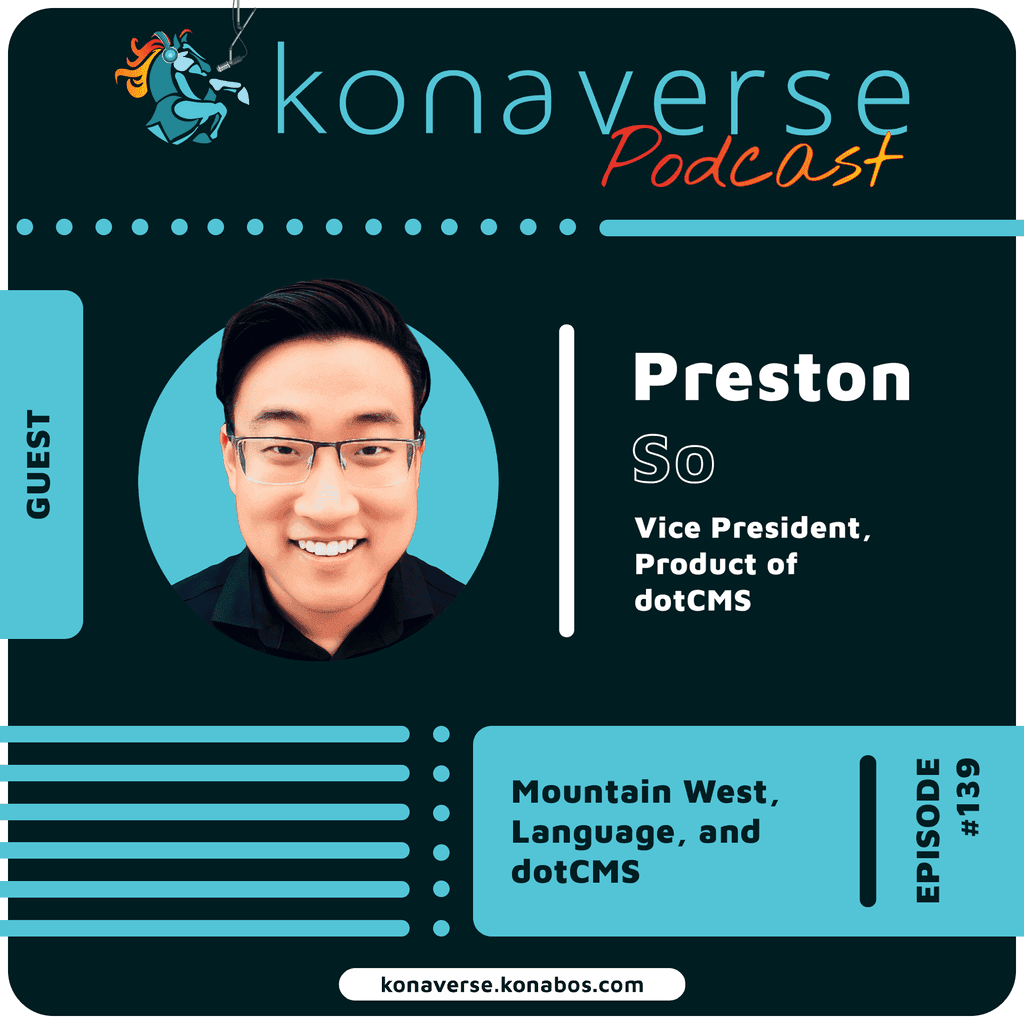
Preston So is Vice President, Product of dotCMS. In this episode, Preston discusses growing up in the Mountain West region, cartography, his passion for language, school, Harvard, career, moving to the New York City area, writing, his hopes for his role at dotCMS, and much more!
[00:00:00] Welcome to Konaverse, a conversation experience platform hosted and curated by Konabos Consulting Konabos is a global technology leader and while this podcast will be connected by technology the glue is human stories and narrative. Technology can bring us together, it can make our lives better and more efficient in
[00:00:19] many ways but it cannot replace human discourse and the magic that can happen by the interchange of ideas. Hope you enjoy our podcast. Welcome to the Konaverse, this is Akshay Sura and this is Matt McQueenie. We have with us today our friend Preston from DotCMS.
[00:00:38] Hey Preston, how are you doing? Hey Akshay, hey Matt, it's a real pleasure to be here with you both today. Yes and congratulations on whenever this comes out but we're talking to you now, it's
[00:00:48] kind of early in your days at DotCMS so we'll get to that point but congratulations. Let's go back to the beginning though Preston. Where were you born? Where did you grow up? It's a great question.
[00:01:02] I was born in Boise, Idaho which is quite the place to be born for sure but I grew up in Colorado Springs, Colorado so I consider myself a mountain west person through and through. I'm a Colorado at heart.
[00:01:18] I've traded the beautiful mountains of Colorado for concrete mountains out here in New York City but my heart will always be at 6,000, 7,000 feet above sea level. So Preston growing up we haven't had many guests who had Boise, Idaho on the bingo card.
[00:01:41] How long were you in Boise before you went to Colorado Springs? That's a great question so I actually only spent a few years in Boise. I actually moved around quite a bit as I was a kid so I spent time in New Mexico, Arizona,
[00:01:57] Colorado, Oregon and eventually ended up in Colorado Springs for my school years. So from kindergarten all the way out through graduating high school I was located in Colorado Springs and as a result my lungs are very high capacity.
[00:02:16] I don't have any issues with going back up to that altitude but it's certainly a very interesting history. I spent time in Portland, in Albuquerque, in Phoenix, Arizona so all around the western United States. That's a lot of moves. What were some of your hobbies growing up? Sure.
[00:02:42] One of my favorite things to do when I was a kid and this is something that would always be sometimes the consternation of my family is I was a huge amateur cartographer. What I mean by that is I would draw maps of places that didn't actually exist whether
[00:02:58] they were fantasy lands from historical time periods or different worlds to more modern day or near future sorts of worlds. But the biggest thing that I think that has carried over to my career and also to my passions
[00:03:18] nowadays is my talent, I guess you could call it for languages. I'm a huge language nerd. I'm a trained linguist. I'm also a polyglot. I speak many different languages and have spent a lot of time living in other countries as well.
[00:03:35] And in addition to that a lot of my time when I was younger was playing music. I was a music minor specifically focused around music theory and music composition. And I also played several instruments when I was a kid too. Wow, it's a lot of interest.
[00:03:52] I think we can end it there. No, I'm just kidding. Now growing up in the West like you did, I think it's fascinating now living in as you said the concrete jungle or concrete mountains.
[00:04:05] Now that you've been in both settings, maybe if you could explain to the audience what it's like in the West, like the open spaces, there's not as much density. I mean it must be kind of a shock initially when you are in a place that's way more dense.
[00:04:25] It's really interesting you see that Matt because I definitely experienced a bit of culture shock when I moved to the East Coast, when I moved to Boston for college. And at the same time, nowadays whenever I go back to Colorado, I get reverse culture shock
[00:04:40] from not being in Colorado for such a long time. The biggest thing that I miss and the biggest thing that I would say is something that, for example, when I wax nostalgic or reminisce about living in the Mountain West in particular
[00:04:55] is the fresh, crisp mountain air, the sounds of birds, especially the ways in which the aspen trees and conifers would kind of billow in the wind. And there's a lot of that soundscape that is missing in my life.
[00:05:11] I mean, it's been traded for a very different sort of soundscape, which I also enjoy, of course, but is something that that sort of always brings me back to that space. And you know, every so often I do try to go back to Colorado.
[00:05:23] I do have a lot of friends still out there. Obviously, you know, once you're, you know, the thing that I said to a friend of mine who's also, you know, out here in the tri-state, but is from Colorado is you can
[00:05:37] take us out of Colorado, but you can't take the Colorado, but you can't take the Colorado out of us, right? And I think a lot of that is just sort of that really, you know, I hesitate to use
[00:05:49] a word like pioneer because that's kind of a problematic term. But, you know, certainly that open landscape mentality, that sort of open greenfield mentality, I think is something that I carry throughout my life and my career.
[00:06:04] And of course, you know, just the legacy of a lot of the history there. I think a lot of people don't realize that Colorado has experienced a huge amount of history over a very short amount of time, but also there's so much
[00:06:18] indigenous history there that is so rich and and very seldom taught, especially in the school system. What I will say is when I moved out to Boston, it was my first time living in a place that was sort of a big city environment, right?
[00:06:36] I mean, Denver isn't really a big city. Now it is, of course, it's becoming a big city. It's, you know, certainly a metropolis today as it's called our springs in terms of its growth potential right now.
[00:06:46] But moving out to Boston, you know, I knew that I really wanted to be in a big city environment. I loved being able to take mass transit everywhere. I think one of the things that came up for me very often growing up is,
[00:06:58] you know, you kind of have to drive everywhere. And, you know, I love driving. You know, obviously I love to drive in places like Colorado and suburban areas or rural areas, but I really do not like to drive in the big city.
[00:07:09] So certainly moving to Boston, you know, gave me the opportunity to really experience that big city life. And, you know, nowadays I don't think I would trade it for anything, anything else. Yeah. So Preston, you mentioned you know a lot of languages and you've
[00:07:28] actually affected a few of them. Like what is it about learning a language that appeals to you? This is something that I think carries into a lot of my leadership principles as well. You know, one of the things that I always do whenever I enter
[00:07:44] into a new leadership role is I focus on what I call radical empathy or radical vulnerability. And I really aim to do this with every single person I meet, because no matter who a person is, no matter anybody that you
[00:07:57] encounter, whether that's, you know, on the street or at a workplace or even when you go out to eat or go out on a night south, on a night out. I think it's really important to have that empathy from the
[00:08:12] cultural level and especially also if you're able to from the linguistic level. I have a rule. I actually have five core rules whenever I travel to different places. And the first of that set of rules is whenever I travel to a
[00:08:28] place that I've never been before, I always make sure to get at least to a conversational level in that language. Because one of the things that I've always learned about living abroad and also traveling in so many different countries
[00:08:41] is that if you can speak even just a few words of a language and it's just please and thank you or hello, how are you? The relationship that you'll be able to have with people in those places and also the opportunities that can come up
[00:08:55] from learning about those cultures and learning about those languages and learning about those belief systems and learning about those philosophies and principles that those folks abide by. It really is core to becoming a global citizen and also being able to interact with all sorts of different people
[00:09:14] from all sorts of different backgrounds as we often do in our industry. And so what that means for me is, you know, as an example, later this year, hopefully I'll be traveling to South Africa for the first time and South Africa is one of the
[00:09:28] most linguistically diverse countries in the world. And I'm looking very forward to working on a couple of languages that are most widely spoken in South Africa before I get on the plane or as usually happens, I procrastinate and I'm usually cramming on the plane to make
[00:09:47] sure I hit the ground running. So, you know, the most important thing for me when it comes to learning languages is that deep understanding. If you go to a country and you're communicating in English, it's in some ways an imposition, you know, because
[00:10:01] you have that anglophone privilege or kind of saying, you know, oh, well, you know, why can't you speak English when the reverse really is true, right? When you're traveling to a different country, you should really be honoring the culture, the customs
[00:10:14] of that country and also honoring the people that you meet. And it's a question of respect and it's a question of cultural exchange. Does on that language point, I don't know if we got how many, how many you feel you speak pretty
[00:10:30] well, but does the fact that you've learned as many as you have, does it make it easier in a way to start learning a new one? Can you see connections between various languages? Like how are you looking at South Africa, for instance, with what you might know
[00:10:48] about the languages there? Yeah, it's a great question, Matt. I was really lucky because in the Colorado Springs school system that I was in, our school district actually required Spanish language classes starting in the third grade, which is very rare across the United States.
[00:11:05] I mean, it's incredibly, incredibly rare to have elementary schools require a second language. And this was one of the things that I think has helped me quite a bit is, you know, I was always passionate about languages growing up, but also I had that educational background
[00:11:21] in the curricula that I was part of an elementary school. And that really built up, I think, my passion and my talent for languages as well, to the point where, you know, I did an exchange program in junior high, where I spent the summer in Brazil and learned
[00:11:36] Portuguese, which is now one of my, you know, chief fluent languages. I also, you know, learned quite a few languages in high school, just out of interest. But I do think that the biggest thing for anyone, and this holds true, especially
[00:11:52] for those I think who oftentimes tell me, you know, oh, learning languages is so hard, like it just, you know, it uses my brain in ways and stretches me in ways that I really don't, you know, like, that's the point. Language learning is one of the most
[00:12:06] challenging cognitive skills and tasks that you can have. And I think, you know, there's obviously now scientific studies that have proven that folks who, you know, work on language learning later in life, right, actually are able to stave off certain neurological illnesses or certain issues
[00:12:30] that can come up as we get older, which I think is a very compelling rationale and motivation for learning languages. I have a very kind of unique approach to learning languages. You know, unlike others, I don't use Rosetta Stone. I don't use Duolingo. I
[00:12:46] tend to not use apps that kind of try to make it seem as if you can learn a language faster. I also don't use the Pimsler method, which I know is very popular as well. I undertake a very serious and a very dedicated self study
[00:13:00] program. And I focus on all four modalities of speaking a language, which means speaking, reading, listening and writing. Some of those can be a little harder than others. But one of the examples is, you know, I remember when I first attended Drupalcon Asia, which was held, you
[00:13:18] know, the inaugural edition of that conference was held in Mumbai. I undertook a seven week very intensive study program that I designed myself to learn Hindi to the point where, you know, I have, I would say sort of an intermediate or advanced level grasp of
[00:13:36] Hindi now. And that involved two hours every single weekday and a full six hour intensive study program on Saturdays in seven weeks. So what I would say to people who are learning a language is, you know, to focus on intensive ways that you can really cultivate
[00:13:55] those different modalities. You can't just get by, for example, if you're traveling to Japan or if you're traveling to Saudi Arabia, you can't just focus on being able to speak Japanese or speak Arabic. In this case, Saudi Arabic, you need to really focus
[00:14:12] on, OK, how much of the written language do I want to learn, which can be a little tricky for both Arabic and Japanese? How much reading do I want to tackle? I would say literacy for a lot of folks is a bit lower of a
[00:14:23] concern. But certainly in terms of speaking and listening, I think it's very crucial. And I take, once again, a very methodical approach. When I was learning Portuguese, for example, I would, you know, amass a library of Brazilian movies of Brazilian music that I enjoyed and then just just
[00:14:41] kind of drill on watching and listening, reading the lyrics to these songs, reading the subtitles and then actually getting to the point where I could watch movies without subtitles in the languages that I work with. So for South Africa, I'm undertaking the same approach.
[00:14:58] I've actually just bought a bunch of books to learn three of the languages that are most widely spoken in South Africa, Afrikaans, Hossa and also Zulu. Still haven't made much headway. You know, Afrikaans is a little easier since I already have learned and speak Dutch. But Zulu
[00:15:19] and Hossa, despite being part of the same language family as Swahili, which is the language that I worked on before traveling to Tanzania. They are very, very different. And the Bantu language family is extremely diverse, extremely divergent as well, which makes it a little challenging
[00:15:39] to adopt some of the lessons learned from those other languages to those families. But to your point, Matt, you know, I think another piece of advice I would give is, you know, if you're looking at a language and you see that there's a related language that you might
[00:15:54] be more familiar with, or that might be a little easier, that could be a stepping stone to learning that more complicated language. For instance, if you're trying to learn Romanian, which is one of the more challenging romance languages, you could look
[00:16:05] at learning Italian as a way to get there because those two languages do share a lot of grammatical features and a lot of things that will make your process a lot easier, even though Romanian has a lot of really unique and interesting things of its own.
[00:16:19] Have you, like I remember some of the African languages have sounds as well, like clicking, right? Like, have you encountered any of those? Like how do you, like I can't even imagine having that as part of the vocabulary on top of words, right? Like how do you
[00:16:38] approach something like that? Have you encountered any of those languages? Yeah. And those who are familiar with click languages will note that I mispronouncing Hossa. And the reason for that is because I'm not yet confident in pronouncing the click that is at the beginning
[00:16:52] of the name or that language. You know, a lot of languages have unique consonants, right? A lot of languages have unique what we call in linguistics phonemes. And there are many languages in, you know, sub-Saharan African particular where click language, click consonants are very common.
[00:17:14] And those are extremely challenging for those of us who have primarily grown up with sounds that are very common in Germanic or romance languages, like English or Spanish. And that can make things very difficult. I'm actually following a YouTuber. I forgot her name,
[00:17:32] but she does a very good job of clearly pronouncing and teaching those click consonants, both out of context and in context. And I've been watching a lot of her videos, but I'm not yet confident in doing it actually pronouncing those consonants myself. But there are these sorts of
[00:17:51] consonants everywhere, right? I think a really good example of this is the retroflex consonants. For example, in a lot of the languages that are found in India, both in the Dravidian languages and also in languages like Hindi and Urdu as well. You find these, but
[00:18:11] also languages that are really phonemes or sounds that are really rare. One of the things that was really interesting is to see some of the commonalities between some of these consonants, right? One thing that I find very surprising, that I found very surprising in my studies of
[00:18:26] linguistics academically is that there are certain sounds that are common in very geographically dispersed language families. One example of this is ejective consonants, right? Ejective consonants are characteristic of languages like Emharic, which has spoken in Ethiopia, but they're also very common across the Americas
[00:18:46] in terms of the languages that are spoken across North and South America prior to colonization. And it's a very interesting thing. And there's also another type of consonant, right? The double L in Welsh, which is one of the most pronouncing, sorry, one of the most challenging sounds
[00:19:06] to pronounce for a lot of people. You know, very characteristic of, you know, words in Welsh like the word for book in Welsh is shover, right? That sound at the beginning is also characteristic of the Nahuatl language, which is the language that was spoken in the
[00:19:23] Aztec empire and still exists and still was spoken in wide parts of Mexico and Guatemala. So anyways, I'm going off on some tangents here, but needless to say that there's a lot of interesting both differences and also similarities that you find in languages across the world
[00:19:41] that really kind of make it clear that, you know, ultimately, the human mouth is capable of pronouncing all sorts of different sounds, but there's still a limit to the number of consonants and vowels that are possible. And it all means that we all do ultimately speak the same
[00:19:58] kinds of languages that are all human and, you know, not to get into animal communication here, but. Preston, you seem so well versed in linguistics that I know you've done your schooling in that too. What are you doing in IT? And where does the parallels
[00:20:17] like being able to learn something so quickly? Obviously, it's your ability to do that. I don't think I'll be able to do it. But also having that, I guess, the the ability to see the similarities and all of that, did that help you in your IT space
[00:20:39] where you're able to pick things up quicker, be able to transition from place to place? Absolutely. I mean, I think one of the things that I learned very early on is and I'm very lucky to have really worked on these skills is self learning and self teaching.
[00:20:58] My IT background is very unusual in that I started it out very young, teaching myself how to code, checking out books from the public library and basically teaching myself HTML, teaching myself JavaScript, teaching myself CSS, all of these things, which actually serves me very well in learning languages
[00:21:17] and the very sort of rigorous approach I take to language learning because I don't really take courses. I don't really work with language tutors. I don't really work with, you know, that that sort of traditional approach to curricula. And I think it, you know, one of the things
[00:21:34] that I always like to share is you know, the best way to learn something is to teach somebody else how to do that same thing. And I've got a very long teaching background as well. One of the things I did in especially in high school
[00:21:48] is I used to volunteer at my local public library teaching folks how to do web development, teaching folks how to write websites, how to create websites, how to, you know, finagle. At that time it was table based layouts. It was really, you know, awful HTML.
[00:22:05] It was stuff that, you know, would make any front of developer today kind of throw their hands up and discuss. But it was very much how people learned back then, right? Was through these classes and you know, there's no better way to learn something until you teach it.
[00:22:18] And that came into play quite a bit when I was in college. I spent quite a bit of time abroad teaching Brazilian students on the outskirts of São Paulo how to speak English. And, you know, that would have been much more challenging and much more
[00:22:37] difficult had I not had that sort of philosophy of, hey, if you learn something, teach it to somebody else. And throughout my career, it's just the approach I take to everything I try to learn. You know, as I learn, I love to learn in public.
[00:22:51] I love to teach what I know. It's why I've written now four books that are for both designers and also for developers. If I learn how to code something, I want to teach it to somebody. If I learn how to design something, I want to teach somebody, right?
[00:23:04] If I learn how to usability test something, I want to teach this somebody. And that really kind of imbues my whole career, so to speak. And it's one of the reasons why I'm always so adamant about sharing what I know and being very open about
[00:23:22] you know, the skills that I can share with others, because ultimately, especially in our industry, it can be really hard to get started. It can be really hard to know how to learn something new. And it's important that we all act as that tide that raises
[00:23:34] all boats by sharing our knowledge publicly rather than keeping it off in the silo somewhere. How do you share your knowledge? Because that's the interesting part of what you said, Preston, is that's exactly how I think we feel like we feel very community oriented.
[00:23:50] And I remember back in the day like 10, 12 years ago now, the first thing I noticed about one of the psycho communities I was part of is no one would share it online. It was very, very protective, like what I have, I can't give it to you and
[00:24:06] trying to be more promoting of that. We created a slack. We started doing Stack Exchange. We started doing a lot of things as a community. And now it's to a point where people openly share like the entire code that they you know, they built for a module
[00:24:27] and things like that. Right. But that took time from your perspective. Wendy, one, Wendy, find time to do all of this learning languages, which seems like a lot of work. But what means do you use to share your knowledge? Because looking at you, you could talk about linguistics.
[00:24:45] You could talk about languages and literature and then also all of the fun digital things that you do. So because it's very I'm assuming the media in which you share is also very. So what do you use to do all of this? Yeah, that's a fantastic question, actually.
[00:25:03] So I try to multi leverage as much of my work as possible. And what I mean by that is if I'm building something, I usually want to, you know, share that publicly. And I think it comes from my background and open source and also my open source ethos.
[00:25:20] I think a lot of us grew up or were, you know, entered our industry through means that were close source, right? Through means that were proprietary, right, focused on closed ecosystems as opposed to open ecosystems. And I'm very lucky in that that the very beginning of my
[00:25:36] career, I discovered what open source software was and the promise and the sheer opportunities that open source can give to everybody. And, you know, it's one of those things where once you kind of take a drink of the Kool-Aid, you can't really go back, right? Open source was
[00:25:57] a very important way for me to learn, you know, because all the code is right there out in the open, right? All of the learning materials, all the documentation, everything is out in the open, right? And that's really influenced my entire career in terms of how
[00:26:13] I interact with stakeholders, how I interact with colleagues, how I interact with people who are outside in the street trying to break in. And it really has influenced how I produce content as well. So I do multiple modalities, like I mentioned earlier, around language learning, same thing.
[00:26:32] But I look for those areas of content production that I really enjoy. And I discovered over the years that, you know, I really enjoy writing. I really enjoy public speaking. And so usually what I'll do is I'll take a concept or take some
[00:26:47] sort of discipline and then just give a whole bunch of talks about it, give a whole bunch of webinars about it, give a whole go to a whole bunch of conferences and share that knowledge. And then also I'll write about it. You know, I have also an
[00:27:00] editorial background that currently serves the editor, one of the editors on a list of part, which for those who don't know is has a legacy of being one of the most important web magazines for web development that's out there. And, you know, through that process, I really, you
[00:27:19] know, have learned how to write something that's a great article, something that kind of gets the reader going right away, is useful, valuable, but also has something interesting to say. And I think oftentimes that's really where a lot of people struggle, right, is
[00:27:35] you want to find that sort of unique element and that interesting catch that will bring the person in and make them really interested in what you have to say. And I think a lot of that could be around tone, around voice, you know, you could
[00:27:54] you could take a bit of a, you know, sort of a sort of a, you know, hey, I'm trying to, you know, define something new here, or you could also sort of honor what other people have done and sort of, you know, tie into a lot of the
[00:28:07] content that other people have produced. There are certainly a lot of people doing great work in this regard. And, you know, I look up to folks that inspire me all the time. And then finally, you know, I think one of the things that I've learned is multi leveraging,
[00:28:20] right? So the biggest thing that that I love to do is, is to take some of the things I've done, turn it into a book, right, take some of the, let's say short videos I might have done or some of the, you know, demos I've worked on and
[00:28:33] turn that into a, into a longer video, right? Into a walkthrough. And so what you'll often see me do is I'll write blog posts and then I'll do a talk about those blog posts, right? Or, you know, one thing that happened at a previous
[00:28:48] role that I had is I was writing for the developer experience or the developer center for this organization. And I wrote probably about 15 to 18 blog posts and then I realized, hey, this could be a book. I mean, I've got about, you know, 40, 50 pages here.
[00:29:05] This might as well be a book and that eventually became my first book that was published back in 2018. Wow. So you bring up writing. It's a fascinating subject for both Akshay and I as well. What kind of writer are you? Do you have to do it
[00:29:22] at a certain time ritualistically with a cup of coffee, you know, pour over? Do you does it strike you? And then you're you go for it and try to finish it like how do you schedule or put the logistics around writing? Yeah. Yeah, I think that's
[00:29:40] points to actually his other question, which is, you know, how do I find the time to do all this, which is a great question. So, you know, to answer Akshay's question first, you know, I've gotten very good about managing my time. And this is one of the things
[00:29:54] that I think a lot of people forget is, you know, time is our most valuable asset. Time is our is the thing we can never get enough of. And then time is the thing that will never have enough of, right? If, you know, one of the books
[00:30:07] that I don't necessarily agree with everything that the author says, but there's a really popular book that's just emerged in business circles called 4,000 Weeks, right, which is that the average human lifespan is 4,000 weeks. And, you know, how do you manage your time in ways that
[00:30:23] kind of honor that sort of limited amount of time that we have? So what I will say is, you know, my approach to writing, in particular, is exactly that. I mean, this is the same exact advice that novelists give. This is the same exact advice that business writers
[00:30:39] give as well is you want to carve out that time out of your day and that routine to always do writing at the same time or in the same context. There's a who was it? I believe it was. Oh, I can't remember, but there's a very famous writer
[00:30:56] who would basically, you know, go to a hotel room, book it for a week and just spend that entire week just writing. Right? I think it was Maya Angelou actually who who that was her approach to writing, right? And, you know, I will say that sometimes it's hard.
[00:31:14] I'm not one of those people, for example, right? I have I have writer colleagues, especially in the creative in the creative or fiction writing arenas, right, who are able to write anywhere and everywhere. I've got a very, very close front of mind. They are able to write
[00:31:27] literally anywhere. They can go to any cafe, any bar, any restaurant. They can write on a plane. They can write in a hotel. They can write in a car even, you know, on their laptop or on their phone. I'm not that person, right? I need I need consistency.
[00:31:44] I need like the same environment, the same sort of vibe, the same atmosphere, you know, at the same time every day. I generally try to carve out, you know, around six to nine a.m. or six to, you know, seven to nine a.m. every day these days
[00:32:00] to do my writing. And I'm not the kind of person who like when inspiration strikes, I'll just kind of jump to the computer and write. I'll jot it down. I'll note it. I'll keep it for later, but I'm just not that kind of person. There are people
[00:32:14] who are wired differently. Obviously, I wish I was the kind of writer that my friend was because there are so many times where I'm sitting on an airplane and I would love to be able to put something together. And I have, right? You know, for example, for business
[00:32:28] writing or for things that are sort of more, you know, I would say technical or things that are a little bit less creative. I can certainly do that sort of writing on planes or hotel rooms, for example. But, you know, I find it tougher
[00:32:43] than I think a lot of my more freewheeling writer colleagues do make sense. And I know we have very little time left, but switching to what you're doing right now, Preston. What's your current role at dot CMS? What do you wish and hope you've
[00:33:03] been there for like over just over a month? What are you wishing or hoping that you want to achieve in the next coming year? Well, if I told you both that, I might have to, you know, we might have to sign an NDA and then stop this recording.
[00:33:19] I'm just kidding. Yeah. So, you know, thanks for asking actually. So I joined dot CMS just over a month ago as of this recording and I am serving our products, our design and also working very closely with our engineering organizations as our vice president of product.
[00:33:40] And it really sort of brings together all of my passions. Right? I love to solve very tough, cross-functional problems that are very strategic and high level. But I also love to do some of the things that I think are really important in product management that sometimes get
[00:33:55] left behind. Things like enabling stakeholders, enabling others, field enablement, things of that nature and also just kind of getting out of the way of a lot of the folks who are there to you know, make these things work and do the magic to make them shine.
[00:34:16] I, you know, I joked the other day actually that I see myself as a junior unblocker basically in this new role. My role is to enable, to empower, to enrich, to ultimately elevate and, you know, get to the point where I can get out of the way essentially.
[00:34:35] And this really kind of ties into my previous roles. Right? I have a very interesting background in that I started out as a designer, first and foremost. So I have that very deep design background I work in the agency world for some time back in Colorado.
[00:34:51] While I was in Boston, I had my own freelance studio and I was also doing a lot of engineering work. And then I also worked early in my career as an engineering manager. So I know what that's like also as an SRE as well.
[00:35:04] So I know that world and then also as a project manager in that world as well. But what has ultimately, you know, already, you know, sort of always interested me and has always kind of motivated me is the product angle. I love the sort of game
[00:35:21] aspect of product, right? It's both an art and a science. I think a lot of people forget that, yes, product is data driven, but a lot of it also is very instinct driven. And it's very difficult to hone that product instinct in a way that that is
[00:35:36] quantitative, right? It's very qualitative. It's a very, I would say, lifelong skill that people build. But that product instinct is so crucial. As far as, you know, my roles after that, you know, I've served as a product leader at companies like Acquia, product and design leader at
[00:35:56] Gatsby, product leader at Oracle and also worked in developer relations, which really ties into a lot of my content production. And I'm really looking forward to over the coming year at dot CMS to build up and serve really, you know, because I do believe even servant leadership
[00:36:15] and also player coach, right? You know, I do believe in and serving and also playing right next to our product and design organizations here at this wonderful open source company that does a lot of great work, has some wonderful customers and also is really doing some very
[00:36:32] interesting things. You know, I obviously can't really share too much about what's coming up ahead, but I can certainly share that one of the features that really excited me as I came on board in addition, obviously to some of the things coming down the pipeline.
[00:36:45] You know, such as our AI capabilities and our other things such as our A.B. testing is what we're calling our universal visual editor. And this ties into a lot of the work that I've been doing over the course of the past month
[00:37:01] or two around what I call the next evolution of content management and CMS and DXP writ large, which is universal content management. In my view, what we're seeing is both the headless and the monolithic or hybrid headless, whatever you want to call it, whatever
[00:37:20] you want to call headless to composable, mock, whatever it is. All of these players are actually converging towards a single shared feature set which matches the feature set that a lot of these software products had 10, 15 years ago, but honoring and respecting and actually prioritizing and prestigeing the
[00:37:42] omnichannel, multi-channel, multilingual, multi-tenant landscape that we see today. For example, it's no longer enough to have a DXP or a headless CMS that doesn't have visual editing capabilities across the front, right? I should be able to edit and preview a voice application or a virtual reality
[00:38:08] application if you're using WebXR. I should be able to work with a native mobile app if it's built in something like React Native or Flutter. And I should also be able to work with all the JavaScript frameworks that are out there. We should no longer be treating
[00:38:21] any of these presentation layers as second class citizens. And we should also not be treating the designers and content editors and compliance officials who work at our companies as second class citizens either. So that's kind of what's behind Universal CMS. If you want more information
[00:38:39] about it, you can check out my blog, Preston.So. And I've also recently recorded podcasts on the Future of Content podcast about this very topic as well. It's very cool. So very big things. We will release this quicker for that. One one question I wanted to ask about
[00:38:58] your history and your CV, which I think is very cool. Anytime the name Harvard appears, I think those of us who have not been able to attend such a storied place are interested. So it looks like you did. You graduated from there with a degree
[00:39:15] and then seems like you did some cool things around like the Crimson. You did some maybe teaching, some assistant teaching. What what is it like and what does Harvard mean to you when you look back on it? Well, I, you know, I imagine
[00:39:35] there'll be at least one other alum from our alma mater who'll be listening to this, but probably probably many. You know, Harvard is really it's difficult to describe. You know, I think that you know, just as I mentioned that I had culture shock coming from Colorado to Boston,
[00:39:57] I also had a similar culture shock leaving the sort of public school system and entering Harvard as well. The best way that I would describe Harvard is as a Petrie dish or an incubator for your passions and what you want to do to an
[00:40:16] extent that you cannot even imagine. I mean, if you want to do something, if you want to learn something, if you want to take a course in something, if you want to design an independent study, if you want to design your own degree, Harvard is one of the
[00:40:31] best places that you can do that. Right? However, I don't really want and this is one of the things actually that's interesting about my career is that there were there were times earlier in my career where I would hide the fact that I went to
[00:40:45] the the age school, right? The big age. And there were times also that I would not mention it. You know, when people ask me where I went to school or whenever people will be curious about my academic background. And the reason for that is that Harvard is
[00:40:58] an ivory tower, right? Harvard is a very privileged place. And that comes with its pros and cons, right? I think that Harvard has given me a lot of opportunities. It's given me a lot of, you know, certainly a network that I would not have had otherwise.
[00:41:14] And it also gave me opportunities in the Boston area that I would not have had otherwise and also in New York City that I would not have had otherwise. But I will say that it's no better than any other school, right? It's it's it's no
[00:41:27] better than Notre Dame. It's no better than CU Boulder. It's no better than UNC. And it's certainly no better than a community college, right? And it's also no better than a trade school or no better than not going to college at all. Because ultimately what matters
[00:41:45] most in my opinion is the fact that you can learn something from literally anybody and whatever background they come from, right? It's a philosophy that I think sometimes can be forgotten at places like Harvard. And I think it was a very big learning experience for me.
[00:42:04] I mean, when I first went to Harvard, when I first got to Harvard, I'm a very you know, I consider myself an ambivert. You know, I really like to meet people. I like to sort of you know, really get to trust people very quickly and
[00:42:18] also to become friends with people very quickly because I'm always very interested in learning something from them, right? But I found that to be a very difficult thing at Harvard because sometimes you're not sure whether somebody is just trying to network with you or is
[00:42:30] just trying to you know, add you to their LinkedIn or get something out of you as opposed to actually having an authentic relationship and an authentic connection. But that was a very good lesson for me because I learned that as a matter of fact, the
[00:42:45] business world and the corporate world operate exactly the same way. So, you know, for better or worse, right? And it was good that I learned that lesson earlier rather than later. But just to reiterate, yeah, I mean, you know, Harvard means a lot to me.
[00:43:00] You know, given the option to go back, I certainly would if I if I, you know, rewound my life back to that point. But I do want to say that there is nothing about Harvard that makes it in terms of the people, right? Certainly academically, professionally, that's a
[00:43:16] different story. But in terms of the people who are there in terms of that particular bubble, there is nothing that makes it any better than any public university or any community college or any trade school or even not going to college, because there's so much to learn about
[00:43:31] this world. And you can learn about the world just as easily anywhere as you could at Harvard. Well, I do want to say I connected with you without knowing it. I just found out on this call and when I went to I got a part time MBA from
[00:43:46] Rutgers and it's funny how all of the case papers are Harvard, right? The case things you do you talk through. Sorry, actually. So, Preston, last question. If you were to go back in time and give life advice to your 13 year old self, what kind of life advice would
[00:44:06] you give a 13 year old Preston? Well, 13 years old. The thing I would say that I would give advice on is time, right? I think we all know that as we as we get older, time tends to dilate and that's, you know, a result of perceived
[00:44:30] time and how we actually process time neurologically. There's actually really clear studies about this. And I would say like use, you know, make good use of your time. Use the time that you have and live in the moment every time you can. Take those quiet moments to
[00:44:51] slow down because time is something you'll never get back. Wise advice. Thank you so much, Preston, for your time. No pun intended, right? Actually. None at all. That was a good one. Well, thank you both so much. Thank you for entering the converse. We hope these discussions gave
[00:45:12] you something to think about, helped you learn something new and provided a window into someone else's story. Everyone's story is worthy and important. Until next time, remember to be fair, be kind and keep exploring.

