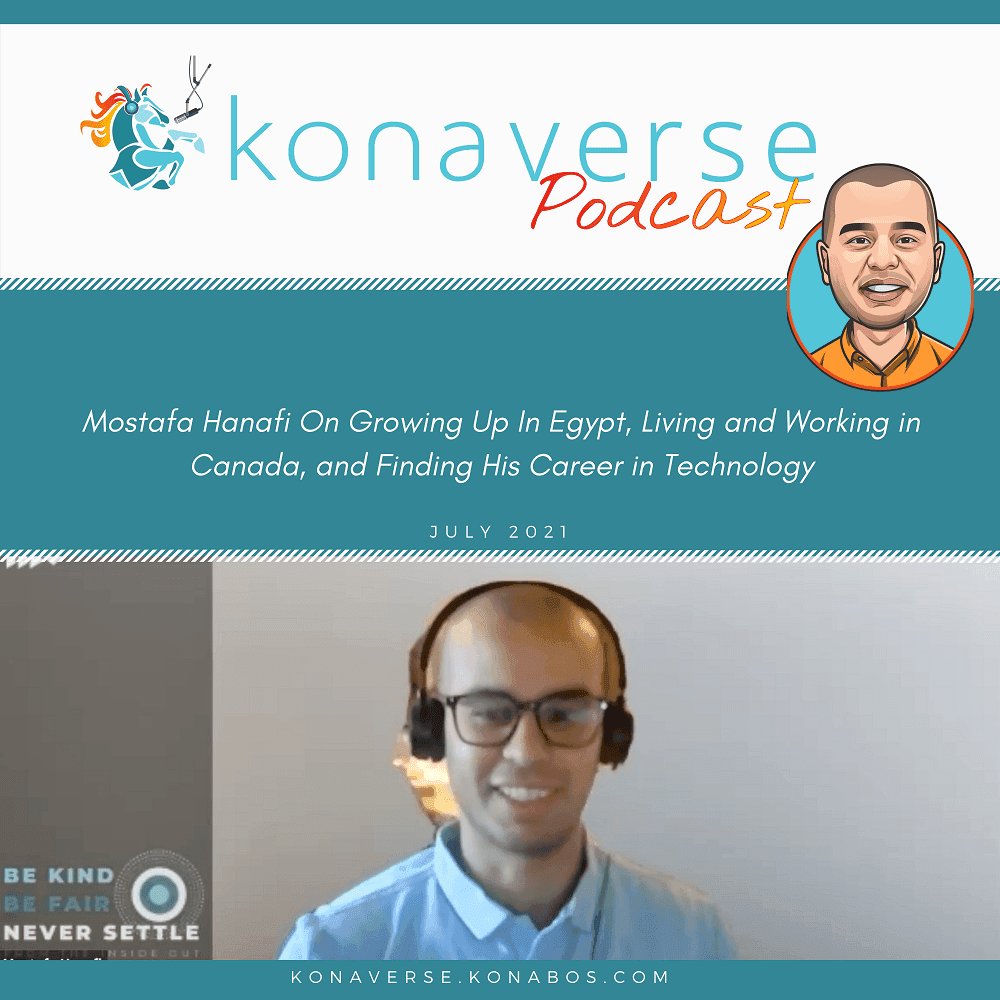
Mostafa Hanafi is Program Manager at Konabos Consulting Inc. In this podcast episode, Mostafa talks about growing up in Egypt, his family, working in and adjusting to Canada, raising two young girls, finding his place in technology, and much more.
Intro
Welcome to Konaverse, a conversation experience platform
hosted and curated by Konabos Consulting. Konabos is a global technology leader,
and while this podcast will be connected by technology, the glue is human stories and narrative. Technology can bring us together. It can make our lives better and more efficient in myriad ways. But it cannot replace human discourse and
the magic that can happen by the interchange of ideas. Hope you enjoy our podcast.
Akshay Sura
Welcome to the Konaverse, this is Akshay Sura
Matthew McQueeny
and this is Matt McQueeny.
Akshay Sura
Today with us we have Mostafa, who's our PMO manager at Konabos. Hey, Mustafa, how's it going?
Mostafa
Hey, guys, how are ya?
Matthew McQueeny
Hey, Mostafa. So we were looking last weekend was Father's Day. Right. And yeah, Mostafa had a had a nice little gift from his kids. And I noticed on there, unless they were mistaken, are you only 31 years old?
Mostafa
I am. Yes.
Matthew McQueeny
Wow. That was a surprise to me. Did you know that Akshay?
Akshay Sura
I didnt
Mostafa
Too old?
Matthew McQueeny
No, I think your younger
Akshay Sura
That's half my age
Matthew McQueeny
No, that's impressive. I think so why don't we go to where we normally do. Mostafa, where were you born? And where did you grow up?
Mostafa
I was born in Cairo, Egypt. Born and raised there. So I've been there all my life. I only moved to Canada seven years ago. So I'm Egyptian heart and soul, and recently Canadian.
Matthew McQueeny
And what does what was that like growing up in Egypt?
Mostafa
It was fun, actually. I'm hoping that my daughter's get a taste of that when we move to Egypt later this year, because I grew up with lots of cousins. So my mom has four siblings, and they were all living in the same building. And I had like 16 or 17 cousins growing up with them. So it's so much fun. We just we go back from school, and it's just on the street playing soccer and, and dinner with cousins and watching movies over the weekend with them. So it was just lots of family interaction. So I think it was it was great. Having this family in Egypt,
Akshay Sura
that's awesome and I can relate to that. I used to have a similar scene. And it was it's nothing like it right. You don't need any external friends when you have so many cousins. So Mostafa, how, like, you know, how was the like the education system like did, were you there until you finished your undergrad?
Mostafa
Yes. And I'm actually very fortunate and lucky. All of my education has been in international schools. And then for university, I went to the American University in Cairo, which is like the top college there. And then I was like, based on this and also some of my work experience in Egypt. I was able to come to Canada and do my master's at McMaster University. So all of this education helped me to be able to fit in the education system in Canada pretty quickly and be able to come and work in Canada without much struggle.
Matthew McQueeny
Mostafa, do you, one do you have any siblings? and then two, what did your parents do?
Mostafa
I have four, two brothers, two sisters. I'm the youngest. The spoilt one they call. And my father is professor in engineering. He lived in Canada for about 15 years in Calgary actually. He was a professor here and he's actually my role model when it comes to anything that has to do with discipline at work, knowledge turning. He's also like a scientist. He invented a couple of things in engineering related to solar energy and distribution of water of stuff. I have no clue what it means. But he's, he's he's really into learning stuff is now like 75 years old, still reading and working at the University. My mom owns and she's a principal of a school so she's originally a teacher, science teacher. And then she built her own school. Which I was actually in that school up until high school. So I was again, the spoilt kid where his mom is the principal of the school. So, and there are so many fun stories in that if you want to get into it. But yeah, this is what my parents did for a living.
Akshay Sura
Is that what? So because of your parents his background? Is that why you guys were pushed into? You know, the the top schools adopt schooling and education was their primary goal for you?
Mostafa
Yeah, the expectation has always been that we work hard in school and make sure that we get good grades and getting to the top universities. Just to stay at that level. They never pushed to, like, some more specific like engineering or, or medicine, like in our culture, most families would do. But he always kept the bar high for us to always focus on your learning, and always aim to be the best at what you do.
Akshay Sura
When like, when did your dad come back from Calgary? Was that when you guys were still not born? After you guys were born?
Mostafa
Yeah, no, we only my oldest sister was born in Canada. And then they moved back. I think it was 1980 or 1981. And then they settled in Egypt. My mom started her school. And since then they've been there.
Matthew McQueeny
Mostafa, what do your older siblings do similar work or?
Mostafa
No, my two sisters, the olders are teachers. One of my brothers is works in oil and gas here in Calgary. So he's a supply chain manager. And the other is a dentist. So pretty wide variety of jobs.
Matthew McQueeny
Now, on that point, what do they think? I mean, you're the youngest, you're kind of doing something different, right? What do they think about your job? Like, what do they? Are they tech literate? Or what do they think you do?
Mostafa
They have no clue what I do. And they asked me every few weeks, and my dad comes up and say you know, I have no idea what you're doing. But looks like you're having fun at work. And you're doing well. And you have a family now you have two girls, so you keep explaining to me and I don't understand. So yeah, no one pretty much understands what I do. So none of my family members are into tech at all. And even my closer family, my cousins, none of them are in tech so I'm the only one who, if you remember Friends, Chandler was working a job that no one knew what it was. It's a very similar situation for me.
Akshay Sura
So Are your parents in Calgary? Are they back home in Egypt?
Mostafa
They're living back home. Funny, they actually came in just yesterday. So so they're here just for the summer. And they also wanted to come in, see the family get vaccinated because they cannot get the vaccine in Egypt. It's, it's pretty bad there. So yeah, they're here for a few months. So they visit every year, every other year, just last year, they didn't visit because of COVID. But they tried to, to come here they enjoy the summer here.
Matthew McQueeny
So, Mostafa, we as we've been talking to several of the people who work with us, you know, Hugo, for instance, when he was looking at leaving Brazil, originally, Canada was a was a was a good landing place to get in kind of easier than maybe other places. What is the what is kind of the connection with Egypt and Canada per se, especially in your family, and maybe overall if you could shed some light on that?
Mostafa
So the reason I moved to Canada is I wanted to do more. With my career and my education. I To be honest, I wasn't like having a hard life in Egypt actually, the other way around, like the social standard that I was living in in Egypt was slightly higher than then in Canada, because over there you will have your own house, your own car, you don't have to worry too much about bills because it's much cheaper. And I was fortunate to have been working with SAP, which at that time was one of the highest paying jobs for fresh graduates in Egypt. So I've worked with them for four years and then I moved to Canada. So I wanted to move to Canada to do my masters and get higher education, more knowledge where I can advance my career a bit more. So I actually had more expectations for myself. And then the reality because after I finished my master's and I was newly married, I thought that okay, I work for SAP. Now I have a master's degree, I know more. And now I'm ready to move to the next step. But then the first job I got in Canada was a teller at CIBC. Which was crazy, like I never imagined that, my family couldn't understand what I was doing in Canada, like you left SAP, you did your Masters, and now you're working as a teller. But that's the Canadian reality, right? Like you need to have what they call Canadian experience. And you need to get into the culture a bit more. So I worked myself from being a teller into getting, again back into tech, working with a startup, and then worked with the perm. And then here I am at Coronavirus. So I'm kind of right now seven years or six years in Canada. Now I'm getting into what I had envisioned for myself. I don't regret any of this, I think it's been still six or seven years of of great experiences and learning. But I am in a place now where I think it's paying off for my hard work all of these years. So yeah, Canada. For me, this is on the personal side. For me personally now for my girls, I still believe that. Growing up in Egypt, in the 90s is not the same as now things have changed a lot. And I want better for them. I want them to learn better than than me and have better experiences. So this is why I wanted to stay here just to give them healthier lifestyle and better education.
Akshay Sura
What did you specialize in for your undergrad and your masters?
Mostafa
Electronics engineering and then, that's undergrad, and Master's in engineering design, which was mostly Design thinking and Human Centered Design.
Matthew McQueeny
So Mostafa, I'm interested when you said you were a teller, it probably taught you a lot of stuff that you still use today, even though you kind of spoke of it as something that was maybe a step down from where you you were? What did, what did you learn from being a teller?
Mostafa
Counting money in a different way. That's one, but yeah, no, just trying to get things done as efficiently as possible. And with the highest amount of focus as possible. I've never thought that tellers actually can do all of these transactions. And it just you cannot miss a cent of what you're doing right at the end of the day, you close your cash, and it has to match exactly. So during your eight hour shift, you have to be working very fast, especially when it's when it's too busy. But at the same time, you have to focus a lot. It's not like you're doing this repetitive work, that you can lose focus you when you're dealing with money and people's transactions it was a lot of focus. I think it helped me in that give me some discipline for timeing as well. When you work in the bank, like there is a start time and an end time you cannot miss that by a minute. Because you have other systems working in parallel and all of that. So it's definitely it was a good experience for me.
Akshay Sura
Nice. So the story behind so your your second daughter was born. And then you guys went through certain decisions. And you guys actually plan on moving or partly moved to Egypt. Before all of the craziness. But could you walk us through like your decision to move back to Egypt for a little bit before the girls get into the elementary school?
Mostafa
Yeah, so when my second daughter was born, and at that time, it was also winter, and COVID and winter Canada is not fun. All of these together started to be a bit too much for us to handle. And we needed some sort of a support system to help us to get through this. And with COVID. We were like stuck as same as everyone stuck at home and the kids at home and we weren't really feeling safe and at the same time we were thinking about our families in Egypt and how quickly people are getting sick and and we haven't spent a lot of time with them over the last few years and we started to rethink of what are we doing here, right? If there is nothing happening in Canada if we're not progressing at this time, and at the same time, we are unable to handle all of the craziness of the newborn, then why not just spend the time with the family move to Egypt, take a break from all of this, and just reset. So once I started to see that our mental health will start to get affected, I wanted to make a change so that we don't feel we don't get into the cycle of, of depression and anxiety all the time. So this is where the Egypt decision came from and, yeah, we're gonna give it a try. Again, I'm very fortunate and lucky that I can still do the job that I love while I'm in Egypt. And I'm thinking of also expanding Konabos to, to be existing in the Middle East and Europe. So I think it's a good opportunity work wise as well. So, yeah, that's, that's how it happened.
Matthew McQueeny
So I'm really interested for both of you guys, Akshay and Mostafa, and others who we've heard their stories. I've always been someone who really hasn't had to go that far away from my family. I remember after college, and I tried to move to Arizona, on the west coast of America. And I lasted like three or four months, and I just kept thinking, Oh, my gosh, I'll never, I'm not going to see my siblings grow up in person and all this. I'm so interested in how you're able and Mostafa, you can answer it like, how you're able to be kind of building your own life right in this new country, and maybe not have the face to face with your family as much as you did, like, how do you kind of how do you work through that mentally? I know we can connect through video conferencing and everything but it's not quite the same, right?
Mostafa
Yeah, of course. And I think I was kind of used for this kind of living. Because with after I finished college with SAP, I used to be traveling three weeks a month in the Middle East, and then back one week in Egypt. And I did that for about two years, or two and a half years. So I was already kind of used to living alone and my family is actually, although we're very attached, but not like extremely emotionally attached where we don't call each other every day or every other day. But we know what's happening in our lives and it matters to us. On the other side, for my wife, that was a big step for her to be away from her family. She was just married for like eight or nine months. And then suddenly, she was taken to Canada. And her family is extremely close. Like they call each other she has three other sisters and they call each other every day. They call their mom every day, they can spend hours on the phone, and they've been like that for for a long time. So for her, she actually did pretty well here, I have to say that and she helped me to be able to overcome the challenges socially that we that we faced here. And, and yeah, without her actually being able to overcome this, it would have been much harder for the family.
Matthew McQueeny
Yeah, no, it's it's really, it's really interesting. I have a similar experience with my wife and her family. We call it the phone chain. Because it's like, everyone calls everybody and then everyone knows everything. And sometimes I'm like, why are you telling them this about me? I'm not even figured it out with it yet. So it sounds like you had some history with Canada, right from your your father. But what what was it like culturally, moving from Egypt and the Middle East to kind of living in North American Canada full time? What was that transition like for you? Um,
Mostafa
I think we were always focused on the positives and what we were missing in Egypt that we found here. And this is, this is what happens to you, especially in the first few months or years for some people where you are just fascinated by the system and the organization and the clean streets and traffic lights and all of the things that you you miss in a third world country. So there was like for us it was a good new experience that we want to try living here. We've traveled before, briefly to Canada and other places, but it was the first time back In 2014, we actually stay and live in this new world. So it was very exciting and then you start to see the flaws of the system or you start to miss some stuff in Egypt, like family and food and the warmth and the weather. And then it starts to get a bit tricky, right? So this is when your, your heart starts to get in, right. So your mind starts off first and tells you, well, this is great. It's much better than before. But then your heart comes in, and you start to miss stuff in Egypt, where it gets tricky. So we had to always keep it balanced, where we know where we're at. And we know that home is still in Egypt, families in Egypt, this is where we want to be, but we're here for something that's better for us and for our children on the long term. So during this process, you get to overcome all of the negatives that you see and you get to enjoy the good things that that went back in Egypt.
Akshay Sura
So Mostafa, what are some of your hobbies like other than so leave the work aside? Maybe the kids aside? What are your some of your hobbies?
Mostafa
Soccer, for sure. I like to play soccer. Whenever there is an opportunity, I used to watch lots of matches before I moved to Canada. But when I moved the time difference made it very hard because all of the matches, the good ones are in Europe, with the European timezone and how it would work. So I dropped the watching, but I enjoy soccer a lot.
Matthew McQueeny
So Mostafa, when you moved back around, you know, before the pandemic back to Egypt. It had been, you said about six, was it about six years since you had live there full time? Yeah. So what was that, what was that like going back? Was Egypt how you remembered it had it? How had it changed? Like, what did you notice after living in Canada for all those years?
Mostafa
Yeah, it was. The first few days are just crazy. You think that you're in a country that you've never lived in before, because you get used to driving in Canada, and dealing with people. And even the restaurants and everything is just different, right? So once you get out of the plane and into the airport, you're just shocked with the amount of unorganized systems that's happening there. So the first few days are a bit tricky. But you'll get used to it like after a while. Again, you start focusing on why you're here. So the family spend time with the family and we try specially at time of COVID. Of course, we're indoors all the time. And we try to to, to just spend as much time as we can with the family. The good thing is also staying away from Egypt for some time. And when you talk to people about Egypt in Canada, or the US, you realize that there is a lot to Egypt than what we know about. So when people start talking to me about the pyramids and the Nile River and all of the historical places where I, like for many of them, I haven't even been there, right. So when we go back to Egypt to try to do all of this touristic stuff that we sometimes they didn't even know they existed. So it's pretty nice this way. So we usually go for about a month or three, three to four weeks. And we try to have like half of that time with the family, the other half pretend to be tourists in Egypt and go to places we've never been before.
Matthew McQueeny
It's funny that I grew up outside I've grown grown up my whole life, basically outside of New York City, and I never really went there. You know, when we grew up, it was like a strange thing. Do Egyptians take offense to the saying denial ain't just a river in Egypt?
Mostafa
No, no, we've heard much worse. People thought that we live in tents and we have camels and some people when I when I was in university at McMaster they were shocked by like the English I'm speaking and I have a laptop and where I was educated in my undergrad. And they felt like we lived in deserts and rode camels so it's funny.
Akshay Sura
So Mostafa, other than the soccer part are you into like cooking? Trying different, like cuisines? Anything, like I know you're, you're an entrepreneur at heart, right? So you guys jumping into a couple of different businesses food related.
Mostafa
Yeah. And we're big on food. So we try to just go out and try different foods every week. So whenever we're in a new place, especially we have to try there Indian, Mexican, Chinese, we have to just figure out what are the best restaurants around us. So yeah, eating is a big part of our culture here. Yeah, and other than that, it's really just looking around and seeing what else is happening around me. So I like to get into like the latest tech stuff, latest gadgets. I want always to be learning about what is happening out there what I can buy and maybe try for some time and then return it. But yeah, I like I like electronics gadgets a lot. And probably that's because of my undergrad education. I was really into electronics and newer devices.
Matthew McQueeny
You guys watch much streaming TV Netflix, you have any shows you like?
Mostafa
I used to, I used to. Yeah, no, I've done my share of movies and, and series for some time, I took a conscious decision sometime last year was during COVID to limit my screen time to almost zero now. Because I found that it's just too much to, to follow up with everything that's going around and also be stuck in front of the TV. And I also think it's it's a good way to lead my daughter and show her by example that spending too much time on TV is not a good thing. So we try to do that.
Matthew McQueeny
So the that's really interesting to me, because I have a similar I think we have similar aged kids, right? I think you have daughters, I have sons, but you I found myself actually subscribing to like real magazines, real newspapers, because even though I was reading them on my iPad, to them, they just think I'm looking at my iPad. But how do you, how do you actually limit the screen time? Because I feel like sometimes you don't get sleep because of the kids and it's like it's easy, like addictive to look at it like what do you what do you actually do? Do you read? do you do? You just played like board games or how do you get away from it?
Mostafa
Yeah, so it's not screen time as in my phone time. So I pretty much do everything on my phone. So after office hours, I do some work over the phone. I also read so yes, I read on my phone like news, stuff like that. So I get my mind off work. Reading some news, reading some stuff about Egypt. I think of myself as kind of a religious person. So I read about religon and, and, and some thoughts that other people have or like articles to help with like productivity and your relationship with your Creator your relationship with your family. So I I tend to like to eat this a lot and it gets gets me or de-stress me a lot. So yeah, it's not really screen, what I mean by screentime is just like watching movies or series. Like without purpose.
Akshay Sura
Who is the disciplinarian? Is it you or your wife?
Mostafa
Me? My wife is the adventurous one. Yeah, so when when we when we traveled somewhere. I am the one who like plans, what we will do and find the hotel, the restaurants, the all of the transportation itinerary, all of that and she focuses on what fun are we what kind of fun stuff we're going to do. What is the next adventure? So,
Matthew McQueeny
Mostafa, you brought up the word productivity. I'm very interested in that because it does seem like you get a lot of things done. You do have two kids. You're living in Egypt at one point, you're living in a different you know, Western timezone. Now, it's right. Sometimes it can drive you crazy trying to figure out how to be productive, but like, what have you found for yourself that kind of centers you and allows you to literally you know, they have the same get things done.
Mostafa
Yeah, exactly. So, I found that first of all, starting earlier Then the rest of the team helps. So this hour that I get in the morning, that is actually even off slack and off teams, and no one knows that I'm online, helps me a lot to at least get myself organized and get stuff done. Before I deal now I know. And now, you know, before into getting the craziness of emails and messages. So this is how I usually start. And then, as you said, like, one of the things I've noticed, I used to do that, and I've been seeing this and so many people that when you want things done, it's easier to just get it done at that time, instead of trying to plan for it, to get it done another day, another time. So when you have a clear list of what are the things you want to do on that day, and in my list, because as you said Matt, it gets really crazy with the kids and, and we're in Calgary, now we're we're not actually settled, we're just renting a short term, condo. So I don't have my office setting. And it gets really hard, right, especially when we had COVID for some time, since suffering from some of the after effects. In my list, I also include what I want to do for the family, and, and, and so on. So just to be able to have this list and and work on it right away, get things done faster, is what I've what I've been trying to do. And I think I have also learned that from Akshay a lot. Like getting things done right away. You don't have to say, Okay, we'll do that. You can actually even on a call, you can have this up on the other screen and get things done. You don't have to wait until the meeting is over. So yeah, that's that's how I try to get my stuff done. I know that I'm not the best at productivity. But I'm trying to try these tricks and see if it works.
Matthew McQueeny
So I have I have two more for myself. And then Akshay will ask our great finisher. So the first one is we kind of buried the lead you had COVID. Right? So yeah, and it and it really affected you for for some time. Maybe you just want to talk a little bit about that, how it affected you how it affected you being a parent, you know, just you know, in a household, just how and you can't see it's hard to see your way through. And a lot of times from what I've heard, what was that experience like for you? Exactly.
Mostafa
So when we moved briefly to Egypt for a couple of months, over there, pretty much everyone I know, got COVID or their wives or their kids or relatives. So over there, it's crazy. Everyone gets it. And we were lucky that we didn't get in Egypt, although like people not wearing masks that often. And then they're not really they're mostly careless about COVID. Right. So we were very scared to get it over there. And then when we move back to Canada, again, for some time, everything here is organized and people are not going out and you barely see anyone and everyone is with mask, social distance all of that, but we still got it here. Which is crazy, right? Like we never expected actually that we get it. And it was just because we visited my brother and his family for a couple of hours in Ramadan. And we were still social distance outside and everything but we still got it. So anyways, so for us, it was a bit of a shock that we got it here in Canada. Now, it was hard because my brother, my sister and their families also got that so we didn't really have any support to help us to get through this. And it was pretty intense for me and my wife. Luckily my daughter just she had it and just like passed after a couple of days, she didn't feel anything. For me and my wife, it was pretty intense. Especially much more than my wife. And it was hard to like without the support to be able to take care of the kids. We have the seven months old or requires attention all the time and most of us didn't have energy to even get out of bed. So we had to put everything on hold, including work and trying to just focus with the girls and and trying for us to get better. Food was definitely again a challenge like we couldn't For like a good couple of weeks couldn't, like stand in the kitchen for 10-15 minutes to do a meal, right. So it was it was pretty challenging. Again, I think we were lucky that for some people, it leaves lots of bad symptoms even after it's gone for us, which just didn't have I have mild symptoms. It's just mainly the fatigue, headache that is still with us. But other than that, it's it's Yeah, it's been pretty intense. I went to the emergency for one day. The problem with it is that there is no medicine, right? You just have to wait for it until it gets out of your system. So it was two to three weeks of, of just struggle with COVID. Again, I think the support that I found at Konabos to be able to focus on getting better and instead of just worrying about work is something that I definitely appreciate. And I think it helped me to actually get the rest I needed and get this out of my system. So yeah, it's it's another fun experience. I'm hoping no one gets into it, especially when they don't have a support system around them that helps them to get through this.
Matthew McQueeny
Absolutely. And we're glad that you're continuing to do better with it. The one other thing I just wanted to ask before Akshay's was, so living in America, you know, we know Canada. You know, we know Toronto, we know Ottawa, all that. But it's kind of interesting to me that you lived in Toronto, and you kind of live on like the version of the west coast of Canada in Calgary. Are there like distinct kind of cultural differences? in those two experiences having lived in?
Mostafa
Yes, yes, here in Calgary people are too laid back. You don't feel any sense of urgency, things are moving much slower, than back in Toronto. It was crazy over there like, competition is crazy. People are all stressed and things are moving much faster. So that's definitely a big cultural difference. The weather well, the weather in Canada is pretty bad anyways, but here, it's it's just much worse. If you leave your car outside in winter, things are going to freeze, the tires will freeze. The battery will die. And it's just not nice. So yeah, this is one of the things that we don't like about Calgary, the weather. But other than that, the scenery here is great. So you get to see lots of mountains when you're even driving on the highway, and lots of lakes. So it's it's nice to be around from scenic perspective, and to be around with the family. But I would pick Toronto over Calgary in terms of weather and just you feel a bit more lively in Toronto than here.
Akshay Sura
Nice. So final question was tough. Knowing all the things you've known now, all the travels, you've done, right? The COVID you got. What would you, what would you advise your 18 year old self?
Mostafa
Oh, I would travel more because every time I'm traveling, I'm learning. So travel more, take more risks, and just don't regret anything. Because every experience, every travel every day, is a learning opportunity. So yeah, and even I'm telling that to my daughter, you're going to travel you're going to have semesters abroad in Europe and Singapore, I want you to travel the world because I have learned it this way and I think it made me a better person.
Akshay Sura
That's amazing advice. Again, thank you so much for your time Mostafa was asking saying we learned we learned quite a bit about you. And at some point I'll share some of mine doing this a lot of parallel things you'll find extremely funny, but thank you so much.
Mostafa
Nice. Awesome. Thank you. Okay, thank you, Matt.
Outro
Thank you for entering the Konaverse. We hope these discussions gave you something to think about helped you learn something new, and provided a window into someone else's story. Everyone's story is worthy and important.
Until next time, remember to be fair, be kind and never settle.

