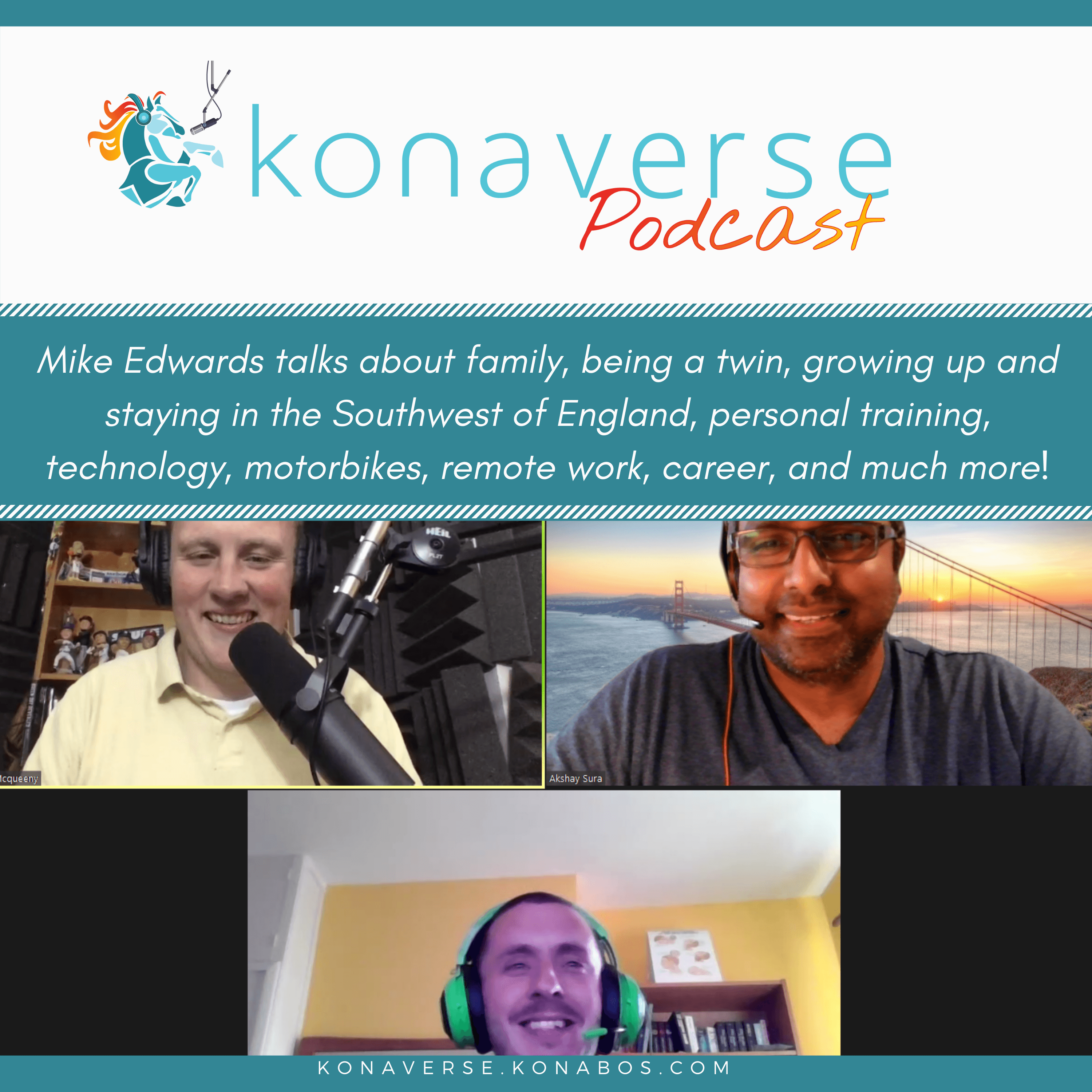
Mike Edwards is the Director of Technology at Konabos Consulting Inc. In this podcast episode, Mike talks about family, being a twin, growing up and staying in the Southwest of England, personal training, technology, motorbikes, remote work, career, and much more!
Intro
Welcome to Konaverse, a conversation experience platform
hosted and curated by Konabos Consulting. Konaos is a global technology leader, and while this podcast will be connected by technology,
the glue is human stories and narrative. Technology can bring us together, it can make our lives better and more efficient in myriad way, but it cannot replace human discourse and
the magic that can happen by the interchange of ideas. Hope you enjoy our podcast.
Akshay Sura
Welcome to the Konaverse. This is Akshay Sura,
Matthew McQueeny
and this is Matt McQueeny.
Akshay Sura
With us today, my long term friend, Mike Edwards. Mike Edwards is a Co-MVP, done quite a bit on in the Sitecore space as well as his recently it's been doing fun things in saving the environment. So how's it going, Mike?
Mike Edwards
It's going well, thanks for having me on Akshay and Matt. Great to be here
Matthew McQueeny
Yeah, and I would say Akshay, we buried the lead. He's the director of technology at Konabos now. So to me, that's kind of interesting, right. I mean, it's a career pivot of sorts. Why don't you talk, why don't you talk about that first, right? It's pressing like the decision to come in come aboard the Konabos.
Mike Edwards
I suppose the decision to come, because I've been, you know most people in the Sitecore community know that I've been working on the glass project and I've been sort of working as a Sitecore solution architects for a while, and very much enjoyed the technical challenges of that I had given me, but after trying to start my own company last year, and will probably come on to talk something about that in a bit. Also, like, I also enjoy doing the more business side and getting in kind of the leadership stuff. So, you know, I was looking around and I spoke to Akshay, and said, hey, you're looking for anyone. He was like, Yes, we are. And now it seems to be this perfect mixture of still keeping my hands a little bit dirty by doing some code, but also being able to embrace doing the business side and helping to run an awesome company. So that sounded really interesting. And so, yes, I jumped on this ship. Yeah, it's been two weeks, and it's been really exciting so far.
Akshay Sura
Nice. So, Mike, so where were you born? Where did you grow up?
Mike Edwards
So I was born in the southwest of the United Kingdom, and was actually born in Bath, but I've lived in Frume, which is just outside of Bath for pretty much my entire life. I've, I've traveled the grand distance of about 14 miles from where I lived as a kid. But the Southwest, the UK is a you know, it's a beautiful place. Rolling Hills, lots of countryside. So yeah really happy to be in this area.
Matthew McQueeny
Mike, the it's probably you know, kind of it's pretty far away from like London, right?
Mike Edwards
That's like, that's, that's like the one thing you should never ask. Where do you live in relation to London? The British are like there's more than London!
Matthew McQueeny
Oh, no, there absolutely is. I've been there. But I'm, I'm trying to almost set the stage like, maybe the better way to ask it. Why? Why were your parents there? Why Why were they based in in Bath when you were born?
Mike Edwards
Well, my grandparents come from Bradford, which is actually in the southwest as well. And our family has just always been in the southwest. My brother's actually doing the genealogy of our family. And pretty much everyone just comes from local, you know? Yeah, so it's like a family hasn't traveled a huge amount. I think the lot. The person who's traveled the furthest is potentially an ancestor who moved to Australia. And there is a town called Loxton that may be named after our ancestor, maybe not we're not too sure there's there's a few different people, few different ancestries with the same surname or trying to claim ownership at that town. So we're not sure at the moment but yeah that's probably the furthest somebody has strayed.
Akshay Sura
Nice. So how many siblings do you have Mike?
Mike Edwards
I have a twin and I have a younger brother.
Akshay Sura
Whoa, wait, you have a twin?! I had no clue!
Mike Edwards
He's not identical. He's he's got blond hair, and now clearly less attractive. So.
Akshay Sura
So you have an elder brother and a twin?
Mike Edwards
Twin and the younger brother,
Akshay Sura
Younger brother. Oh, wow. I didn't know that, that shocked me. I didn't know that. So what kind of field, you're obviously in technology, what are your other brothers into?
Mike Edwards
So my twin brother, he's an environmental health officer for the local council. So, I'm going to simplify what he does, and he will hate me for this. But he's sort of person around, checks that restaurants and businesses are following safety guidelines and things like that, and making sure that where you eat is healthy and clean, or if somebody's got a complaint, following those sorts of things up. So he really loves his work and he has lots of interesting stories of what people have done and what he's seen. And then my younger brother runs his own company, doing 3d visualizations. So if you want a house built, he will mock that house up on a photo, so you can actually see what it looks like. And when you try and get permission from the local council for that, you can then present them with this picture and go, look, it's gonna look amazing. And his work is amazing. He has, he's done really well with that.
Matthew McQueeny
Like, what was your twin brothers, life like in the last year of Coronavirus? Because I assume that was a pretty big part of going and checking out restaurants and things like that.
Mike Edwards
He was still going out and checking though because you know, takeaways was still open. So you still had all those sorts of businesses that needed to be taken care of and I think there was also giving some advice and support to, companies as well, trying to understand the new trade arrangements with Brexit and stuff like that. So he's been kept very busy. He did do less site work, and he really likes going out on site and visiting people. So when he has the opportunity he was he was always out trying to visit people and check up on them.
Akshay Sura
Nice. So when did you first get into technology? Or like how did you end up in the technology field?
Mike Edwards
This goes back, so probably first got into computers when I was about 10. And my dad bought a PS 2. So this is not the PlayStation, this was the IBM PS 2. So it was 10 megahertz two mega memory and about 16 megabyte hard disk. Big old CRT screen, we had to turn both things on separately, nothing was connected and that's where it started and doing a lot of rapid learning there because I used to break that computer quite a lot and I had to fix it before my dad got home from work. Doing that was sort of my Crash Course intro into that and then got into programming, probably around the age of sort of 12-13. And did some online, not so not online, so did some evening courses. So we learn how to program in c++ and then Visual Basic. Those were like adult training courses at the local college. And I just remember the first time it was me, my brother and a friend, we turned up at this course. I sat down, these 12 year old kids, and the instructors like I think you're in the wrong place. And we're like, No, no, no we're meant to be here. So yeah, that was that was a really good sort of crash course in training. Of course because being kids is just like second nature, you know, you just be brought out with it so it wasn't too difficult to learn. So yeah, continue doing that. I actually went to university then to do a degree in Computer Science by only lasted three months. I actually just got bored with what they're teaching us. So yeah, so then I dropped out of that. I then did some training as a close protection officer.
Akshay Sura
Protection officer, what?
Mike Edwards
Most people refer to them as a body guard
Matthew McQueeny
Really!?
Unknown Speaker
And that was really interesting. But I decided not to go into that area. Because that straight after doing that training, I then did training in Personal Training and Fitness. So then I became a fitness instructor for three years, always on the side tinkering with like, programming stuff. And I always knew I'd get back into I.T but at that point in my life, I was like 19 and I was like, I want to do something out of I.T. So at least I've got experience of other places and other things as well. So yeah, I really enjoyed going into the fitness industry and it was a great place to get those sort of social skills, you know, how to engage with people how to present infront of groups and things like that, you know, you're doing fitness classes, shouting down the room telling people to do more press ups, that sort of thing. So yeah, it's really really good experience. But yeah, I did know eventually I'd get back into I.T and then yeah, After doing three years of that, I got my first proper I.T job,
Matthew McQueeny
Mike, we're, we're about the same age and I got really into personal training too. So that's a weird question. But what was your, what was your training methodology? Was it hit method was it you know, volume?
Unknown Speaker
I don't remember that being many things, we would generally, we would dealing with sort of the general public back then and it was just general fitness instructors, and we'd give a balanced program. And then when people came in, and they were like, Oh, I need to train for this specific thing, we then then try to tailor something for them. So that time, I wasn't specializing in anything like that sort of, is it hit?
Matthew McQueeny
Yeah were you really into exercise? Is that what brought you to it?
Unknown Speaker
Yeah, I've got into exercise from college. I started I joined a gym, it's actually pre 16. It wasn't too bothered about exercise, but then post 16. Again, I think it was known this knowledge of knowing that I was going to go into a career o I.T at some point, I was like, I need to get into exercise and do some form of exercise. Otherwise, things, things shape wise are going to go go wrong. And at the same time, I also became a lifeguard at the local Leisure Centre. So then we got free access to the gym anyway. So it's sort of kicked off that whole thing. And still, I still go to the gym regularly. So it feels weird to say, What am I done now? 22 years later, I'm still training in the gym. like three days a week? Yeah, anything I've committed any to anything else as much as that part from eating maybe?
Matthew McQueeny
Akshay, can I ask him a question there? Because I want the answer. When and how do you train with these schedules? These kind of global tech industry schedules that we all live on, I'm having a hard time finding when to do it.
Unknown Speaker
Well, luckily, at the moment, I've got my mornings kind of clear. No, working with you guys in the U.S, it means I have five hours, or five or six quiet hours in the morning, when nobody is around to send me an email or ask me a question. I mean, it's probably slightly easier to me, as well, me and my partner, we don't have children. So we, we have probably a little bit of an easier time in the morning and the evenings than you two do with having to manage children as well as find time to fit in exercise. Mine you they're probably quite a lot of exercise themselves are'nt they, running around
Matthew McQueeny
that's right, I look at the watch and it's like 10,000 steps and I'm like, wait, what? How did that happen today?
Akshay Sura
Mike, what what was your first job in like, what, what kind of field was it in, in the sense in technology and what kind of programming languages did you have to use?
Unknown Speaker
So my first job was for a university, their internal Information Services team. And this was a new team that they just set up. So they pulled some people from their help desk and created this new team to create internal applications. So I joined their team. And it was they were programming in C sharp and so we were looking at creating things like, one of the biggest projects we did, there was a student portal. It seems weird now to think back in those days, there was no kind of online registration system for the students coming to the school. So when they came for registration day, they would bring all their forms, and then hand these forms to the admin staff who would then to manually enter into a system. And that would include like their module selections, and things like that. And that would take weeks now, and staff would be pulling three, four hours extra day, every day just to try and get all this stuff entered. And make sure that students module choices could then go into the timetable and the timetables would work. So the biggest project we did there was to just simplify that so students could do their registration before they got there, do other modules selection, so that when they got to registration day, they just turned up basically said that name, handed over a few necessary forms that had signatures on it, and the university knew who it was and we the first release that eliminated all the overtime that people were doing. And had was really, really good success from our point of view. I suspect it's been rewritten but yeah. So those sorts of systems time sheeting systems, they're basically anything any department needed internally. We were there to write some software for it. And it was a fun place to work had a great team there. And guess becasue it was in YouTube, we were all exploring as well. You know, learning new things and teaching each other new things.
Matthew McQueeny
So, Mike, you said that you haven't really left your your area where you grew up, you'd be able to work here. How has that happened? Have you been able to plan to make that happen? Or did you did you leave at some point to have to work? I won't say London, but leave to work somewhere else? Or have you been able to just kind of hold down here and have a career.
Unknown Speaker
Luckily, I just been able to hold down here, I know. I got into cycle with a local company. So I went and worked for a compay called Edu serve, which were, I believe, Sitecore first UK partner. So I started working with them and know lots of well known Sitecore names have come out of Edu serve. And yeah, so I started working with them, they were based in Bath. And following on from that I've actually been able to work remotely with with the different organizations for the most part. With the contracting, there has been a lot of traveling. So it's been me traveling off backwards and forwards to different places sometimes. Well, that's not been too bad. And now in this I've enjoyd, we've seen different parts of the world by doing that and mixing onsite rework with remote work has been quite a quite an interesting experience. Now, I suppose I was a bit of a forerunner for that, because now everyone's doing it and it was jumped on the bandwagon. Let's just yeah, we can all work remotely. So yeah, and I just yeah, just been very lucky that I kind of structured it that way. And that's kind of always been that way. I'm quite, I like being in the countryside. I'm not so keen on being in the middle of a city, I like being able to get out into trees and fields really quickly, going for walks on the weekend and stuff and just seeing some greenery. So yeah, being in it being in a big city just wouldn't suit me at all.
Matthew McQueeny
I just want to ask one follow up on that, because I think it's really interesting to this time. So you brought up the point that, you know, a lot of societies now remote. But in your experience, like we've all been in basically a year now, regardless, but what what are the successful things to do to work remote? Because it has its challenges, even though it has it's kind of blessings and positives, that you know, you don't have to commute and all that. But it can have its own difficulties, right? Like, what were the things that you had to overcome and get good at, and that maybe you could pass on as, as good behaviors to help help others in this kind of situation.
Unknown Speaker
So, I mean, communication is key. So tools like Slack, having a constant channel where people can communicate all the time, to actually is, is kind of key. So there's freedom of information. Having a kind of open call, I want to say open call policy now, where people are encouraged to call each other. I've found that when you're the one not on site, it's very easy to be forgotten about. So I'll call that kind of like the hybrid model where, say you've got number 90% or 80%, your team in on site and two or three people remote, quite often these remote people will be forgotten. So if you're the remote person, you have to make yourself slightly louder so that everyone knows that you're there and that you're contactable. And then from the outside those who are in the office need to make sure that you're included in in all the calls and conversations. I think one of the projects I did, the one thing I found the hardest is that I wasn't able to join in those serendipitous conversations that are happening in the office. Know somebody would come in that morning and people were like, oh, how was your weekend? You sort of do the informal chat and then suddenly go, oh, did you see that bug yesterday and they would start talking about solving a bug or solving a problem. And because you're remote, you're then they don't think oh, we better call Mike up to call to bring him into that conversation. And that that can be a bit difficult because you do feel like sometimes you're missing out on a lot of context. So I generally like if, if people are some people remote, it's like generally better to have everyone remote because everyone everyone's forced to use conference calls facilities like Zoom and stuff to have a conversation and that means that people remember to pull those other people into it, as well. And one of the things I've learned here, which I really like actually is Akshay's policy of actually just contacting people just to have kind of short non-work conversation with them. So that you build up that personal repertoire and understand and get that personal connection with people because also working remote, it is sometimes easy just to limit your interactions with other people to just task based interactions, where like, I'm only calling you because I need to solve this problem. And that doesn't build a company culture, you know, you need to be able to have these personal connections and understand about people's lives and what they're up to beyond work to actually make a company culture. So forcing those interactions is also I think, key to working remote.
Akshay Sura
Nice. Mike, when did you get into motorbikes, and are you still riding a motorbike? If so, which one do you have?
Unknown Speaker
So I got into motorbikes more out of necessity I think, initially, so when I was a personal trainer, I was working in a gym that was about nine miles away. And it was a kind of a awful, I at that time was cycling to work and it was about 4.5 miles all uphill, followed by 4.5 miles downhill and then reverse on the way back. And that was kind of fun during the spring and autumn. But summer, it was way too hot. So by the time I cycled to the off to the gym, I've just covered in sweat. And then in the winter, you got the reverse problem, it was freezing cold. So the gym manager at the time, he said, Oh I know what I'll do, I'll just buy you a scooter, you go and get your CBT. So he off his brother-in-law I think it was he bought this cheap 50 cc scooter. It was rubbish thing and they were like top speed like 30 miles an hour. And I'm having to go along 60 mile an hour roads in the UK, which are just these windy little roads, but everything still goes along at 60. So it's absolutely terrifying, especially when you get overtaken by a 30 ton truck. And you can feel them pulling you under. I was also just musing about this little scooter was that in the winter, the engine was so small that it couldn't cope with the cold, and there's just this one hill that was really steep, it would always cut out halfway up this hill. So I'd ride it halfway up, get off, push it to the top of the hill, get back out and then continue the rest of my journey. So after writing that probably for about six months, I was like I need to get something bigger because this thing keeps cutting out on me and also I just didn't feel safe because I'm slower than everything else on the road. So that's when I went into doing my direct access which allows me to just go onto larger bikes faster bike straight away and that was basically it, the start of it, that's what got me started on that and I've gone round Europe on it you know, I've been to Sugans on one. I've had, I've come off it several times more times than I care to admit. I've had one very serious accident where I was airlifted because I had a head on collision with a car. Yeah, so it's it's dangerous. I don't think I know any motorcyclist who hasn't had some accident of some sort. But I still have a motorbike I still have my Daytona 675, the red one right up to Sugan. I still really enjoy it. It's just a lot of fun. If you've had a stressful day is definitely one of the things you get on it and you tune out everything else because you just have to concentrate on what you're doing and it's sort of great sort of stress reliever. Now as I have got older though, I do write a lot slower. I notice that, I'm much more cautious now. Probably learning from past mistakes. But yeah, I really really enjoy it. And I take Laura out in the back as well so she's she enjoys getting on the back of it and there's nothing barriers than when you're when you're cutting through traffic. You're like I was in a queue and you're just like yes, this queue is not bothering me I can skip to the front yeah. Do either of you ride?
Matthew McQueeny
No we're just we both are Tesla people.
Akshay Sura
I used to back in back in India, but those are like the 125 150 cc bikes though.
Matthew McQueeny
You know what with me is in the last year, my mother in law was like Oh get bikes, you know, get my wife a bike that can put a kid on the back and we get the six year old his own bike and and then my wife was like, she'll get you a bike too. And I'm like, Alright, why don't you give me a mountain bike. And I know it's not a motorized but I was like and we have all these mountains here on motor Ella mountain bike. So she got it and I I lay out every single time I go out there I come back with some really, really bad injury and I'm sitting in the woods going, how the, what did I do to myself and it's like, you know, there's bears, there's all this. So that is the extent of my biking and I'm not sure if I've pulled the bike back out this this season. But Mike -
Unknown Speaker
I always have more respect for mountain bikers, because it does seem to even more dangerous to me that motorbiking is here just careering down the hill with these tiny little breaks, I'm not really sure if they are going to work and going over jumps and trying to dodge trees and stuff like that.
Matthew McQueeny
You know, what really gets me about that, too, is I went out there and I'm a novice, right? I got a bike. It's got the springs on the one wheel, but then there's people you go out there, they got the springs on both wheels. They have like monster truck wheels. They go in teams, they have outfits, they have the locked in shoes that go in I'm just like out there with like Air Jordans. You know? It's probably not as, as clear, but it's one of those things. And I mean, this is like in, in tech or anything to you get into something sometimes in here. Like, there's like a whole deeper world here. And you almost have to make the decision if you're okay, maintaining as a fun loving novice, or do I want to commit and really go down the line. And I think sometimes it's a weird discussion, but like, I think sometimes you almost have to choose one or the other in this society.
Unknown Speaker
Yeah, I mean, it's a time thing is like if you're going to become an expert, it's like, do you have the time to dedicate to becoming the downhill mountain bike expert? Yeah, I tend to like trying a lot of different things. So now I've done archery, climbing, snowboarding, Kung Fu. Yeah. And I'm not an expert in any of them. But I like, just trying lots of different things and seeing how they seeing how they work and learning about them.
Matthew McQueeny
What do you think of Brazilian jujitsu?
Mike Edwards
I'm not gonna take on Hugo if that's what you're asking
Matthew McQueeny
I was gonna say we could have our first Konaverse match or something, live event.
Mike Edwards
I see you Teeing that up, trying to take bets on that
Matthew McQueeny
So speaking of that, you talked about, again, I think it's cool being placed somewhere for a lot of your life. I'm actually very similar. I have not left the state of New Jersey for the majority of my life, you know, so I shouldn't be going like, Oh, what a guy just staying at his house, you know, pretty similar. But you said you traveled for work and everything like that. And you can travel for vacation? What are some of your favorite? What are some of your favorite places in the world you've been.
Unknown Speaker
Um, so I love the Alps for snowboarding just because it has the longest and best runs. So we would normally go snowboarding. So once if not twice a year. And it's just beautiful, you know, being up in the mountains. Seeing whitetop Mountains, it's just great. And then no snowboarding I like being active. I'm not a good sort of sit around doing nothing like sitting on a beach kind of person. That's not for me. So if I'm going on holiday, it needs to be something active where there's something to do each day. There's like an ADHD things need to be always fidgeting. So yeah, so I love doing that. And it's great. It's great sport, it's what to take with no, we go normally go with a group of about six of us. So you've got the fun during the day, and then you've got the Alps pre ski afterwards. And you just hope that you make it to the end of the week intact, you know. Then probably the best place we had been is Vietnam we went took Laura there to Vietnam for a 30th birthday. And we spent two weeks traveling through Vietnam. And it's it's a beautiful country, really nice people everyone's super friendly. Lots of interesting architecture. The food's amazing as well. Its one of those places where every every sort of little cafe restaurant you go into just just like amazing and something different. Now and again, but very culturally different to the UK, you know, some things we weren't expecting is going around a meat market you know, in the UK, go to the supermarket and all your meats packaged up in fat packed units, whereas over there, the meat market there was just skeletons on the side and people are just cutting bits off for each other and stuff like that. So they're much more connected to where their meat comes in, in some ways than than we are. Crazy driving styles though, coming from the UK where driving is very ordered over there they often it felt that they were just playing games of chicken with each other they know to poke vehicles on the same side of the road and like he's gonna he's gonna flinch first. But yeah, but just just studying, we went around, going to get the name Halong Bay on a junk. And yeah, that was just spectacular, the sort of spires of rock just coming out of the sea and just loads of them and just floating around that was with gorgeous. So I'd really recommend Vietnam to anyone, we really hope to go back at some point. But it's also so much more the world to see. Yeah, I love traveling around Europe as well. Took the motorbike around Europe, well around France mainly at that point. What I like about Europe is theres so many cultures, so many countries, if you think about Europe its probably about the size of the States in terms of actual physical landmass, but must be 30 plus countries in in Europe, and each one has a different culture. So you can easily get to somewhere that just feels very different to where you've come from you know, different foods, different languages, different style of architecture. So yeah so Europe's great, I think I'm really lucky to live, that we live near Europe to be able to go and explore it.
Akshay Sura
So I know Laura is vegetarian, you try to be vegetarian as much as you can, like, how did that start? Like what are the views and beliefs that keep you guys vegetarian?
Unknown Speaker
So Laura has been vegetarian, I think since she was about 12, maybe a bit older. And sort of, probably the story of a lot of people who've gone vegetarian. So when you date someone vegetarian slowly than matted meat in your diet dwindles to the point where eventually, you kind of just become de facto vegetarian. So I got to the point where I was only eating meat when I was going out in a restaurant or something like that. And so I decided, actually, I'll just go full blown vegetarian. And that was really a combination of just looking at, like, resource usage. You know, we're all we all know that we're suffering from problems of overconsumption. And there was also animal welfare issues. Now how how industrial farming works for the amount of meat that we need to produce. So these were kind of the two driving factors. And initially, it was hard. But now like, with the different meat alternatives coming in, they are so good, you know, I'm going to give a shout out to beyond meat burgers, because they are amazing. And I love beyond meat
Matthew McQueeny
Sponsored by the Konaverse,
Akshay Sura
not because you have stock in them but they actually taste good
Unknown Speaker
that might be a benefit as well. But yeah, I agree. Because I'm kind of, in some ways, a bit of a reluctant vegetarian, I really liked the taste of meat and so I do miss having a bacon sandwich, or a lamb shank or something like that. It's like, when I go to the restaurant, you can smell some of the food that your friends are eating, and you're like I wish I could. But on the plus side is vegetarianism and veganism is becoming really mainstream. So definitely, especially in the UK you kow there's lots and lots of alternatives coming on and restaurants have lots of restaurants now have specific menus. So it's become a lot easier. Also, in some ways more interesting. British cuisine tended to be based around you'd have your meat and then something extra with it. But it was always like the meat was the focus of the dish. And when you become vegetarian, you realize actually have to make everything more interesting. Because you haven't got the meat there and you make something else a focal point. Yeah, I don't, I don't miss it. I just I'm just looking forward to the lab grown meat. Sign me up,
Akshay Sura
Are you guys big into cooking, trying other cuisines and stuff?
Unknown Speaker
Laura's experimental into cooking, I would say that my cooking technique is turn the oven on and put something in it. And if I'm lucky, I remember to take it out again. Hopefully before the fire alarm goes off. I would say I've got into, over lockdown, because you have more time I actually got into baking so I can make a good loaf of bread now. But that's probably the limit of my cooking expertise.
Matthew McQueeny
That's pretty good. Mike the I'm always fascinated by like, everyone's involved with tech these days. Right? But like when you actually work in tech, and then you have this part, which seems like a natural balance to also want to be away from Tech and outside and doing all that. What is it? How do you manage that balance internally because it seems like you think about it right?
Unknown Speaker
Yeah, so I think with those sort of things, it has to be like time limiting those things. So giving yourself a discipline, like I need to turn this off and step away from the machine at x hour, you know. I can't be always connected and that can be hard to be disciplined about. But certain things like maybe not putting a work email on your phone or having settings on your if you do have on your phone, having settings that don't seek your work email over the weekend or somewhere that you're not getting those notifications. And making, for me, making sure that I'm doing some that isn't computer based, because I still like to play computer games and those sorts of things. But also very well, yeah, do you need to do need to step out from behind the screens and connect with the real world. Because what else are you doing for I guess, you end up just having your entire world being your desk. And I do sometimes when I'm looking at my house going, I have so many rooms in my house, but I spend about 16 hours in the same four by five meter room. I should really go in into these other spaces, and I've got a garden and we've got an allotment next to our house as well, where we grow our own veggies and stuff. So I need to go and do those things. So yeah, it's just yeah, just about setting those boundaries and and also having goals that are outside I.T as well that you want to achieve. You know, so one of our goals is that we want to grow, we want to grow our own veg, and we know we're trying to this year, we're going to see if we can go crazy on tomatoes. And let's see how much we can grow there. And we've got some polytunnels we bought this year as well. So we're gonna see if they will help us maximize what we're producing. In the gym, I've got a challenge now with one of the gym instructors there to see if I can out lift him on something. So I have to get to the gym so I can be I can compete with him. So, yeah, I'm also quite competitive person. So if I set a competition with somebody, I generally, that's generally a good way of trying of making me do something. I dare
Matthew McQueeny
you to get two big clients in the next two weeks.
Mike Edwards
I should caveat that with if I don't think a task is in any way achievable. I tend to just stop. It has to be challenging, but attainable.
Akshay Sura
Mike a couple of years ago, you decided you wouldn't be doing contracting anymore. You want to take a different approach to life now, you know, yeah, being a slave driver, an extremely rich individual with acres of land in Bath with minions and stuff, right? So like, what made you decide? No, it's it's enough of contracting, I want to try something different with like, retract, DNS. So the next one we'll be talking about, but what what was the trigger?
Mike Edwards
Um, I think for me, it was, I've done contracting for a long time. And I just I'd also done Sitecore for a long time. And I just part of me wanted to try something different. Just to broaden my experiences and my knowledge base. Because it can be very easy now to just stick in one niche. And also, I'd had this kind of idea in my head about wanting to do something special, especially environmental place, which is the big one I did about a year and a half ago. Which is trying to trying to do some that could help the environment. And prior to that I created an app that was a mobile app that was really just designed for me, but I put up on the App Store. So people buy it. And this was trying to gamify not using your mobile phone. So I created an app that allows you to run your own farm, grow crops, raise some animals, upgrade your farm into a nice country estate, with lakes and parks and stuff if you want to as well as growing pigs and making your own cheese and stuff. But the whole way that you you build this farm is by not using your phone. So you had to put it down, leave it behind, which is another great way of disconnecting yourself from work. Because you can look at the messages coming in. So I had this idea and I was like this is kind of like well, how can we use gamification features to try and encourage people to do positive things and we had this idea of maybe we could use this in the environmental space. And so me, Laura chatted about it and we thought we'd try and get this project to go together trying to build a platform that would engage and encourage people in the same way. Yeah, and so that that was, you know, an interesting and challenging project to set up. Now, mostly, by all the technical stuff was kind of relatively straightforward to us, it was all those sort of business things like going to talk to organizations and charities who wanted to engage with the platform, trying to market to people having conversations with individuals about joining the platform, all those sorts of more business side, more sales and marketing side stuff, that was all out of our comfort zone, things we just hadn't had to do. Because being technical, we will, it's not normally something easy to do. But it was great to force us to learn a lot more about the environment, know what's going on with the, with climate change, and those sorts of subjects as well. So there's also that whole learning experience as well, because you need to become sort of subject matter experts in the area, if you're gonna work in the area, we didn't want it to just be sort of shallow, that what we're doing. So we we spent a lot of time learning about what the terminology meant different verification systems, how projects work, in the environmental space, all that sort of stuff, as well. So it's really interesting and challenging project. But unfortunately, we just couldn't make it scale.
Akshay Sura
How did those work, Mike like, so I kind of understood, but I didn't really understand. So, there's obviously other services similar to my forest, right? So like in companies or individuals who want to offset their carbon, they put in dollars in to offset and what exactly happens? Can you walk us through the process.
Mike Edwards
So what happens is really depends on the project that you're investing in. So you might have a solar project and what the solar project will be, will be that they will say, because we're building a solar panel, solar panels that say produce two gigawatts of solar energy, you don't need to build a coal gas power plant that also produced would produce a similar amount of energy. Therefore, the carbon saved by building a solar power plant, well, we can actually sell as carbon credits, and that by doing that, that allows them to fund the actual building of the project up front. So that's if you go with those kind of projects, the projects that we generally supported with red trust projects. And so red plus is about protecting rain forests from deforestation. And so those projects were based around assessing forestry that's under rain forest that's under threat. And then working with the local communities to actually protect that rain forest from being destroyed and about 15% of carbon emissions, I seem to remember that stat was comes from rainforest deforestation. And also, existing forests are massive carbon sink in themselves. They absorb a huge amount of carbon each year. So not only when you cut it down you're releasing a lot of carbon into the air, but you're also really damaging future storage as well. So protecting it is really a vital tool. But there are lots of different carbon offsetting projects if you if you're going down the carbon offsetting route. So you'd have everything from cookstoves. Slightly weirder ones, Tesla, because it produces electric cars gets to sell carbon credits as an offset.
Akshay Sura
one of their main revenues by the way, if not many people know that but they sell carbon credits to other companies
Mike Edwards
and Bitcoin this year as well. So yes there's lots that people can do in that space. And it's, I have to say it's kind of more of one of those transition tools its definitely not a tool that people should rely on in the long run. Because we should be aiming to reduce our footprints and reduce the carbon emissions. We shouldn't just be going oh we can just offset it.
Akshay Sura
Like what do you as individuals, I know you you both are very like environment conscious, right? Like what are some of the things you guys do to reduce your carbon footprint
Mike Edwards
so we bought an electric car, I think you both said you're Tesla drivers, we actually bought an old, older version. So it's one of the sort of first i3 Rex models that came out. So it only has a 60 mile range. But living in the UK, for us, we don't I, so I really sound local, because I'm like, we don't actually travel that far.
Matthew McQueeny
You never leave Bath
Mike Edwards
But no our parents, my parents live about 15 miles away, Laura's parents live 15 miles the other way, so we can see them all in a day and get home, all right. And it's only when we go on holiday or travel further that it becomes an issue. But the charging networks are really improving in the UK now. So that's not so much a problem. But I would love to have one of these modern, more modern one at some point where you can get 200 miles, what I'm really hoping is that they introduce aftermarket batteries where I can just take my car, and then they'd be like, right, we'll swap your small battery for this giant battery that we've just developed. And that would be really good because the vehicle itself is fine. And there's another, that thing seems like it's gonna go on forever. So just be a new one. So we did that. Let's see, we grow, we tried to reduce our food miles by growing food at home where we can. That is not as easy as it is you think it would be. No, it's not just planting a seed in the ground, you got all the problems of competing with predators and pests and weeds and stuff like that. So that's always an interesting challenge to overcome. And each year you do it. You do appreciate farmers a lot more when I'm trying to grow half a dozen carrots. And I'm thinking how do they produce millions of tons of carrots every year when I'm struggling to get six out. We do stranger things, I suppose as well why we have a cheese manufacturer near us. And we were very conscious that when you buy blocks of cheese in the supermarket, each one comes wrapped in plastic. And that produces lots of plastic. So we were like how can we reduce this. And if we go to the factory, we can buy in five kilo blocks. So you know, then it's just wrapped in one plastic. And you can just cut that down. And I think that saves something like 22 individual plastic units. So significantly plastic reduction in plastic. So we do things like that, you know, we shop with brands that have a reuse or minimal packaging policy, especially for like cleaning stuff. So that's what we're trying to do. But it's not, it's not easy. I wouldn't say it's easy for anyone, there is a cost involved. Unfortunately, there's still this sustainability premium that gets added to everything, which is a real shame. And the biggest problem we have is just excess plastic packaging. They're still companies, now we've probably all, actually we don't use Amazon. But I'll use Amazon as an example. You know, you get a box from Amazon and everything's wrapped inside another plastic box, which has also got plastic padding around it to stop it getting jostled and stuff like that. And it's just, I just wish companies looking a bit more at what they are, what how much packaging their products do need. And really reduce that down to the bare minimum where possible. But I'm optimistic for the future. There's lots of great minds producing alternative materials now. There's recently one I listened to the other day about somebody who's producing plastic from seaweed that preserves food for longer because it actually allows the food inside to slowly dehydrate. So it doesn't go off. So you can actually keep fruits viable for much, much longer. Sounds weird, and I can't wait to see it in practice.
Matthew McQueeny
So, Mike, the final question we tend to ask because I know you've listened to every episode is what what advice would you were always playing with the age because of our guests. But what advice would you give to 18 year old Mike?
Mike Edwards
Oh, I think it would be probably be bolder. I think at that age, I was much more cautious and probably a bit more worried about taking risks. At that time now just be bolder. If things go wrong, it's not the end of the world. So it doesn't matter. Just give it a try. That probably be my best advice at that age.
Matthew McQueeny
That's a good one. So, Mike, welcome to Konabos. Welcome to the Konaverse. It's been great talking with you here.
Mike Edwards
Thanks. Thanks. Great to chat to you too, as well. And I look forward to challenging you as I go through my Konabos career.
Akshay Sura
Sure. Bring it on.
Mike Edwards
Bring it on. Yes.
Outro
Thank you for entering the Konaverse.
We hope these discussions gave you something to think about, helped you learn something new and provided a window into someone else's story. Everyone's story is worthy and important. Until next time, remember to be fair, be kind and never settle.

