

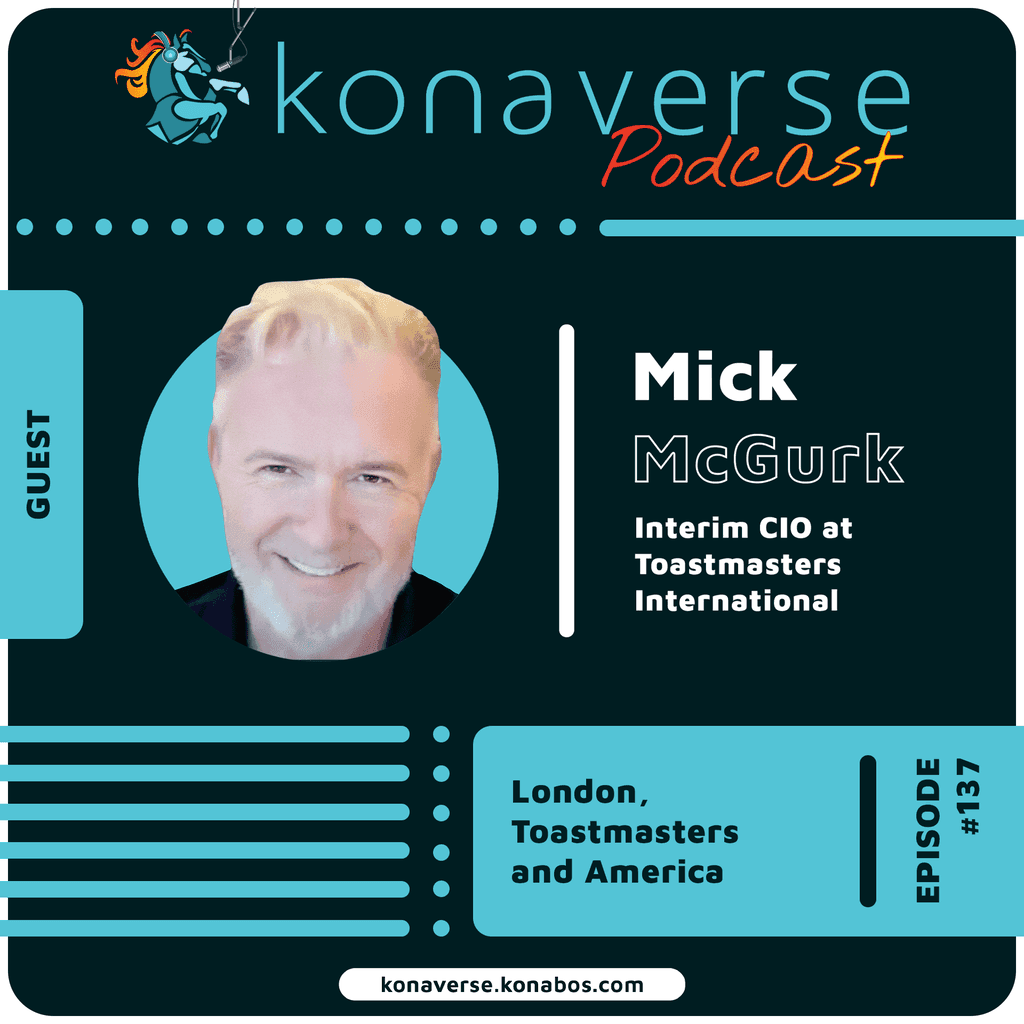
Mick McGurk on London, America, and Toastmasters
KonaverseMarch 26, 202401:07:1161.54 MB

Mick McGurk on London, America, and Toastmasters

Mick McGurk is Interim Chief Information Officer at Toastmasters International. In this episode, Mick discusses growing up in London, England, sports, photography, career, moving to America, Texas, leadership, technology, Toastmasters, and so much more!

[00:00:00] Welcome to Konaverse, a conversation experience platform.

[00:00:04] Hosted and curated by Konabos Consulting.

[00:00:06] Konabos is a global technology leader

[00:00:09] And while this podcast will be connected with technology

[00:00:12] The glue is human stories and narrative.

[00:00:14] Technology can bring us together

[00:00:17] It can make our lives better and more efficient in myriad ways

[00:00:20] But it cannot replace human discourse and the magic that can happen by the interchange of ideas.

[00:00:26] Hope you enjoy our podcast.

[00:00:30] Welcome to the Konabos, this is Akshisura.

[00:00:36] And this is Matt McQueenie.

[00:00:38] Today we have our good friend Mick or Rick depending on how you want to call it

[00:00:43] and we'll get to that story.

[00:00:45] Hey, Mick, welcome to the show.

[00:00:47] Well, nice to be here.

[00:00:49] Yes, thank you so much, Mick.

[00:00:51] So we like to go back to the beginning.

[00:00:53] You do have a British accent.

[00:00:55] I'm guessing you were born there.

[00:00:58] Where were you born?

[00:00:59] I was born in Paddington, London.

[00:01:04] And I grew up really kind of outside of the area.

[00:01:09] A place called Eastco, which is in the London suburbs.

[00:01:15] Up until the point I came to Texas, I lived there.

[00:01:18] I lived that area.

[00:01:20] But I grew up and I began my working local to there

[00:01:25] and then moved into the city of London.

[00:01:29] Did your parents do when you were growing up, Rick?

[00:01:32] Oh, I see.

[00:01:33] I called you Rick.

[00:01:34] You already slipped into it.

[00:01:36] See this is the problem that the pair of us have myself and Mr. Astley.

[00:01:41] So my mother was, she worked in, she was a shop worker

[00:01:45] and my dad had a number of jobs.

[00:01:48] So he was a milkman.

[00:01:51] He managed for various companies like Nestle and Walls

[00:01:56] and he was also a cab driver.

[00:01:58] So he did whatever, they did whatever to kind of put food on the table.

[00:02:03] We didn't grow up in a privileged environment.

[00:02:07] But they did whatever family at that time

[00:02:10] did which is to do their best.

[00:02:12] And that's what we can ask.

[00:02:14] Do you have siblings, Mick?

[00:02:16] I have an older brother and an younger sister.

[00:02:20] So they both are in England.

[00:02:25] My brother runs numerous companies.

[00:02:28] He's an IT guy.

[00:02:29] He runs blockchain companies and he also service providers.

[00:02:37] And then my sister, she's been a school administrator for the last, I don't know, 20 plus years.

[00:02:43] So yeah.

[00:02:45] So growing up, what were some of your interests?

[00:02:48] Where were your hobbies?

[00:02:49] Well, I'm like typical, Rick.

[00:02:53] I'm a keen sports fan.

[00:02:57] I played a lot of football, rugby, cricket, a box for a bit.

[00:03:02] So I did all of that sort of good stuff.

[00:03:04] And anybody who knows me knows that I'm a passionate Chelsea supporter.

[00:03:08] Good, better and different.

[00:03:10] Yeah, my dad took me to my first game when I was very, very small.

[00:03:15] So I've seen the good, the bad and the ugly with the team at the moment.

[00:03:20] So kind of a bit, it's a small thing into a bit of ugliness.

[00:03:23] But I won't change my allegiance.

[00:03:26] They are my team and I'll defend them just like well, anything else.

[00:03:33] It's amazing with English Premier League, obviously, how there's so many teams again in the

[00:03:37] London area, right?

[00:03:38] And then in some of the other cities, how do you, how does Chelsea become your team?

[00:03:42] And I've actually been to games there because growing up, my dad always likes to stay in Chelsea.

[00:03:49] I think he's there right now, actually for business on the water there.

[00:03:51] But what was it about Chelsea?

[00:03:54] Why was that team?

[00:03:55] My dad.

[00:03:56] My dad was a Chelsea supporter.

[00:04:00] So I mean, the closest team, London team to me growing up, proper growing up, but was

[00:04:06] really, I guess, lawford, which is, yeah, the stretching the part when you call it a

[00:04:11] London team because not really part of London.

[00:04:13] But my dad was a Chelsea supporter.

[00:04:16] My grandfather, in fact, was a full-on supporter.

[00:04:18] So if you know anything about the two teams, Chelsea is in full.

[00:04:24] It's not in Chelsea.

[00:04:27] But my grandfather, that was a full-on supporter.

[00:04:30] And my dad was a Chelsea supporter.

[00:04:32] So I just followed the like grew up with the glory days of the early 70s.

[00:04:39] Yeah, some fabulous players at that point.

[00:04:42] And does it?

[00:04:44] I was sold.

[00:04:46] And yeah, it's one of those things.

[00:04:49] It's tough for you to turn around and say, I'm moving to another team.

[00:04:55] You know what you would call unfair with the supporters.

[00:04:58] That's right.

[00:04:59] Yeah.

[00:05:00] Yeah, you mentioned quite a few sports there.

[00:05:03] Like, did you do that?

[00:05:05] Like, did you play those from school or?

[00:05:07] Yeah, yeah.

[00:05:08] So the English school system is somewhat different to the American school system.

[00:05:13] You know, the emphasis isn't on sports.

[00:05:15] Yeah, there's a huge emphasis in the US on sports.

[00:05:19] In the UK, there really isn't that emphasis.

[00:05:22] You played for your school team.

[00:05:23] You made play for local teams.

[00:05:26] And I did both.

[00:05:29] But that's where you and your mates got together.

[00:05:32] You played during school breaks and that type of thing.

[00:05:36] And we would play from first breakthrough to last break, again.

[00:05:41] You know, you would have your, yeah, yeah.

[00:05:46] Yeah, you'd have a morning break, 15 minutes, lunch break, which be, you know, an hour,

[00:05:50] 45 minutes to an hour and then an afternoon break another 50 minutes.

[00:05:54] And you play an entire game keeping score, keeping who's on on each side throughout

[00:06:01] that.

[00:06:02] So yeah, I played it.

[00:06:04] I enjoyed it.

[00:06:05] Yeah.

[00:06:06] Football is my passion as a, as a thing.

[00:06:11] Rugby is the game that I really enjoyed to play because you got to hit people for free.

[00:06:17] And it's made some, but there's a difference between playing football, mosaic or you guys

[00:06:25] call it soccer as opposed to, you know, playing rugby.

[00:06:30] Rugby is a much more of a team sport because you have to look out for it.

[00:06:35] And then you have to look out for the next player because you're likely, if you don't,

[00:06:37] you're going to get hit harder.

[00:06:39] So that's where I highlight and then yeah, cricket because it's a summer sport and we play

[00:06:47] cricket in England.

[00:06:50] You know, that boxed for a bit as well.

[00:06:53] And again, it came back to, I'm a red headed Jimmy.

[00:06:57] You can't see it today, but I'm a red headed Irishman by birth.

[00:07:04] So when the red head comes out, the fist come flying.

[00:07:07] So boxing was a way of managing that.

[00:07:11] I have two red heads under the age of 10.

[00:07:14] You know, you know, you know, you can see the touch, but it doesn't take long to go off,

[00:07:22] does it?

[00:07:23] No, it doesn't.

[00:07:24] So this might be a silly question, but did you watch Ted Lasso?

[00:07:28] I watched the first series and then watched the second series.

[00:07:31] Yeah.

[00:07:32] It's kind of interesting in that.

[00:07:34] I mean, look, it's fiction.

[00:07:35] It's a TV show, but I do feel like it showed the experience of Premier League in a way

[00:07:43] that was interesting, but it goes, it almost goes the opposite way of what you did, right?

[00:07:47] He was like a Midwestern coach going into, well, I guess it was Richmond there and then

[00:07:53] you're going from there into the Midwest.

[00:07:57] But did you, yeah, I mean, did you enjoy the show at all or I guess you didn't?

[00:08:01] No, it's a great show and great, great acting.

[00:08:07] I think it showed it was a break into for America of the absurdity of a sport.

[00:08:19] You had this guy had no experience of soccer.

[00:08:23] I mean, he came from American football and trying to adopt the American way in a sport

[00:08:32] which really has no stopping points other than when the ball goes out play in America

[00:08:37] or, of course, you know, it's place.

[00:08:39] It's much more structured.

[00:08:40] And whether I'd be watching American football since we were watching a redskins.

[00:08:48] So I loved watching, then this is when I was living in England watching the Super Bowl

[00:08:56] back then because there was a sense of commonality between rugby.

[00:09:01] Yeah, players hit hard, intake prisoners and it's the same thing with rugby.

[00:09:06] It's got a little bit more soft now.

[00:09:07] And rightly so because there's this player safety that has to come into it.

[00:09:13] But there was a one player on the Washington Redskins team.

[00:09:15] I think his name is John Riggs or Regans.

[00:09:18] The hit and I knocked off, he could play rugby.

[00:09:21] Now there's not many American football players that I would say could play rugby.

[00:09:26] And it's not because they're physically there on Abel because they're big guys but it's

[00:09:30] the speed of the game and it's the time that you spend on the field.

[00:09:35] Yeah, there isn't.

[00:09:36] Oh, we stop now, walk off, get some oxygen and come back because I was saying to the other

[00:09:41] day.

[00:09:42] It's really nice that America has a sport that people with breathing problems can play

[00:09:49] because every time they have to go off and get oxygen.

[00:09:52] Yeah, it's just again, it's just a brick taking the making the fun out of an American

[00:09:58] sport.

[00:09:59] Just as Americans make fun out of a bridge sports.

[00:10:02] Yeah, that's there is.

[00:10:05] Did you ever get in San Antonio now?

[00:10:08] And we'll get there and I think that's where you've been.

[00:10:11] Did you ever get into the one protein there being the spurs because when they were in

[00:10:17] their heyday, they kind of plead almost like a soccer version of basketball?

[00:10:22] Yeah, not really the spurs.

[00:10:24] So I spent 17 years in Houston so the rockets were my team and I went to a few days and it

[00:10:33] was quite funny.

[00:10:34] Again, there's a difference between even watching sport in America versus watching sport

[00:10:43] in England because certainly the nature of football versus basketball.

[00:10:49] So if you miss someone scoring in basketball, they're going to score again.

[00:10:54] If you miss someone scoring a goal in football, they may not score.

[00:11:02] Yeah, footballer remainder of the match.

[00:11:04] So you don't get up and go whereas what I found especially when I first came over, we're

[00:11:11] all these people leaving.

[00:11:12] They weren't going to get food or again a rest frame or whatever.

[00:11:16] The first time I went to watch the rockets play, I've been given tickets.

[00:11:21] And there were these two ladies in front and they were crocheting.

[00:11:27] And I'm like, what's all that about?

[00:11:33] I'm thinking are the guys on the field getting on the court getting cold and they're quickly

[00:11:41] rushing up some sweaters for them or something.

[00:11:44] It just seemed so observed that you're going to a sport, you're going to watch the sport

[00:11:51] be part of that sport and there you are crocheting or knitting.

[00:11:58] So that took me an age to get used to the fact that in America people go off and they'll

[00:12:11] go and buy something in the shop there whilst the game's going on.

[00:12:17] In England, you don't even do that for cricket.

[00:12:21] Now if you don't have much about cricket but a test match has played over five days and

[00:12:29] at the end of that five days there may not even be a winner.

[00:12:35] And so it's really five days of drinking.

[00:12:40] So people don't tend to get up and go off and come back half an hour later.

[00:12:44] They sit there, drinkers sit there.

[00:12:47] That type of thing.

[00:12:48] They're the same one person off to get eight points and come back but it's a different

[00:12:55] mentality really is.

[00:12:57] And I've noticed that in football, baseball and basketball, the ability for people to

[00:13:08] get up and go.

[00:13:09] We just had the Super Bowl which is really good but again, did you see the half time show?

[00:13:19] In England, the half time show is you get to the bar, you get some more drink and then

[00:13:25] you've got 15 minutes between.

[00:13:29] You're not there again.

[00:13:30] I wonder who's playing at the half time show.

[00:13:34] The FA Cup Final or the World Cup Final is not about half time, it's about sport.

[00:13:39] So that's one of the things and I think is commercialism.

[00:13:42] That's part of the deal here.

[00:13:45] You have to have commercial breaks every X number of minutes to pay for it.

[00:13:50] And this guy's getting paid big salaries so you have to be able to pay for it.

[00:13:54] The only way to do that is through a commercial endeavor.

[00:13:58] So it's different.

[00:13:59] It's just different concept.

[00:14:01] That's not to pass your mark this ball because I love America's ball.

[00:14:05] It's more bashing the supporters.

[00:14:08] No, no, totally get it.

[00:14:12] So coming all the way back because we went into the future we're supposed to be asked.

[00:14:17] So growing up what did you want to be?

[00:14:19] Make like what was your career inspiration as a model?

[00:14:22] I wanted to be a photographer.

[00:14:25] That's what I wanted to be.

[00:14:27] I had a keen interest in photography.

[00:14:30] I used to go up to London, go to galleries and I was like keen interested in the photography

[00:14:40] of the 60s which wasn't too far from me as far as an age goes.

[00:14:46] And then I grew up through school really through that punk era of anti-establishment,

[00:14:55] anti-government and all of that sort of good stuff.

[00:14:59] So it was a much more free form.

[00:15:01] It was a big change from the 60s, was a change, the 70s, early 70s, was a change but

[00:15:09] there was a melting pot which turned into that punk era.

[00:15:12] So I grew up in there although I was never a punk myself.

[00:15:17] I was actually a little bit too young for that.

[00:15:19] My brother, he was about 19 months old on me.

[00:15:23] He was more into that than I was.

[00:15:25] It was that whole anti-establishment.

[00:15:27] And so I liked taking photographs, not of like, that was a naturalist, but of people,

[00:15:36] the way people interact.

[00:15:38] But it was an expensive hobby because you had to get into things developed.

[00:15:46] So I was a kid.

[00:15:47] I had to build my first SLR camera via catalogue.

[00:15:54] And so I paid pound every month for whatever long and it was a zenith camera.

[00:16:02] And I took it wherever I went.

[00:16:05] And I went to later on, certainly in my early 20s when I went abroad, always have my camera

[00:16:10] with me, always took photographs and I bought obviously different cameras.

[00:16:14] I traveled around Australia and would take photographs with my mates.

[00:16:21] So that was kind of my keen interest.

[00:16:23] I fell into it because I think that's probably what you're getting to,

[00:16:27] because I've been in IT Neo4 approaching, well, actually not approaching four decades.

[00:16:34] So the one thing that people don't realize, I've been here in the States for 26 years.

[00:16:41] I don't have a degree.

[00:16:43] Yeah, I've been doing what I've been doing and progressively moving forward.

[00:16:52] And it's all experienced there.

[00:16:54] So I fell into IT in a very simple way.

[00:17:00] I worked for a market research company in the UK called Audits of Great Britain.

[00:17:06] They were kind of the European version of Nielsen.

[00:17:09] And I actually, that day were in my hometown of East Goh.

[00:17:15] And my brother worked there and I left school.

[00:17:19] Really didn't know what wanted to do was I'm going to go to college or not go to college.

[00:17:22] Again, in the UK, less than 1% went to college at that time.

[00:17:29] Because you need to figure out how to do some work.

[00:17:35] The most universities were very, very restrictive about who got in.

[00:17:42] And so my thought was I need to go and work, go and help my family.

[00:17:48] So the eye wasn't a burden.

[00:17:51] And that's what I did.

[00:17:52] So I went and I was what was known as a messengers statistician.

[00:17:57] So I did two things for this company.

[00:17:59] I did statistical analysis for them.

[00:18:01] And I was a messenger.

[00:18:02] So it predates email.

[00:18:05] And what that was is that a letter would be typed up or a member would be typed up,

[00:18:10] if you put it in a brown envelope and they would be written down and you carry it off to that

[00:18:15] above. So that was my first job and I did that for about 18 months.

[00:18:22] And there was a job that went in the computer room as a computer operator.

[00:18:29] I didn't know what it was about.

[00:18:31] I didn't know anything.

[00:18:32] All I knew was that I paid four times as much as I was making being a statistician.

[00:18:39] Oh my goodness.

[00:18:41] And so I was very good at math.

[00:18:43] And so when someone says you're going to have four times as much just by changing job,

[00:18:47] I went, yep, that would do me.

[00:18:49] Got interviewed, went in there.

[00:18:51] And this was the time of paper tape, card readers and real to real tape.

[00:19:01] So that's what I did.

[00:19:03] I mean, we would, people go, oh yeah, how much memory?

[00:19:08] Well, we were taught memory.

[00:19:11] I worked on, for anybody who would remember,

[00:19:15] I worked on a deck and prime machines.

[00:19:18] So these were mini computers.

[00:19:20] So you had your main frames in the minis and I worked on the miniside.

[00:19:26] And to change drive, to a disk out of the drive, it was like pop-i.

[00:19:32] You had one arm that you'd lift the whole thing out and it was all platters.

[00:19:39] And you'd have to spin the disk, lift it out and you could,

[00:19:43] a pop-i arm because you generally used the dominant arm, which for me would be my right arm.

[00:19:48] And it will get bigger because some of the platters were quite heavy and you'd be moving those

[00:19:53] in and out. So that was my first foray into computing.

[00:19:58] This is not being boastful. I found it simple. I found it easy.

[00:20:02] Yeah, I've never found IT to be complex.

[00:20:07] I found people to be complex but not IT.

[00:20:09] Now, I'm going to be a pop psychologist a little bit.

[00:20:14] Not of you but just in general, do you think that your kind of keen interest in photography

[00:20:22] ties to that a little bit where you're talking about people you talked about in,

[00:20:28] that was an important thing to you to almost document what people are doing.

[00:20:31] And then in some ways you do have a technical understanding of things when you're

[00:20:37] working with a camera especially in those times. Do you think that that helped you have this kind

[00:20:43] of personality for tech? Well, I think the problem with technology is that we tend to ask

[00:20:50] those people who have a friend of mine told me once. He went to work in Saudi Arabia.

[00:20:58] He's an IT guy as well and he told me that over there, this is back in the late 80s.

[00:21:07] When you go off the plane, you get two buckets. One is for the money you're going to get and

[00:21:14] one is for the crap you're going to take. And it's the same in technology.

[00:21:19] When you're dealing with technology, you tend when you first start out with a very big,

[00:21:24] you know, you start feeling that a bucket of technology.

[00:21:28] You fill that bucket up with everything you've learned from a technology standpoint.

[00:21:34] Then as you move to more sort of like supervision or management, you get a second bucket.

[00:21:38] And now that's filling up with more of your knowledge about people and how to deal with them.

[00:21:44] But you can only balance the level of one bucket. So the more you're doing management,

[00:21:50] the less you're doing technology. So I'm a very observant person as far as people go.

[00:21:59] And I should probably what stood me in good stead all of these years.

[00:22:03] I can read people very, very well. I can do the technology. As I said, you as an individual

[00:22:11] can make technology very, very complex. But if you break it down, it's still zero than one.

[00:22:18] When you break everything down, it's still zero. And once what you have to do is to be able to

[00:22:23] develop relationships with people, you know, used to do that with my photography

[00:22:28] by looking at people. Because you know, you could have five images. But there's only one good one.

[00:22:37] Yeah, because you're looking at the expression on someone's face, you're looking at the background,

[00:22:41] you're looking at all of these different aspects. And from that, what you do is you say,

[00:22:47] okay, that's my best picture. And it's the same with people. I've managed to people around the world

[00:22:53] for the last 20 plus years. And you can, you're not managing the technology, you're managing the

[00:23:02] people who manage the technology and you're growing them, you're coaching them, you're getting

[00:23:07] them to the next level. So anybody that comes on this, oh, this is really complex. No. In your mind,

[00:23:13] it's complex because you want it to be complex because you don't want to explain it.

[00:23:17] Yeah.

[00:23:18] Now, if you, it's very easy to explain anything to anyone, if you avoid the, the strict terms of

[00:23:30] how Sonic is constructed, if you break it down into its constituent path, it's very easy to

[00:23:35] understand. You know, I've done a number of ERP implementations, probably the most complex things

[00:23:41] you can do, you know, because it touches so many different facets of a business.

[00:23:47] But when you break it down, it's just process into a system that knocks out another process.

[00:23:55] Break it down. Don't, don't, don't, you know, it's like AI at the moment. Every's like crazy about AI.

[00:24:04] But again, it's relatively simple. There's an input, there's an output. The quality of the

[00:24:10] information going in gives you a quality of information going in. So all of that, as I said,

[00:24:17] you know, I've been doing this for or decades now. That wouldn't have been doing this for four

[00:24:22] decades if, um, if I had to rely on a degree. Yeah. If, if, if, if I walked into any business and

[00:24:32] said, hey, here's my degree, trust me. And I couldn't do the job. All I've got is a piece of

[00:24:40] paper I've had people with masters degrees reporting to me that, you know, to be honest,

[00:24:45] couldn't tie the shoelaces together. And you'd have to coach them. Well, get away from your,

[00:24:51] your what you've learned in school and learn what the real world's asking for. Yeah. Lean on it.

[00:24:58] But don't use it as the as you main crutch. So it's interesting. My, my, my philosophy and my,

[00:25:07] my, my experiences have moved me from being a technologist to being a, a, a, a humanist. It's like

[00:25:17] the people are the most important part of the equation. Not the technology that you're using.

[00:25:23] Technology really is, yeah. As you know, yeah, guys, I mean, how many different

[00:25:29] web, you know, digital products to you guys support. Yeah. All right. In the day, they're interchangeable.

[00:25:38] Yeah. Most of them use the same, same stack. It's what the flavor that the customer wants to use.

[00:25:46] Yeah. Your job is to break it down and make it easily understood by senior leaderships who,

[00:25:54] again, have possibly just like me moved away from being a technologist to being a manager of some sort.

[00:26:00] So that bucket of technology is much lower than it once was. So you have to be able to explain it in

[00:26:07] in a way that they can easily digest it, understand it and move away from pure technology as the driver.

[00:26:16] Technology isn't the driver. You know, technology is just something that helps you get where you want

[00:26:22] to be. You never felt any kind of disadvantage by not having a degree or at any point, did you think,

[00:26:32] should I go get it because if I want to? Yeah. I mean, there has been several occasions where

[00:26:40] I've been, I thought, yeah, maybe I should go ahead and do that. Interestingly enough,

[00:26:49] I had to leave the US for six months, not through anything I wanted to do is the fact that

[00:26:56] hey, from a legal perspective, the attorneys that were doing my visa at the time screwed up.

[00:27:05] So I'm very nice, a little short sharp. Hey, you've easily screwed up and we need to send you back

[00:27:13] to England. Yeah, there could have been worse places I could have gone. So in order to get me back

[00:27:19] to the US, the company that I worked for at this time with really good company, good aim,

[00:27:24] aim fund, same investments, they commissioned a study of me up to the point from a professor at MIT.

[00:27:35] I didn't even know they were doing this. Yeah, I just got asked some questions and that study

[00:27:46] from MIT, he basically came back and said, based upon my experience, my knowledge, but I don't know

[00:27:53] the rest of it, this is where I would be in the world of academia. And I was like, oh, great, fantastic.

[00:28:03] Could you just turn that into a degree? And I wanted to do the work.

[00:28:08] I did a project at four aim investments at the university of Houston. There's a place called

[00:28:16] the Bowschool of Business, which is named after Ted Bauer, the founder of Aim Investments.

[00:28:22] And I did all along with the rest of my team, the build out and negotiations were company

[00:28:29] IBM and Royters and so on. To get them what they needed, they came back at one point and said,

[00:28:35] hey, look, we'd like to give you an honorary degree. I was like, whatever, yeah, I'm not fixated

[00:28:43] on paper. You know, I'm really, yeah, I'm not fixated on a piece of paper that tells me

[00:28:53] that I'm intelligent on them. I'm really not that fixated. And my first company that I mentioned

[00:29:00] AGB, they sent me off to do an IQ test, yeah? And I was like, okay, and my IQ was 142.

[00:29:11] I didn't even know what I meant because I wasn't, you know, it's not something again that I'm,

[00:29:18] I can turn around and go, wow. Yeah, look at me. I've got friends who have got degrees

[00:29:27] and lots of degrees that haven't had a job.

[00:29:33] What is that to you? Yeah, if you don't use it and apply it correctly, I've got friends that

[00:29:39] have got degrees in a particular subject that they spent four or five years getting.

[00:29:44] And don't do anything with that education, they've gone off and done something else.

[00:29:50] Yeah, I fell into IT as I mentioned by happens chance. And I found out that I was actually very good at it

[00:29:59] and I didn't, I'll be honest, I didn't have to work here. Now I don't, I mean,

[00:30:05] I mean,

[00:30:09] yeah, technology wise here. I know what's going on. I keep myself abreast of what's going on.

[00:30:13] You know, speaking with you guys, you know, I will take on any,

[00:30:19] anything that I'm asked to do and I'll give it my 100%.

[00:30:26] And it's easy to kind of go, I've not no experience of that.

[00:30:32] Yeah, I've worked in pretty much all facets of work. I've worked for the 16 years and finance

[00:30:44] in the UK working for whether it's a broken house or retail banking. Yeah, I built out

[00:30:54] trading floors and those are some of the hardest environments to work in, especially in broken

[00:31:01] houses. People don't like you. I've worked in construction, I've worked in green energy,

[00:31:07] I've worked in medical, I've worked in oil and gas, I've worked in manufacturing.

[00:31:14] And every time I've heard the same thing, oh, you don't have experience of.

[00:31:20] So we're talking about IT here. IT doesn't make a shoe.

[00:31:29] All it does is helps along the way. We're recording things.

[00:31:35] And so anybody that turns around says, oh, you don't have experience of end?

[00:31:42] I have a blog experience of IT.

[00:31:44] You tell me one server looks different to another server in a different organization. Your

[00:31:52] processes may be different, your culture may be different. But if you go from one oil and gas

[00:31:58] company to another oil and gas company, guess what? The culture, the services, the way they do

[00:32:06] things is completely different. You go to, I worked in US oncology and that was IOP.

[00:32:19] Because the first thing one of the first things they did is they sent you to an oncology hospital.

[00:32:26] One under their umbrella. And you got to see the result of your work.

[00:32:33] Because you never see that, IT. It's rare that you kind of touch and feel the end result.

[00:32:40] But when you go into place like an oncology department where people are

[00:32:46] are reliant on doctors and nurses and medications to live, what I do or what I did for their

[00:32:57] matters, but it never puts substance to it. Whereas if you're just sitting there in a dark

[00:33:06] and room coding away and you've never seen that, you've got no idea of how important what

[00:33:14] what IT does these days is it connects everything. So that human touch again is really important.

[00:33:22] And IT has a problem. It's had a problem for the longest about that human element.

[00:33:33] Always been able to read people very, very quickly.

[00:33:39] Man, it's one of the things that's probably helped me along the way is being able to understand

[00:33:44] when I go into a room what each person's personality will deal with. As I said, 40 years in IT,

[00:33:55] working in City of London, working in the US. In the City of London, I don't know if you guys

[00:34:03] have got any experience of that. It could be a real tough environment. I've been called every name

[00:34:08] under the sun. My sexuality has been called into question. It's very simple. I'm

[00:34:16] marrying him straight on it doesn't matter what your sexuality is, but all of that I've been punched,

[00:34:22] I've been kicked, I've been smatter, I've had computers thrown at me, people thrown at me,

[00:34:29] it doesn't matter. I've had fights on training plots, but I'm able to read people

[00:34:39] from there. I've got a thick skin so if you call me something, I don't care. Call me what

[00:34:44] you like. It's not a problem. I don't have the problem. And what that means is that when I go into

[00:34:51] a room, because I can pretty much read person's personality, I can nail empathize with that person

[00:34:58] personality. I know how to deliver to that room what people need and how they need to understand it.

[00:35:08] So if I go into a room where it's technical people, I can deliver in a technical way. If I go

[00:35:15] into a room where it's senior leadership, so they're not technical and then from different facets

[00:35:21] or other business I can deliver that. And that's something that not a lot of people can do is

[00:35:30] because they tend to get hung up on the technology rather than what the impact of that technology is.

[00:35:39] Yeah, Mick, what brought you, you said you've been here 26 years in the US. What brought you here?

[00:35:48] Was it a tough decision or it sounds like you really wanted to come?

[00:35:53] My stock answer and I've used this one for the last 26 years when anybody says what brought me to

[00:35:58] America, I will always say a plane. It's a big thing with wings. You can see him up in the sky

[00:36:03] for most of the time. That's got discounts and very nice jewelry stores.

[00:36:13] The truth of the matter is that my wife and I have been married for about a year,

[00:36:17] been together for a lot longer than that. And we just had our daughter.

[00:36:23] I was at home on paternity leave and in my daughter was born at the end of December. So in England,

[00:36:34] wet, cold, miserable. My wife said get out and just go up the right side. I won't go over

[00:36:43] and I bought a trade magazine computer weekly. Thumbin' through it,

[00:36:48] yeah, I bought her some magazines, stung through it. And there was a full page of diverts

[00:36:54] in there which said how would you like to work? And now I'm from the Gulf of Mexico

[00:37:01] an hour and a half to the Caribbean. And there was this beautiful white sandy beach with a parasol in

[00:37:07] it. And beautiful blue sea blue sky, but one little fluffy cloud. I think I've still got it somewhere.

[00:37:17] And I was reading through and I was in the finance side of things and I read,

[00:37:21] I said well there's much up there. And we sat and talked and we said let's give it a bash.

[00:37:30] So I'll ring them up. I wasn't the only one. So the reason for coming over was to say why too

[00:37:37] get if you remember. Everybody was freaking out that everything would die. And this particular

[00:37:44] company is saying, and investments. We're looking for people. They couldn't get people from the

[00:37:50] other traditional US bases for the finance New York Boston Chicago. So I didn't know where Houston was.

[00:38:00] I knew it was in Texas. Never came out here. We arrived early May. My daughter was four months old.

[00:38:11] We brought our dog with us. We were intending to stay a couple of years.

[00:38:18] Screwed that up 26 years later. But the thing is that particular company was my first

[00:38:25] experience of an American company. I'd worked for Japanese companies before and I'd worked for

[00:38:31] European companies before. It was my first real experience of an American company. And it was quite

[00:38:36] an eye-opener. Within that first week, I got sent to the Tukbao's office. His Bloomberg machine was

[00:38:50] probably wasn't working. Whatever reason. So I go up there, this fresh off the boat brick.

[00:38:58] And I saw as you secured the system and I said, hey my name is Mick. I'm here from the

[00:39:07] market data team. I understand Mr. Bair has a problem. She said, hold on a second, let me go

[00:39:15] and see if he's available. So she went in there. She came out because yep, he's available before

[00:39:20] to go in. So I'm going into the top top man. A little bit nervous because the experience of London,

[00:39:27] top top people, they treat you like crap. You're the dirt on the bottom of their shoe.

[00:39:34] So I'm expecting that. So I go in there. This very tall man stands up. Now I'm just

[00:39:40] driving six foot. He's like six four, six five. Very stately looking gentleman. And I walked in

[00:39:48] and he put his hand out and he said, welcome Mick. I'm like, what's going on here?

[00:39:55] He said, I said, well I understand you've got a problem with Bloomberg. We said yes. So

[00:40:01] most of the garbage, most of the gear is underneath the desk. I go, he pulls his chair back

[00:40:07] and he offers me his chair. Now in London, that would never happen. You would have to jump under

[00:40:16] the desk, big kick to know the rest of it whilst they get trying to get him with other things.

[00:40:20] He's given her. Then he says to me, he says, do you drink coffee? Nothing. It always is a trick question

[00:40:26] on British. So he's drinking on a tea drink. I said, no, I actually do drink coffee. He said,

[00:40:32] how do you take it? I said, I'd take it with milk and sugar. And he kind of looked at me and

[00:40:39] I went, oh yeah, it's a cream over here, isn't it? You call it cream. We call it milk, whatever.

[00:40:44] And then I'm expecting him to say, I take mine this way and for me to go off and get it. No,

[00:40:50] he goes off, grabs two cups of coffee, sits down and he's soaked for there. I'm fixing his equipment.

[00:40:58] And he goes, so how is Helen? Which is my wife's name. How is she adjusting?

[00:41:06] And I'm like, what's going on here? This is, you know, with 15, 1800 people. I'm a nobody.

[00:41:12] But he knows he knew my wife's name. He tried to know my daughter's name and

[00:41:19] screwed her up because her name is Shavorn. So he tried to say it phonetically. So I bought

[00:41:24] no work. He knew a lot about us and we weren't the only bricks that come over at that point.

[00:41:32] There were a number of us about 10 of us that come over. And he was interested in me. It was

[00:41:40] interesting in making sure that we got what we needed and we were comfortable and all of that.

[00:41:46] And that was my first experience of someone. And there were two other co-founders,

[00:41:53] the gentleman called Bob Graham and Gary Cron, exactly the same type of personality.

[00:41:59] They were interested in you. And that changed my whole just working with them. And then I had

[00:42:06] a CTO who's certainly no longer with us John Dean. Brilliant man. Brilliant man. Again,

[00:42:14] someone who could articulate technology was more interested in you as a person.

[00:42:21] Because he knew that if you were getting what you needed, whether a person or technical,

[00:42:28] you're going to be happy. And I took that and I've taken that as my philosophy.

[00:42:35] Yeah, I could be the greatest technologist in the world. But if I got no

[00:42:42] responsibility for people and how they are and my interactions with people,

[00:42:48] then I've got nothing. And so for me over the last 20-plus years,

[00:42:53] yeah, whilst when I was moving up in IT and the UK it was a very selfish thing.

[00:42:59] I wanted the next position because there got me more money and that's what a good start.

[00:43:03] Now it's around coaching mentoring. It's around making sure that the strategies that

[00:43:09] arrive for the company and what we're building is a cohesive team. I'm not saying I've never had

[00:43:17] anybody leave me, but I've had people follow me to other companies. And it's because I tried

[00:43:27] to treat people well. Now, what I also tried to do is have a laugh with them. So only will give

[00:43:33] people nicknames. It's never in, you know, to be hurtful or anything. But I'll pick up on things

[00:43:41] as a soundfellial, you know, all observed things. I've had people, I gave one person

[00:43:48] and they named Dory. If you ever seen the film, yeah, we'd be in a meeting and it would come around

[00:43:57] the room and we'd discuss it and she'd go and ask the same question again. And she'd do it two or

[00:44:04] three times. I had another girl that I called Ripman Winkle because she would yorn in meetings.

[00:44:11] And it wasn't, you know, to have a go at them. And hey, I got given nicknames. And that's when I

[00:44:16] always know that I've succeeded is when people give me the same level of respect that I give them,

[00:44:23] which is have fun, have fun at work. You mean we spend eight to 10 hours a day working with people

[00:44:31] that we should like and we should enjoy their company because you're going to get more out of them

[00:44:39] that way. Yeah, if you're going in every time and it's conflict, conflict, conflict, you're not going

[00:44:45] to do your best work. You're not going to be wanting to be there. Yeah, if you wake up in the morning

[00:44:49] and you go really on another job, there are better jobs down there. So for me, it's, you know,

[00:44:59] I learned that from those three three three gentlemen who write the top and a CTO who I admired

[00:45:09] amazingly amazing people. And that really stood me instead, yeah, over the time. And has allowed

[00:45:17] me to progress because if I, if I, if all I relied on was my technical achievements,

[00:45:26] yeah, I wouldn't have been CIO and head of IT for various companies. And to be able to manage people

[00:45:38] with a human touch, I think it's really important. And again, in this day and age,

[00:45:44] you know, if you look at bottom lines and that's all you're interested in, you're going to lose that,

[00:45:47] you're going to lose all of that experience. So Mick, I don't know if you remember again,

[00:45:55] I'm going to go back and you guys are going forward. But do you remember how you felt

[00:46:02] what happened for your first ever job that you applied to? Well, my first ever job was at IGB.

[00:46:10] So my first ever job was the job I got. Now, I worked some stuff, yeah, it's very school

[00:46:15] and stuff, you know, well, how you worked in supermarkets, you know, grocery stores. But yeah,

[00:46:20] I went in for the interview at IGB and by the time I got home, I got the job. Strangely enough,

[00:46:31] or interestingly enough, at the time there was a film being made up to Pinewood Studios called

[00:46:38] The Wall, Pink Floyd. And I'd gone up to, because I wasn't working and just left school

[00:46:48] and I wasn't working. And they were looking for extras. So I went up to the job center up

[00:46:58] at Oxbridge and it just so happened that they were casting for extras on Pink Floyd's The Wall.

[00:47:07] So there's these crowd scenes with skinheads and all I have here.

[00:47:13] So I got cast for Pink Floyd's The Wall. And I came home and I told everybody,

[00:47:21] that my grandmother was telling everybody that, you know, Michael's going to be in a film. He's

[00:47:27] going to be in a film, you know, she says, good Irish later that she was. And then I go and I get this

[00:47:36] having interview at IGB and I get this job, well the problem was they were starting on the same day.

[00:47:42] So I had a choice. I could either go to Pink Floyd and have three or four days worth of work.

[00:47:50] And it wasn't that time when you could tell an employer, oh I'll join in a week's time.

[00:47:55] Or not. And my mother said to me, you'd need to take the job and not worry about being on a film.

[00:48:02] So it's one of life's regrets, I guess. Not that I would have been a star or anything but just

[00:48:09] who have said, yeah, I was in that film. So that was kind of interesting. But it was my first days

[00:48:18] of going in there. Yeah, I was just just typical young man going into a corporate environment,

[00:48:26] nervous not knowing anybody. I was a very, very shy person back then. Not so much now. I think

[00:48:33] they got beat and helped me working in the city of London. But I was a very shy person. I would go

[00:48:37] bright red at the first strap of a hat. Now I couldn't talk to girls and all that sort of good stuff.

[00:48:41] Yeah. Since then, the Blanney Stone hit me in many ways and I've tried to keep them a match up.

[00:48:51] But yeah that was it. I was nervous. How people are going to see me,

[00:48:59] take to me all of that sort of good stuff. So, Mick, we've met you at the point when you

[00:49:08] are at Toastmasters. So, what's the connection, the logical jump that I think you moved also to

[00:49:19] San Antonio from Houston and then we know Toastmasters is in Colorado. How did that happen?

[00:49:28] Were you a member with Toastmasters or how did that happen? I had been a member very briefly,

[00:49:32] but I had nothing to do with this. So, I'd worked for a company called San Antonio

[00:49:39] Schoo. Now I was the head of IT there. And like most of that level of position,

[00:49:47] you know, there's almost a natural time when you leave or you're asked to leave because

[00:49:54] you've gone through what you need and need to do. So, I was looking around and Gardner.

[00:50:03] So, if you know Gardner, they approached me. Let me know that there was an organization called

[00:50:14] Toastmasters which you'll see I knew in Denver that needed some assistance. Primarily it

[00:50:23] was to help them fix their ERP implementation. So, Toastmasters had been trying to implement or

[00:50:34] replace their legacy systems with Dynamics, Microsoft Dynamics, FNO and the CE for about four or

[00:50:43] five years. They've gone through a number of implementation partners and so on.

[00:50:48] So, I met with the then CIO and the senior people. And I've recognised as again,

[00:51:00] as I've said, I'm a fairly good read of people. So, it was on a call like this.

[00:51:06] I'm being interviewed Gardner on the call as well. And I've recognised that the problem wasn't

[00:51:14] to the implementation of the ERP, the problem with the people. And that's not to say that they're

[00:51:20] not good people because everybody is a good person. It's just the way that they worked together

[00:51:25] wasn't conducive for a positive outcome. So, I got brought in to do one or two things. One was to

[00:51:36] fix the project. The project was going nowhere, it was a mess. And the other was to try and

[00:51:44] steady the ship within IT. So, we had there are a few tough decisions to be made that had to be made.

[00:51:53] And so I would meet with the then, well, the then the CIO and discuss some of the issues around

[00:52:02] the staffing. It's a small group of individuals and that's important to know because when you've

[00:52:07] got a small group, you have to work together collectively because otherwise you're pulling yourself

[00:52:10] a button. They were pulling themselves apart. People were leaving their turnovers, was

[00:52:17] kind of bordering on chaotic. So, unfortunately the decisions were made to

[00:52:27] remove the then CIO in a few other people. And I was asked to then be the interim CIO.

[00:52:36] I was asked to be the CIO. But it was contingent on me moving to Denver.

[00:52:50] I didn't want to move to Denver. I like it here in San Antonio. So, what I did is look,

[00:52:57] I'm happy to stay on this interim CIO whilst we look for someone. So, I,

[00:53:02] you know, along with a couple of other junior people, found a very good person for the role

[00:53:15] who I consider a friend now. And one of the things that I do is when I interview someone,

[00:53:23] what I'm looking for is someone that I can work with, whether they're building beneath me in

[00:53:30] the structure or above me. Because I like to have fun as I've mentioned before and I have liked

[00:53:38] make sure that we work together, you know, cohesively to get things done. So, we hired a very,

[00:53:48] very good person. And I expected to be a role of the project at the end of that year.

[00:53:58] The CIO and the new CIO actually came to me and said, look, would you consider staying on?

[00:54:04] I suggest because I enjoyed the people that I've kind of been able to get the shit back moving

[00:54:11] in the right direction and people working together and kind of getting them to a point of being

[00:54:15] happy to come in to the office. I said, yeah, I'm fine with that. So they actually created a role.

[00:54:25] So my role was senior director for enterprise application project management and whatever else

[00:54:30] was thrown at me. But again, I'm not fixated on titles. I'm more interested in the work and

[00:54:38] making sure that those people who are smarter than me and below me in the structure are getting

[00:54:45] what they need. Because if they're getting what they need, I'm getting what I need. It's a fairly

[00:54:50] simple equation. If I take the burden of things coming down, complaints on my shoulders to allow

[00:54:59] them to be successful. So that's what I do. So I've been just over two and a bit years

[00:55:07] in that role. And it's fluctuated. I've got digital products today, which is obviously where

[00:55:14] you and I met on the digital product side. But it's a good group of people. They're working

[00:55:22] well together. Use your typical too much work, not enough people. Too much work, not enough budget.

[00:55:31] Because you can fix everything with either. But you can't fix everything if you've got

[00:55:37] nothing. If you've got a deficit in one. So that's where we are now. And as I said,

[00:55:43] I'll be leaving toastmasters in about six weeks time. And it's not through choice. It's just

[00:55:50] because they would like this role as they move more back into the office from the COVID is

[00:56:00] into in to Denver. And again, my family here, my wife has a job here, my daughter has a little

[00:56:10] business. She's she's she's graduating as an extitition. She's running a little spot here. So it would be

[00:56:18] the duty service to them for that. And I've also proved that you don't need

[00:56:24] to be in a particular space to be affected. And I fly up to Denver and do work and

[00:56:32] be able to people so you don't need to be I don't need to be next to you working.

[00:56:38] Pat me on the back, I can pat you back virtually. Yeah.

[00:56:44] What's next for Mick? What's next for me? So obviously, you know, I got about six more weeks that

[00:56:51] I've been at toastmasters and I'm doing a couple of things. So obviously, I'm out there

[00:56:59] and I'm back talking to Garner about you know, potentially doing this stuff with them. And we'll

[00:57:05] see whether that happens. But I've also I've been in the Microsoft Dynamics space now for about seven

[00:57:12] years managing, you know, implementation, managing the data to the operation services. And it's

[00:57:20] a good environment to be in. If you don't know about Microsoft Dynamics is it kind of morphed

[00:57:27] from one product, which is called Exapter that Microsoft bought, which is which is a true ERP.

[00:57:32] It's now morphed into a platform of services around, you know, the Dynamics 365 logo label.

[00:57:42] And you've got marketing, you've got sales, you've got field service, you've got all of these

[00:57:46] different things underneath it. But again, the same principle applies. So the other thing that I'm

[00:57:52] actively doing and I'll be launching hopefully within the next couple of weeks is a Microsoft Dynamics

[00:57:58] practice. I've got a couple of companies that I will be working with and supporting

[00:58:05] who have resources that are going to be made available to me. One of the big things that I've noted

[00:58:14] around ERP implementations and anybody that's been around ERP implementations have heard of the

[00:58:22] horror stories of ERP, you know, the spending of hundreds of millions, billions in certain circumstances

[00:58:30] on ERP. But what I did as I did and I kind of did an analysis of why. Why the ERP style,

[00:58:40] you know, why there's implementations about. So I want to take a slightly different approach because

[00:58:44] of the big organizations tend to take that similar sort of leave it with us and we'll do it for you.

[00:58:53] Problem is is that what ends up happening is the organization gets that flavor, not the flavor

[00:59:01] that they need. So I'm taking a slightly different more holistic view of need to understand

[00:59:08] what it is you do. So there are a number of things that there are mistakes which are

[00:59:16] we repeat the yields of the past so we look at the systems that we currently use the legacy

[00:59:20] systems and say I really like that legacy system. I want that legacy system to be reflected in the

[00:59:30] new system and so what you do is you end up building custom code to do that rather than say well

[00:59:38] what are the best practices, what are the business processes that we should change

[00:59:44] to leverage the facilities and the features and the functions of this new system.

[00:59:54] Because the new systems build to be efficient. What you do is if you go and say I'm going to

[01:00:00] customize it and you just create global work so it becomes inefficient and you create yourself

[01:00:04] or manner of headaches. What tends to happen is that management here, it's going to cost me eggs,

[01:00:12] when can we get started and they go all head on. Rather than spending the time looking at the

[01:00:19] processes upfront and determining that the processes are things that possibly need to change

[01:00:24] and that means that you have to change some of the work and practices within departments

[01:00:29] to take effect of some of the efficiencies that you'll see. AI is coming into especially

[01:00:38] through the dynamics here with things like co-part which is obviously Microsoft,

[01:00:44] ChatGTP and they've got two flavors of the fruit and then the paid pro version of it. That's coming in

[01:00:52] so how do you leverage that without going crazy and going, it's all AI and it's going to do it all

[01:00:59] for me. I'll just turn it on and it's going to do it all for me. So yeah, you have to take

[01:01:03] it in that. So that will be, you know, we'll be launching my website in a couple of weeks once I've

[01:01:12] got all of the details done and then the other thing which is complete tangent to it when

[01:01:24] kind of between me leaving San Antonio show and joining those masters. I started a little candle making

[01:01:36] business. Yeah, exactly. I could see it. Look at your face. It was very cathartic.

[01:01:44] So I looked into it and I started putting together the blends of fragrances and all of that

[01:01:52] and I thought, you know, I really haven't spent a lot of time on that. So yeah, I've sent

[01:01:59] to friends and family and that's all the stuff. But so the brand is called Cashman Candles. It's

[01:02:11] named after my mother's maiden name. The Cashman plan as it were in Ireland is very large

[01:02:27] from a genealogy perspective. I've got relations that have actually gone through the whole thing and

[01:02:37] my mother was one of, I've survived and got this family that didn't survive brothers and sisters

[01:02:45] and then my grandfather was one of the 11 and so on. So it's a huge, huge family. I've got

[01:02:53] cousins coming out of woodwork. So I named it Cashman Candles in kind of because my mother passed away

[01:03:00] several years ago and I've kind of named it in honor of her. And really all the strong women

[01:03:10] that came from that lineage because to be honest, women are more important than men.

[01:03:20] Always that being, always will be. So I've named it after her and then I'll be launching

[01:03:30] actually, I'll be doing my pop up here in San Antonio. Not this weekend but the following weekend

[01:03:38] just in my subdivision they do a pop-up market once every quarter so I'll be doing that there.

[01:03:46] But it's something that actually relaxes me and I enjoy the smells, the fragrances

[01:03:55] that you can blend. So that's kind of the two things that I'm going to be doing.

[01:04:00] Along with if anybody wants me to, I'm going to help write the shift, fix their problems,

[01:04:05] identify where issues are and I'm more than happy to do that but that's kind of the short and

[01:04:11] the longer term. Well, make our final question that we always like to ask our guests is and

[01:04:20] thank you so much for this hour. It's been great hearing your story is if you went back and gave

[01:04:27] the 15-year-old Mick some advice back from the future, what would you tell him?

[01:04:35] I would have told him to continue with the photography and probably take myself up to

[01:04:44] some of the just school of art to pursue that and not worry about the 17-year-old that needed

[01:04:56] to go out to work. I've been doing computing for 40 years now and I said I found it relatively simple,

[01:05:07] I've done everything from programming through to building our trading floors, designing, managing

[01:05:14] people all that sort of good stuff. I fight it relatively simple because again if you look at

[01:05:21] the zeros and ones it is a fairly simple thing but I would say that I could never turn around and say

[01:05:31] I enjoy IT, I enjoy people and if I'd have done the photography I think I would have enjoyed

[01:05:37] the people and the experience of creating something. So I've got cameras, I've got half a dozen

[01:05:51] different SLR cameras, I've got drones, I've got all these sorts of good stuff so it still do it.

[01:05:56] It's just not to that level that I may have wanted to do. So really me, that's it but yeah they

[01:06:04] are the big thing I would say especially those early years people are more important than anything

[01:06:10] you're going to do in the world. Treat people well, treat people with respect and they'll treat

[01:06:18] you the same way. If you treat people like crap, it has my mother would say if you've got nothing

[01:06:24] to say good to say about someone don't say anything. But have a laugh doing it, have fun doing,

[01:06:31] have fun life is too short to be miserable. That's great, great advice, thanks so much again for

[01:06:39] joining us. It ain't no it's been a pleasure it's been fun. Thank you for entering the connovers.

[01:06:46] We hope these discussions gave you something to think about, help you learn something new

[01:06:51] and provided a window into someone else's story. Everyone's story is worthy and important.

[01:06:57] Until next time remember to be fair, be kind and keep exploring.