Matteo Frana on Bergamo, Entrepreneurship, and React Bricks
KonaverseMay 14, 202401:07:3261.86 MB

Matteo Frana on Bergamo, Entrepreneurship, and React Bricks

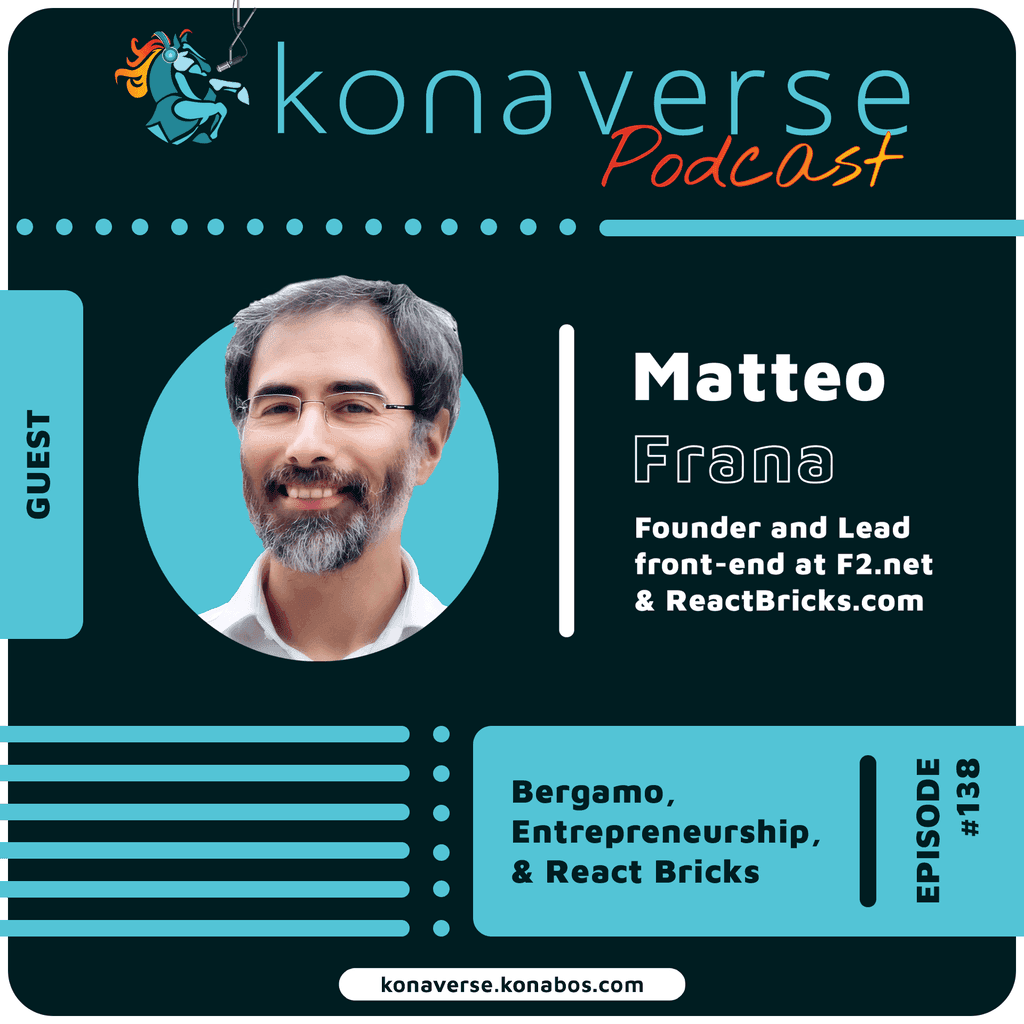
Matteo Frana is Founder and Lead front-end at F2.net and ReactBricks.com. In this episode, Matteo talks about Bergamo, Italy, growing up, family, his start with techology, the advent of the web, entrepreneurship, artificial intelligence, and stories behind the founding of F2.net and React Bricks.

[00:00:00] Welcome to Konaverse, a conversation experience platform hosted and curated by Konabos Consulting

[00:00:06] Konabos is a global technology leader and while this podcast will be connected by technology

[00:00:12] the glue is human stories and narrative.

[00:00:14] Technology can bring us together, it can make our lives better and more efficient in

[00:00:19] many ways but it cannot replace human discourse and the magic that can happen by the interchange

[00:00:25] of ideas.

[00:00:26] Hope you enjoy our podcast.

[00:00:31] Welcome to the Konaverse, this is Matthew McQueenie and I am thrilled to be joined by

[00:00:36] another Matt, Matteo Frauna, founder of React Bricks.

[00:00:42] Thanks so much for joining us Matteo.

[00:00:45] Thank you for having me.

[00:00:46] How are you?

[00:00:47] Good of course, we're doing great.

[00:00:50] So with the Konaverse we always like to go back to the beginning.

[00:00:54] Where were you born and where did you grow up?

[00:00:58] I was born in Bergamo, Italy.

[00:01:00] It is near Milan and I grew up there and well I'm still there very near to where I spent

[00:01:09] my childhood.

[00:01:12] And Matteo, what had you growing up there?

[00:01:16] What did your parents do?

[00:01:20] My father was an entrepreneur, now he's not an entrepreneur anymore.

[00:01:27] He was in a totally different sector because it was in the advertising gadgets sector but

[00:01:35] anyway I absorbed the entrepreneurship from him and when I started developing website

[00:01:46] in 1996 really the first customer were with the invoices were done with my father's

[00:01:54] company and so until 2004 really I didn't open my own company and my mother was a teacher

[00:02:09] in elementary school math teacher.

[00:02:11] Oh, very nice mix.

[00:02:13] You had the math and the business.

[00:02:16] What do you remember about when you were growing up and you would see your father

[00:02:21] being an entrepreneur.

[00:02:22] Were there things that stick with you to this day?

[00:02:28] Yes, really the try to do something great for customers and it was something that I really

[00:02:42] got from him and in fact when I was in high school I immediately when I saw

[00:02:51] the web, the advent of the web, the first web pages my first idea was okay I want to

[00:02:57] create pages and they wanted this for customers and so I started the first pages

[00:03:04] and well it was a great times back then.

[00:03:10] Well I started programming when I was 10.

[00:03:15] Well I started a little bit before when it was seven or eight on the Commodore 64.

[00:03:20] I have my Commodore 64 here with me still in my office but that was more of a game than when

[00:03:29] it was 10 on an IBM 8088.

[00:03:32] I started with GW Basic with the first programming and then when I was 17 we saw the advent of

[00:03:41] the web in 1996.

[00:03:44] It was in high school and I monopolized the PC connected to the internet.

[00:03:50] There was one PC connected to the internet.

[00:03:52] It was always there and there were no surchanges at the beginning.

[00:03:59] On the magazine you saw these long URLs from the NASA where you

[00:04:05] with the until the in the URLs and you had to copy that to see an image that maybe you

[00:04:12] wasn't looking for that but that was magic because it came from the phone cable.

[00:04:16] It wasn't there in the computer so I really did the early days and well and so I thought

[00:04:25] I want to create a web page myself and then I started creating web pages using the first

[00:04:31] tools so not a bother then hot dog pro editor by sausage software.

[00:04:37] I think it doesn't exist anymore.

[00:04:40] Just a pen shop pro free which was then acquired by Corel but initially it was my just

[00:04:49] and so well I always felt this I want to create something also for others

[00:04:56] and so I found the first customer when I was 17 and then during university

[00:05:06] the world became a world more and more for customers and in fact in the end I didn't finish

[00:05:13] the university because I left before when I had three exams left and well it's a pity but at

[00:05:22] a certain point time so that it wasn't bringing much to me anymore and so well I left with three

[00:05:31] exams missing. Oh wow yeah you do hear that a bunch the other thing you hear a lot from our guests

[00:05:38] in this industry that Commodore 64 is always talked about as the first computer device right

[00:05:46] that we use do you ever what was the thing that brought that into your home why did your family

[00:05:52] understand that that was an important thing at the time because I everyone didn't have them right?

[00:05:57] Yes it was my

[00:06:05] owned really that sorry my uncle that worked in the

[00:06:13] the sector so he was digitalizing the agriculture and so he brought the first PC and he

[00:06:28] gifted me with the Commodore 64 and when it was 10 with the IBM 8088 so I had this

[00:06:35] was lucky to have him that introduced me to the computer science. Oh that's great and

[00:06:43] so that was around 10 years old it feels like you were very taken with technology did you

[00:06:49] what was it like growing up in Bergamo though like did you go outside a lot did you play sports

[00:06:55] did you read what were some of those early times like growing up there? Well I never played sports

[00:07:04] much I'm really not a sports person until let's say 10 years ago when I started running and but

[00:07:17] slowly but I also did a 100 kilometers run in Italy there is the passatore from Florence

[00:07:27] to find inside it is 100 kilometers it took it very slowly but I finished it but I never been very

[00:07:36] passionate about about sports and well Bergamo is I think it's a great city because it's

[00:07:46] not too small and not too large and anyway it is very near Milan so in university I did it in Milan

[00:07:57] at the Milan Polytechnic so you have the big city very near you can get customers from Milan

[00:08:05] but at the same time it's a city which is better because it's a bit smaller and I prefer the

[00:08:14] size of Bergamo it is a 100,000 people city and so I think it's the right size not to be too much

[00:08:26] but have the tertiary sector well developed and you can get customers from Milan go to

[00:08:34] Milan to for university so it was great and well one thing that I did from when I was as

[00:08:47] Molly is playing I played the guitar at elementary school and then the piano

[00:08:56] there was a time that I was quite good when I started playing jazz and so at school we had

[00:09:04] the harmony group where we played the jazz standards and at that time I was quite good then

[00:09:13] I stopped playing and now I play guitar again and I like to compose songs I try to sing but

[00:09:22] I'm not able to sing but I like to compose songs and play the guitar

[00:09:28] Do you find that that background in music helped your career in technology in any way?

[00:09:39] Well I think that maybe it's not a direct cause but it's something about the way I am

[00:09:51] that expresses in different ways and I think that they have this is a part of me which is very

[00:09:57] rational and a part of me that it's more not rational but instead more passionate about

[00:10:09] improvisation music poetry I like to write poetry too and I think that in some way having

[00:10:19] both the aspects are important because the more creative aspect is great for designing

[00:10:28] and so it's great when you design an application from really designing it but also

[00:10:36] when you open the design funnel when you think of the possibilities that you have I think that in

[00:10:42] that moment it's important to have also the creative aspect so the improvisation poetry and so

[00:10:51] you open the funnel and you can see maybe more possibilities and then when you have to close

[00:10:56] the funnel of the design to really decide what you have to implement and implement that in

[00:11:02] code of course the more rational part is important so I think that both the music and

[00:11:08] maybe the entrepreneurship the design part of the development of a web application they are both

[00:11:18] consequences of my being a bit rational and a bit more creative.

[00:11:24] Yeah well it's interesting because when I even think about composability headless

[00:11:32] really work yeah it's meant to work together with a lot of solutions in service of the

[00:11:37] customer feels a lot like improvisational jazz. Yes you have some elements which you already

[00:11:46] know that everybody knows and let's say the structure of the piece that you are playing

[00:11:52] but then you can improvise on it so combine things in ways that to create something new.

[00:12:00] That's right so an interesting thing when you were talking about in 1996 and you got to

[00:12:07] spend time at a computer with the internet probably monopolize it a little bit I feel

[00:12:12] like a lot of folks I hear who had the ability to do that always were interested most in the

[00:12:18] hello world thing like that you were able to make something and just put it up for yourself

[00:12:22] to me it sounds like you very quickly were ready to commercialize that that you were ready to

[00:12:28] help customers and others get up there. Well yes I think that for the web it's easier because

[00:12:37] the first program that I wrote of course on commons Santa Clara the first program was

[00:12:42] line 10 print Matteo line 20 go to 10 and that was not something that you could commercialize

[00:12:49] but with the web in that era was very easy to create something and there was such a need

[00:12:57] nobody was creating web pages and so if you went to a company and of course my father was already

[00:13:04] serving customers so it was easy to go to his customers and say oh you don't have a web page

[00:13:12] you are not on the highway of information what are you losing your competitor web pages and so

[00:13:19] it was quite easy to say okay you have to buy your domain name you need a web page and so anything

[00:13:28] would do it it was not something that had great design back then you have just tables

[00:13:35] so it was just the logo and a couple of text lines and it was the home page so

[00:13:44] it was very easy to commercialize the first web pages because there was such a need of them

[00:13:52] so this is more businessy at a young age but do you remember how you were even working to like

[00:13:58] estimate these jobs or how to tell them how much it would be oh well in the beginning it was

[00:14:05] we talked about a four size pages to let them understand we took these a four paper and well

[00:14:16] a web page which is longer free a four paper is this price if you want more it was something like

[00:14:24] that because uh we sold the pages so website of three pages at this price but well it should

[00:14:33] not be longer than two way four papers otherwise it counts as another page so the estimate was quite

[00:14:42] easy because it was done in this way using the lengths of pages and the quantity of pages back then

[00:14:49] that's interesting and when you look at even today we'll get into a lot of that stuff but just

[00:14:54] to connect with that is the process really that different

[00:14:59] haha well it's a bit more difficult of course now that the design is much more sophisticated

[00:15:07] you have also this variable that you can propose customer design they could not like the design so

[00:15:17] it's a bit more complex to estimate the time at the beginning of a website

[00:15:26] and well it's the same for web applications really you don't know if the customer knows what you want

[00:15:35] to be in this the usual it's a quite difficult tool to estimate cost at the beginning so

[00:15:45] now it's more like you have these contracts where you do the experience steps things like that

[00:15:52] it's deep so the last year has been everything with generative AI right is there having been at

[00:15:59] the dawn of the internet in many ways in that the commercial internet and then now kind of being

[00:16:07] in the dawn of this whatever it's going to be are there ever parts that feel

[00:16:12] similar to you I think not because it's a bit different because now

[00:16:28] building AI is not as easy as building for the web so when you build the web pages

[00:16:38] you had the really in your hand the building blocks it was just creating an html file

[00:16:46] after sending it to ftp on a web server I configured my own web server back then it wasn't

[00:16:52] it wasn't Linux but I chose Windows and t4 and I had my own physical server that I put

[00:17:01] in an internet service provider so I knew the full stack from the operating system

[00:17:09] and how to set up a mail server how to set up the DNS with bind you add all the fundamentals

[00:17:16] in your hands right now building something like gpt it's something that you cannot

[00:17:23] do yourself you can use it so using the AI is more like a system integrator work than okay I

[00:17:34] create artificial intelligence of course you can do you can create application that

[00:17:40] leverage AI but it feels like using a service more than having the building blocks in your

[00:17:49] hands so I think it's a bit different and well on the other I was always interested in AI I followed

[00:17:59] the first projects in AI by Ben Gerseld was the novel mental project back then

[00:18:07] where we talked about the artificial general intelligence and what is intelligence

[00:18:14] and now I'm happy that people is so interested in AI at last people is starting

[00:18:25] is really excited about what AI can do at the same time I think that we still don't

[00:18:36] we are still very far to creating a in AGI with what we have so we saw in the early days of AI that

[00:18:48] companies were always interested in a narrow AI so and not building artificial general

[00:18:55] intelligence I think that now we are focusing on a technology that is bringing something which

[00:19:03] resembles artificial artificial general intelligence but it's not the way to get there

[00:19:09] I think that we will need to

[00:19:14] introduce other paradigms that are not GPT to have something which

[00:19:22] which is artificial general intelligence so my my real interest that they had back then

[00:19:29] is not so high in this moment for the for the artificial intelligence that we have right now

[00:19:38] I think that we will get to a certain point but then we can go over that with what we have

[00:19:46] right now so I would have never believed that a sort of neural network could reach the results

[00:19:53] that we have with GPT if you asked me a few years ago do you think that with a very big neural

[00:19:59] network we can have these results I would have said no so but I think that these by itself

[00:20:08] is not going to build an AGI for us my last AI quite well we'll probably talk about AI I'm sure

[00:20:17] but how does Mateo use AI like how does it fit into your life what are a couple of the top ways

[00:20:25] could be personal could be professional how is it fit in for you well I use it when I do some

[00:20:32] copywriting of course not using the the output as it is I use much notion AI because the notion

[00:20:42] is the tool that I always use and so the improved writing of notion is especially when I write it

[00:20:50] in English I used to write a sentence try improve writing then I get this output I rewrite it myself

[00:21:00] and then I do another iteration improve writing and when I really happy with the result then

[00:21:07] I write it so it's like an helper in in better copywriting and this is essentially the use that I do

[00:21:17] with AI I don't code with AI at all but it's maybe also because what I do is programming a

[00:21:29] library so the react bricks library maybe we talk about it and the most important thing

[00:21:37] is creating great APIs for customers and create code that is easy to understand by the team that

[00:21:48] it's efficient so it's not something that I think can be done with AI and anyway iterating with AI

[00:21:59] would make I don't think that would make my life much earlier yeah I almost think it it's like it can

[00:22:07] but it's not necessarily what you want it loses the special sauce or the you know without intervention

[00:22:16] like it could do a lot of the legwork you need to get you started to fill the canvas to do that

[00:22:20] but you need otherwise you're not different than the other person just using it right

[00:22:25] because you're just leaning on a different you're leaning on a system you need the special piece

[00:22:31] even if it's 20 right you need that special piece on top that makes it yes yes so maybe I could use

[00:22:38] it but I don't particularly write I don't particularly like prompting and then having to fix what I

[00:22:45] receive prompting again maybe it's the way I like to work but I prefer a top-down approach

[00:22:52] think okay I designed this and I'm sure I prefer to write the code myself still yeah no yeah it's

[00:23:02] just because I'm becoming old I don't know no no I now you bring up a good point there's there are

[00:23:08] things that need to maintain humanity let's call you know otherwise it's just not different than

[00:23:15] the next person using it right or going down the rabbit hole and changing and changing you know but

[00:23:22] yes let's and writing code also is something which I really like the effect of talking to

[00:23:31] computer in their language is something which is a very fascinating but so with my son I have a

[00:23:39] a son of eight years old and the daughter who is five and I'm starting to teaching programming him

[00:23:50] but I don't particularly like the no code tools like blocky things like that so I am teaching him

[00:23:59] with the logo language which is where you move a turtle in the screen but you have to write

[00:24:06] the comments and if you do something wrong the computer doesn't understand I think that there is

[00:24:12] something very fascinating in writing code writing in the language of the computer

[00:24:18] and so I'm teaching him with this it has a visual thing because you see the turtle moving

[00:24:25] in the screen but you needed to send the correct comments yeah no I mean we're going down a

[00:24:33] path but I think a good point there is you can use AI you can use low code no code but it's really

[00:24:42] going to be best if you know how to do it otherwise without it yeah because it'll actually

[00:24:49] create better product if you know how to do it anyway because a lot of times with low code no

[00:24:52] code sure anyone can come in and do this do that but then the edge cases of what sometimes

[00:24:58] what you need to do can't be done through it and so you're limiting the ability of your vision

[00:25:04] and aspiration because that's all you can do and you don't know the background of what's

[00:25:09] happening behind it too sure sure yes yes yes and when the program become complex it will be

[00:25:16] also difficult to spot bugs if they are introduced by AI we always need to keep

[00:25:25] the ability to understand code of course because it would be very dangerous if AI

[00:25:34] writes all the code for us and we are not able to really understand what it is like

[00:25:42] so you brought up children and I'm in a similar I have two boys nine and five

[00:25:48] and almost the same almost the same just with the two boys you have a boy and a girl but

[00:25:55] how is a parent do you approach technology with them I mean the code stuff is language

[00:26:01] I mean is teaching and education but how do you how do you tow that line between what we've

[00:26:08] come to learn about the downsides of tech right attention like cell phones mobile how do you

[00:26:15] work that as a technologist yourself well it's it's difficult because it's very tough to

[00:26:26] try to have them not using cell phones for example and so I agree that it's it's not

[00:26:39] great for attention to being always with these tools in their their and because in the end they

[00:26:48] can have everything when they want and the world outside doesn't work in this way so with the

[00:26:58] if they have YouTube and they can click even if it's always something safe so their children's

[00:27:05] song but they click and they have it and they click and they have it and also the on demand in on TV

[00:27:12] it's something that it's not so great because they want a cartoon and they ask and they have it

[00:27:20] because you have it on Disney plus or Netflix and you click and they have it and so

[00:27:27] the world outside doesn't work in this way their teacher is working he's speaking slowly

[00:27:34] and they cannot change when they don't like what is being said so I think it's it's a bit

[00:27:42] dangerous to have all of too much technology so we try to avoid this and sometimes then you need to

[00:27:50] watch the TV and what's on you look what's on you we cannot change to Netflix because we

[00:27:55] you want something yes they need also to in some way

[00:28:03] we are not as human we are not yet ready because our interaction are not on in this way so so fast

[00:28:13] so I think that it's important to to always not exaggerate with the technology and so

[00:28:23] one approach to learn how to program is something which is very interesting because they

[00:28:30] learn to reason about things but the passive use of technology is something that we need to be aware

[00:28:39] of yeah two very funny things on that point with my own I have all the streaming services and some

[00:28:46] of them like Hulu I don't have the one where the commercials are gone right and so they'll be watching

[00:28:53] something and the five-year-old will just say what the heck is this why it's this thing popping up

[00:29:01] but then the really funny thing is days later my nine-year-old will do this he'll be singing

[00:29:08] like triple bacon double whopper like Burger King songs that he saw on the

[00:29:14] you know that he saw on the commercial so that that is an interesting thing to me because

[00:29:21] content for our lifetimes has been monetized by advertisement and yes it is like an alien race

[00:29:30] showing up seeing advertisements so it's a very strange thing but uh I want to go back to

[00:29:39] let's get back on the business path so you talked about being in college leaving early to explore

[00:29:47] your entrepreneurial opportunities what what happened in your own thought process that gave

[00:29:53] you the confidence maybe some would say the uh you don't know what you don't know

[00:30:00] but what what gave you the confidence to to leave school and go for that pursuit

[00:30:06] well it was a gradual in some way because when I started university I was already working for

[00:30:18] customers and the first year I gave all the exams plus one so everything was okay

[00:30:25] second year and same I did all the exams and then the work started to

[00:30:32] to require more time and so I started not going to lessons and just doing the exams and so I left

[00:30:42] some exams back and then with the fourth and five and fifty years it was always following last

[00:30:51] the lessons and so I gradually wasn't more at working than than than studying and well so

[00:31:03] at a certain point with my friend Dario who is still working with me I I knew him in 2001

[00:31:13] at university and at a certain point we were we started working on a a master degree thesis

[00:31:25] and we should have finished together but then those last three exams I never gave them

[00:31:34] so we started designing the thesis together by the way it was about grid computing something

[00:31:40] that back then the term was grid computing then appeared cloud computing as term and so having

[00:31:48] these agents on multiple multiple servers and then Dario finished the thesis also installing this

[00:31:56] agent on all of our servers that we were using for Kathar because we had a server in Auschwitz

[00:32:03] until I think 2006 we had our our server farm in office and it was it was interesting but

[00:32:14] well so it was a gradual living university and working more and at a certain point

[00:32:24] I was giving one exam per year and then everything ended there

[00:32:31] did you ever finish no no I didn't finish I have never came back three exams left and

[00:32:39] I don't know if it would come back or everything is already deleted from the university database

[00:32:45] I don't know I need to check but maybe I could give these three last exams

[00:32:52] just for the satisfaction well you have to be famous enough that they give you an honorary degree

[00:32:59] oh well it's not easy it's not easy so if you look at if you look at your resume on linkedin

[00:33:09] it appears that this company you started is the one that you've had right up until today

[00:33:15] is that right yes yes yes in fact the domain name is f2.net just two characters because in

[00:33:23] it was registered at in the beginning at 1990-97 back then you still could find the domain name

[00:33:30] with just two characters and so the company behind React Breaks is still f2.net

[00:33:39] wow and so it's that's a great period of time to look at a business and then I know

[00:33:45] React Breaks probably came from this uh the almost that myth mythological product

[00:33:51] that every agency says they're gonna create and you did but um back to the beginning in

[00:33:58] the early years was it tough like or did how did you get through the parts you didn't know about

[00:34:05] business maybe about sales marketing getting customers farming like what did that business

[00:34:11] stuff come natural or did you have to learn hard lessons there well I'm learning much more in

[00:34:20] these latest days with our products so then working for customers building the websites or web

[00:34:34] applications for customers because really you don't need to be good at marketing good at sales

[00:34:40] there is such a need for web applications or websites that customers came by themselves so

[00:34:48] apart from the first customers that were the customers of my father's company

[00:34:53] then it was just a word of mouth and I never had to do any sales because one customer

[00:35:01] brought another customer and brought another customer when you do a web application development

[00:35:07] and you do it in a certain way you try to do it very well customers come you don't have to

[00:35:14] do any marketing any sales anything and so when we built the product uh react bricks really there

[00:35:23] was another product that we built before react bricks that was a and that it was important to

[00:35:30] understand something about startups that was a social network based on interests the name was

[00:35:37] tags chapter and it was the the idea was I don't want to talk with the people in my

[00:35:43] that that I already know I want to talk with people that share my interest in quantum mechanics or

[00:35:51] in music or craft beers so that was the idea and then we understood that this was our idea but

[00:36:00] we never validated it with the market and there was no way to monetize this idea even if we had

[00:36:10] some I think thousands of users at a certain point but it was something that was not never

[00:36:17] validated and we built it once and then we rebuilt everything for to have more performance

[00:36:23] with also a graph database of course and we built it for everything with the with the Neo4j

[00:36:31] and then rebuilt with orient db without having a a small idea how we could monetize this thing

[00:36:40] and so with react bricks it was very different because we knew that there was the necessity

[00:36:48] for a visual CMS and now we see that every CMS want to be visual so the idea was

[00:36:56] was good back then in 2019 and as we created the first MVP we immediately saw that there was

[00:37:04] this need because we found the first customers really when the product was still a sort of MVP

[00:37:12] for example Capbase now is being acquired by Vila.com was our first customer and when we released the

[00:37:21] product in January 2020 and March we had the first paying customer so we really validated the

[00:37:32] product and went through the product market fit and started again there's too many things that with

[00:37:43] the other project we didn't know but all the sales the marketing part is something that I learned

[00:37:53] these last years because I was I was my media is that customers just come if you do work well

[00:38:05] and you create great web apps customer comes and with the product it's not the same you can create

[00:38:12] a great product but customers don't come by themselves and you need to do some marketing

[00:38:18] and you need to understand how to do sales and I'm still learning well it's okay I mean it's really

[00:38:27] interesting for the agency which it's still going right it's a yes it's still yes we are abandoning

[00:38:38] it to work full-time on we have bricks really so we are keeping let's say the biggest customers

[00:38:46] or some customers from the early days that we don't want to abandon but we don't take any new

[00:38:56] work as agency oh that's great yeah they have that term I don't know if they use it there we are

[00:39:01] grandfathered in you're allowed to stay with the program now with the agency though how big did

[00:39:08] it get in terms of people who were working for you with you like how big did it get and did

[00:39:15] did the growth almost surprise you when you would come up lift your head up and look around

[00:39:20] well no we always stay stayed small so with the agency at max we were we were five people

[00:39:32] so yes yes we always stayed small let's say a boutique digital agency

[00:39:40] but well in in five developer you can do many things and so as for the design part we outsourced

[00:39:54] it we were really an agency focusing on the software development part and so we never grew

[00:40:04] too much and I liked it in this way and we still are 10 people now so I think that it's

[00:40:17] it's great that you can really do very important things even with the small team and sometimes

[00:40:26] you can also move much faster consider that the first MVP of Ria Bricsa was the front end was

[00:40:34] all created by me during the first lockdown in Italy so it was end of 2019 beginning of 2020

[00:40:42] and I created the first MVP by myself and then I saw okay it's something that which is great I

[00:40:49] really like what I created and so Dario Michael founder created all the became the part

[00:40:56] in not j.s and so the product came together but the the first product it was a was created by

[00:41:04] two people oh nice you bring up an interesting point there in Italy I remember that was like

[00:41:11] the first place that truly almost was hit by covid in ways that it was like telling the world

[00:41:20] like wait what this is happening what was what was that like living through that in the early phase

[00:41:26] yes we and in Italy in particular Bergamo the the city where I am was the first to be hit so it was

[00:41:35] like the the Wuhan of Italy was Bergamo and so we it was very tough there was the period of

[00:41:47] lockdown that I was in office alone because everyone was at home and so I could come to

[00:41:59] to office since we also managed the infrastructure of e-commerce in the pharmaceutical sector so I

[00:42:07] could come to work but it was just me in all the the building and I continuously heard the ambulances

[00:42:19] passing in the streets and the street was empty I went in the parking lot and it was gus me and

[00:42:26] hearing the the ambulances that passed along it was a very very tough tough period we scared

[00:42:35] when you'd come in I was scared when I went grocery shopping for example in the first that

[00:42:45] there weren't masks and masks in the first period it was very difficult to to find masks so we built

[00:42:52] masks with anything I remember the first month that they build and don't remember exactly

[00:43:00] with what they built it with the elastics and something like that it was a homemade homemade

[00:43:08] mask and going grocery shopping I had some fear you know you had the gloves but you touched the

[00:43:20] shopping cart and then you touched your face oh I touched my face the first period was scary yes

[00:43:29] I mean it's it it's amazing to me as we're essentially coming on like three years of the

[00:43:35] vaccine being around but it's it's resilience too but how we've bounced back to where we are today

[00:43:42] even right like when you think back to that time which is not that crazy long ago

[00:43:49] yes to be like we have to remember that sometimes right like what we have against

[00:43:53] yes yes yes yes yeah um in the agency because I want to get to the react brick story

[00:44:04] in the agency though what were what systems were you primarily building customer websites on

[00:44:12] well and we uh most uh we mostly created web applications so uh let's say production

[00:44:22] management system or e-commerce sites or um was vertical erps and something like that

[00:44:35] configurators of products integrated with the production management things like that

[00:44:42] but sometimes customers ask for websites and so much of the work for the company of the

[00:44:49] agency was not focused on websites but more web applications when customers came

[00:44:57] we at the beginning we always built something custom for each for each customers we did ASP.net

[00:45:07] administration dashboard and then at a certain point with when we didn't want to build websites

[00:45:14] anymore when customers asked for websites we used WordPress so uh we used WordPress and we didn't like

[00:45:24] but we also didn't want customers to go to another agency just for the website and so we

[00:45:32] we used WordPress and we never liked it and with WordPress we saw the limits that you have

[00:45:42] when you you give the blank canvas of WordPress to the customer and so then they can do anything

[00:45:51] and they can create the the green comic sans text over at the ground or and so you start

[00:45:59] limiting what they can do with WordPress we use the advanced set of custom fields

[00:46:04] so that we were back to gray forms and so from there we saw the the problem and really this is

[00:46:12] something that I always witnessed because you know uh from the code we had front page at a certain

[00:46:18] point but then from page or dream we were uh was not enough because at that point we needed to

[00:46:25] integrate with the databases and so ASP came and you were back writing code ASP ASP.net

[00:46:32] and then we added the real CMS is like Joomla or WordPress and so where you could also create in

[00:46:41] a visual way but you see every time that you try to introduce visual editing in some way

[00:46:47] you are giving editors the freedom to take design choices and this is something that you cannot do

[00:46:54] for a corporate website and we still see the same thing because with the visual tools they are

[00:47:01] great today we have weeks web flow they are great but with weeks for example you have to choose a

[00:47:08] template so you cannot convey the pixel perfect corporate design and with with something like

[00:47:17] web flow which is more powerful in some way gives more power to create anything it's very easy

[00:47:24] to compromise the design so we saw that there was a gap in the market

[00:47:33] and so we analyzed what's underneath of our customer and the first one is convey

[00:47:39] the corporate brand and these mean two things the developers should be able to

[00:47:45] create and to have limitless design possibilities so they need to use the CSS framework of their choice

[00:47:55] to create a pixel perfect design on the other side the editor should not be able to break

[00:48:03] the design so to compromise the the brand and this is the first need then of course if we think

[00:48:11] what what our customer needs then it's something which is which saves helps saves time and so to

[00:48:19] save the developer's time we need to build something that is after the first setup doesn't

[00:48:26] require development time and on the other way something which is easy to use for the editors

[00:48:34] and if we just see these four requirements we see that we have a problem because with the

[00:48:39] headless cms we have the ability to convey the corporate image so the developer can create

[00:48:45] what they want for the designs and editor cannot break it but if an editor needs to add a new

[00:48:53] paragraph the developer needs to add a new field to the headless cms so we we need

[00:49:00] much development time so we cannot save the developer time and for editors they are not

[00:49:07] easy to be to use because they are they have entities relationships things that we love as

[00:49:15] developers but that are not simple as the the page concept that we have in WordPress for example

[00:49:23] and on the other side the visual are exactly the opposite so it's very easy to build a

[00:49:30] there is the freedom to create composing pages with no developer time required

[00:49:36] but of course you cannot convey the exact corporate design and it's very easy to compromise

[00:49:43] the design so we see that the two the two tools that we have are complementary but we don't have

[00:49:50] a synthesis of these and so we we we so how can we solve this problem and we went back

[00:49:58] to when we were children and we fought off Lego bricks so everyone loves playing Lego bricks

[00:50:06] and if you think with Lego bricks you solve the problem because you can create anything with

[00:50:11] Lego bricks but you cannot change the single Lego brick you cannot you cannot ruin the design

[00:50:17] system of Lego bricks so you have the the two things and what's more we have code so we

[00:50:26] have the react code so we can do something which is more powerful than Lego because you can

[00:50:32] build your own Lego set so if you combine bricks and the ability to create your own Lego sets

[00:50:40] you have limitless design possibilities no way to compromise the design freedom to create

[00:50:46] and we also one thing more is that we have the props with react and so we can add buttons

[00:50:54] to the bricks to the Lego bricks to change the color for example if you want so we can

[00:50:59] delegate to the end users to the editors the ability to change something but only what we

[00:51:06] decide that can be changed if a two by four brick cannot be changed to a four by four but maybe you

[00:51:14] can change the color and it can be red or blue so you can with the props you can define exactly

[00:51:19] what can be changed so that it's very easy for for editors but they cannot break the design

[00:51:27] and well so I think that this paradigm of of the Lego bricks is very powerful in it maps one to one

[00:51:38] with the design system of a corporate so this is why I will start we needed as an agency

[00:51:47] I was a didn't want to keep a maintaining WordPress even if it was headless at a certain point

[00:51:57] but you need to maintain it on the API side and we didn't want that and we wanted to have a great

[00:52:06] experience for our customers and also for us as developers

[00:52:12] and well this this speaks this is not speaking at you this is more the audacity of entrepreneurship but

[00:52:20] what made you think you could be the person that created this or your group could be the

[00:52:25] people that created this product oh well I mean it I needed it I think that I thought that I

[00:52:37] could create it because I was very experienced in the react and I figured it in my mind that

[00:52:48] with using react and this concept of blocks I could create this and really during the first

[00:52:56] lockdown I started doing it and while I was doing it I was convincing me more and more that

[00:53:02] this was the way and so since the first time we pie so okay I can add a brick I can change the

[00:53:09] property using sidebar controls this is exactly what I need I create in react which is what I love

[00:53:16] and my editors can do exactly just what they what they can do and one more thing which

[00:53:23] is very important is the visual editing of text and images because it's not just bricks

[00:53:28] and changing sidebar props but the unique thing that react bricks still has on the market is

[00:53:35] the fact that you have inline visual editing it's like writing in a in a work process or this is

[00:53:42] something that's in other adlesi message that says that they say that they are visual but

[00:53:47] it's like writing in a sidebar and see the preview on the page with react bricks you

[00:53:53] click on the page and you write directly the texts and for images you click on the images

[00:53:59] it's not like a sidebar where you have the gray form in a sidebar beside the content is you

[00:54:07] write on the content and you reach for a sidebar only to change the thing that you also reach

[00:54:13] for a sidebar in world of pages you need to change the paragraph size okay you reach

[00:54:17] for a sidebar but if you need to just write you click on the content and you just write

[00:54:23] so this is very immediate and editors don't need any training and also developers don't need any

[00:54:30] trading because a brick so a content block of react bricks is just the react components

[00:54:36] so you leverage your knowledge of react you just add our visual components and the schema

[00:54:43] to define the sidebar controls that map to your props but it's really very easy to start from a

[00:54:48] design system already created in react and the turning in into visually detapled content blocks

[00:54:55] for react bricks so it's great for both developers and the content editors

[00:55:03] so that you answered the question well one thing I wanted to ask on that in terms of the

[00:55:09] ideal customer is react bricks standalone now or is it still best in a complementary role to a

[00:55:17] two other systems like headless cms is and such no no no it works as standalone and it

[00:55:24] it always works standalone the idea is to have a one-stop shop for the content needs

[00:55:33] so it doesn't work together with other cms is not like other tools like maybe uniform which is more

[00:55:40] a an aggregator of to compose other tools with react bricks that you save the content as jason

[00:55:48] on our apis so it's you don't need anything else also for images when you upload an image to

[00:55:55] react bricks we create all the responsive versions and we serve them from a global city

[00:56:01] and you don't need any external service to manage images so you just need react bricks and you're good

[00:56:07] to go but of course you can integrate with our apis if you have data on a headless cms if you

[00:56:13] have data on headless commerce you can bring this data in your bricks and now with server

[00:56:20] components is also easier because with the latest version of 4.2 we fully support react

[00:56:27] server component with the two starters using next 14 and it's very easy so to to have your

[00:56:34] get data function fetch external data use it in your in your bricks for example we are e-commerce

[00:56:42] sites there is a very great e-commerce site that went online lately it's berabera it's a uk

[00:56:52] fashion store producing bags and for example they use swell as a headless cms together with

[00:57:00] react bricks for the product details page content so some data comes from the headless cms

[00:57:06] some and the landing pages let's say the product landing pages or the other pages come from

[00:57:12] react bricks that's very cool so speaking of customers i'm going to re-ask a question i asked

[00:57:18] earlier because you intimated this but what did you learn about the business of sales and marketing

[00:57:26] and all that now with a product company because you do have to do that pretty intensely in this

[00:57:31] kind of company right yes yes yes well i i learned that it is something that you have to learn

[00:57:47] so it's not something that you can improvise it's not it's not easy it is another job that you have

[00:57:54] to learn but that can be learned even for technical people maybe i will never be greater marketing

[00:58:04] i will never be great at sales but in some way you have to learn something to start because in

[00:58:12] the beginning you have to do the marketing you have to do the sales and it's something that

[00:58:18] you can always improve on and so i read books on marketing books on sales to try to understand

[00:58:25] how these works and well it's very important for example to understand the needs of customers

[00:58:34] for example with the sales especially like me i'm very passionate about the product you see

[00:58:40] that i i talk i like to talk about the product but really when you do the sales you need to talk about

[00:58:47] the customer needs and so this is something that you have to learn not to explain the features

[00:58:53] but to ask questions to customers and understand what are their needs this is something that it's

[00:58:59] not easy to do especially when you are a technical founder and when you're very passionate

[00:59:05] about your product but you need to step back and ask questions and then show how your product can

[00:59:13] solve their needs very very well said very well said all right we're down to our very last couple

[00:59:21] here um one thing i was thinking of with uh you brought up that you started only running 10

[00:59:27] years ago what what what spurred that why did you start doing that 10 years ago sorry

[00:59:35] running you talked about oh yes oh yes yes well i started because my father-in-law was

[00:59:43] running and so i started following him when we call on my parents-in-law we went running

[00:59:52] and so i started very slowly you know one kilometer of run one kilometer of walk

[01:00:00] and then up to the 10 kilometers and then i did the rom marathon when i reached the 42 kilometers

[01:00:08] and then well i went to do some ultra marathon also in the mountain and one in in Liguria was great

[01:00:18] because it was a place it's the Cinque Terre in Liguria is a mountain very near to the sea

[01:00:26] and so it's always up and down up and down up and down and it was great and then i did these

[01:00:34] 100 kilometers run wow it was seven years ago and then now it's two years that i'm not running

[01:00:44] anymore i shouldn't stop again wow wow that's it's amazing the how resilient the body can be

[01:00:51] right to not do something to pick it up later and then to be able to do 100 kilometer races i mean

[01:00:58] talk about if you don't look at the at the uh chronometer and you just have the objective

[01:01:04] of be able to do a long distance and i was training just once per week because they all

[01:01:12] say that you have to train at least three times per week i just went running on sundays and

[01:01:19] just doing a long run on sundays and well if you don't look at the chronometer you don't want to

[01:01:28] be the first it's okay that's amazing so all right our last two we always ask

[01:01:37] what does the word community mean to you well um community uh it's uh

[01:01:46] the people who love what we are doing and so in some way it is a great part of the

[01:02:02] success i can perceive so it's the part maybe it's not the part of the success in terms of

[01:02:10] revenue but in terms of satisfaction when i receive emails of developers that try react breaks and they

[01:02:19] say wow this is just what it was looking for uh it's an amazing product it's a great satisfaction

[01:02:28] sometimes it's more something's fine than to find a new paying customer so the community

[01:02:36] it lets you feel that you are doing something which is good something which gives

[01:02:46] a new way to to work to people and when we see that we have now nine thousand users using react

[01:02:55] breaks it's great that you create something that is changing the way people edit websites in some

[01:03:02] way even if it's not paying the customers uh for most because we have uh we aim at uh enterprise

[01:03:10] for the paying the plan the most but having these all of these people using react breaks and giving

[01:03:17] feedback is really a great part of our satisfaction even if we are not in the open

[01:03:24] source but having this great community that gives feedback positive feedback about the product is

[01:03:31] really very satisfying very nice if you were to go back Matteo and advise your 15 year old self

[01:03:41] with some piece of advice what would you tell that young man well it's tough

[01:03:56] uh because i think that it's easy to say

[01:04:02] build build build something don't work for customers work for for your ideas

[01:04:11] more but i think that it's part of the way things should go that in the beginning

[01:04:18] you need to to do other things it's i think that my path is in this way because i followed that path

[01:04:28] and so trying to change things early on i think doesn't make so much sense so i think that in your

[01:04:36] 15 your 20 you need to just work hard learn to work hard in some way to understand what

[01:04:47] you are very good at doing and then in your 30 you need to become very very good at doing

[01:04:57] that thing and you can do it when you are working for for customers for example if my example

[01:05:04] of the agency you have a way to do one thing but become very good at that thing and then well when

[01:05:13] we are more in your 40 i think that it's it's great to start widening your interests and so

[01:05:25] it's true that you're very good at doing one thing but you understand that you need to be

[01:05:28] good at doing other things and that is what you need to create a startup in some way so a product for

[01:05:35] the market and saying well when you were 20 you didn't need to work so hard for customers it was

[01:05:43] better to work on your project i think that it's not how thing goes before you need to

[01:05:51] first understand very well what you're very good at and being become the the best at that

[01:05:57] thing and also create an economic safety for for you for for your family when you know that you can

[01:06:07] risk more and you're more open to learn new things it's the i think that it could be someone

[01:06:14] could say okay it's later in the 40 to do a great startup but i think that instead it's

[01:06:19] the right moment because you can risk more and it's also the right moment where you

[01:06:26] say okay i am very good at programming and at designing but now i need to explore new things

[01:06:34] become good also at marketing at talking to customers to understanding how to grow the company so i

[01:06:42] think that it's good the path that i did i would redo it in the same way no particular suggestion

[01:06:51] very well said build it brick by brick right yes yes but hey oh thank you so much for joining this

[01:06:58] was a phenomenal conversation thank you thank you Matthew thank you for entering the cornerverse

[01:07:07] we hope these discussions gave you something to think about help you learn something new

[01:07:12] and provided a window into someone else's story everyone's story is worthy and important

[01:07:18] until next time remember to be fair be kind and keep exploring