

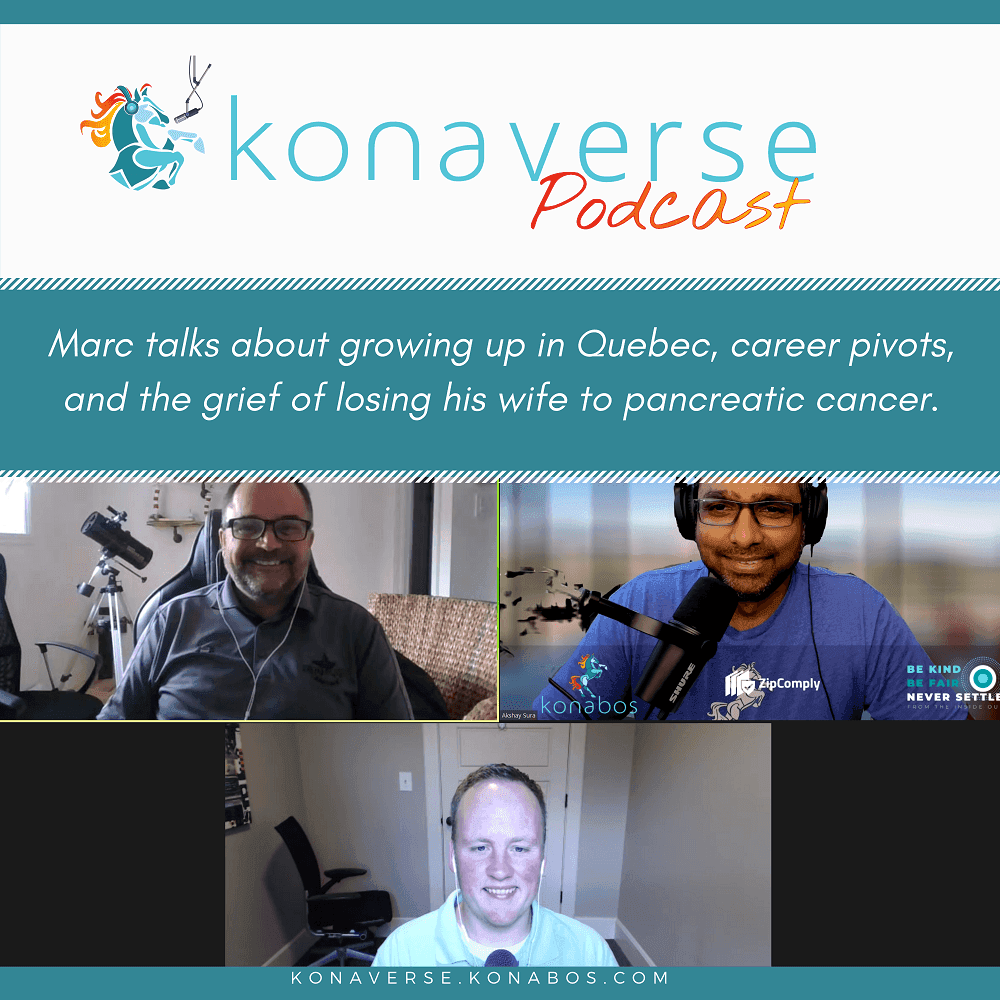
Marc Lamothe is CMS Systems Admin at American Bath Group. In this episode, Marc talks about growing up in Quebec, career pivots, and the grief of losing his wife to pancreatic cancer.
Intro
Welcome to Konaverse, a conversation experience platform hosted and curated by Konabos Consulting. Konabos is a global technology leader, and while this podcast will be connected by technology, the glue is human stories and narrative. Technology can bring us together. It can make our lives better and more efficient in myriad ways. But it cannot replace human discourse and the magic that can happen by the interchange of ideas. Hope you enjoy our podcast.
Akshay Sura
Welcome to the Konaverse podcast. This is Akshay Sura,
Matthew McQueeny
and this is Matt McQueeny.
Akshay Sura
Today we have with us Marc Lamothe. He is, I can't say he's a client, because he's also my friend. Welcome, Mark. How you doing today?
Marc Lamothe
Thank you. I'm good. I'm really good today.
Akshay Sura
Yeah, Mark works as the, I don't know the new fancy title.
Marc Lamothe
The fancy title is system administrator,
Akshay Sura
there you go, system administrator for American Bath Group. So Mark, we can get I guess it's Matt question. You can go Matt.
Matthew McQueeny
Sure. Yeah, that's great to have you, Mark. We always start here, right? Where were you born? And where did you grow up?
Marc Lamothe
I was actually born in a small town called Moose Factory in Ontario, Canada. And no roads go there to this day. So it was by a Military Air Force Base in Northern Ontario and my dad worked on the railway. So I was born there and I I grew up there until I was six years old, we moved to Northern Quebec and I spent the rest of my childhood in northern Quebec.
Matthew McQueeny
So, Mark, when you you literally say there's no roads that go there. How does that how does that work? How does how does one come to live in a place where no roads go?
Marc Lamothe
I guess my dad worked on the railway. So he was he was the foreman of the of the railway station there. So he was the general manager of that railway station. And they were mainly supplying the Hudson Bay Company. And there was a NORAD Air Force Base there in Mooseini, or near Moose Factory. I was born that was like, the town was Mooseini there was an island where the hospital was on and that was called Moose Factory, that's where I was born.
Akshay Sura
So rails go there, roads don't
Marc Lamothe
a railway goes there and planes would be there for space. But it's not there anymore. It's abandoned. But yeah, there was an Air Force Base and the railway.
Matthew McQueeny
And so Moose Factory
Moose Factory, that's where they make moose. So yeah.
They actually make moose there. That's, that's very interesting. So I'm in the I'm in the US, right. So and I think when we're oftentimes, so is Akshay when we're in the US, we we look at Canada and almost lose track of scale. Right. So when it's northern, you said Northern Ontario, like, what is the what is the point on the map maybe where, you know, it's this many kilometers from this or like, what do you when you orient yourself and tell people where you grew up how do you kind of?
Marc Lamothe
Well, I tell them, it's near James Bay. So then they get a sense of, you know, James Bay in the Hudson Bay, way atop so we were near really like five or 10 miles away from where the James Bay so I was born on that island in the Moose River and Moose River goes up to James Bay. So they it's about 1000 kilometers, I guess, or a bit more from Toronto. So yeah, it's, yeah, it's a ways, maybe more even. So it's a big ways.
Akshay Sura
Do you remember anything primary childhood, like when you were only six, so I don't really know if you remember
Marc Lamothe
I remeber going to kindergarten there. I remember seeing Northern Lights. I remember. I remember, it was dark. during the wintertime, all the time, the sun would come up and then go down three hours later. And in the summer, it was like light outside all the time. So the sun would go down nearly at midnight and come back up nearly like around three o'clock in the morning. So it was really special to to have those memories. I remember our dog I remember snowmobiling, with my dad putting us in the sleigh. I remember a couple of things, but not that much because we left I was six years old to go to Northern Quebec Rouyn-Noranda
Matthew McQueeny
Sounds a lot like what we hear of Alaska, you know, with where the lights are vibrant all day and they actually have baseball they have baseball leagues there that play overnight basically because you have lights.
Marc Lamothe
Absolutely. Yeah. during the wintertime it's and I remember like this snowfall was amazing. There was so much snow but when you're little you know, you don't have the same perspective. But I remember my dad telling me Yeah, some years there was like 12 feet of snow that would come in.
Akshay Sura
So do you still go up there for like relatives or
Marc Lamothe
I have never been back there. Close to there, like five or six hours away, but never back to Mooseini. I'm planning on going one of these days. Yeah, for sure.
Matthew McQueeny
And so you then went to Quebec you said correct? Whereabouts in Quebec. And what brought your family there?
Marc Lamothe
Well, my dad had to move for his job on the railway they were shutting down that I guess that section of the railway so he had to get another job. And that's where he decided to go was in northern Quebec. In Rouyn-Noranda town called Rouyn-Noranda. Rouyn is the French portion of the town and Noranda is the English portion of the town. It actually houses one of the one of the three largest copper smelters in the world. So one is in Ontario, that one is in Quebec, and the other one is in, in Russia. So it's one of the three and we moved there. Like I said, I was six years old. And there was a lot of English speaking people, because of Noranda, because of that smelter in the 30s, or 40s. I think a lot of people came from Poland and Ukraine to come and work in the mines in northern Quebec. So a lot of my my high school friends, are English and their Polish or Ukrainian, of origin. So yeah, they I like I learned to speak French, from my friends, actually, because my parents decided to send me to English school. So I went to English school until, you know, until I went to college.
Akshay Sura
So I just looked up Moose Factory and it's at the top most basically Hudson Bay
Marc Lamothe
Can't go much further, right?
Akshay Sura
Yeah, it's much further than I thought it would be. So that that is that's amazing. Quebec looks like it's a huge province, though, just in terms of landmass.
Marc Lamothe
I think it's the biggest, I think it's the biggest province I think only Northwest Territories surpasses it in the area.
Matthew McQueeny
So Marc, you were six, when you went from the one to the other was crossing was crossing that line, you know, between Ontario, and Quebec, was that like a huge culture change or did you even notice it
Marc Lamothe
Yeah it was a culture shock for us as as kids, like, I only spoke English and we moved to a French neighborhood, we didn't move to the English neighborhood because my dad got a job on the French side where there was two train stations in Rouyn-Noranda and he got his job on the French side of town, at that train station, for the ONR, for the Ontario Northline Railway. And, and so all the kids in my neighborhood would just speak French, and I would just speak English. And, like, that was really difficult. I was like, how am I going to make any friends but when you're six years old, you know that your your parents just kick you outside and you learn to you learn to speak the language eventually, maybe, like my parents were both bilingual. So I guess, like I knew some words, or something like that, because it wasn't that difficult to to make friends and to, you know, start learning the language. And French was the second language. So in school, they would teach us a lot of French.
Matthew McQueeny
So you said that your parents were were both bilingual.
Marc Lamothe
They were
Matthew McQueeny
Oh nice. What did your mom do?
Marc Lamothe
My mom was actually she was an accountant. She worked most of her life, different from other ladies back then they would stay at home but my mom, she she wanted to work and she would you know, she would she would buy us a lot of stuff. Because it's like she was the second salary in the house. So she would just she would just spoil us a lot. We were spoiled as kids.
Akshay Sura
How was the like, just schooling the neighborhood just growing up was it?
Marc Lamothe
It was awesome. It was really awesome the schooling like we we like, a lot of people say this, but we used to walk to school it was a couple of kilometers away. But we still, we took the bus sometimes when we were younger, but when we got to like, like secondary school, like, I guess after seventh grade, eight, nine, ten, eleven, twelve grade, we used to walk to school, but it was fun. And I had a lot of friends English, both English and French. And in my neighborhood, we would like the kids would play outside all the time was crazy. And there was a, like, I guess, this mountain in front of my house that we would play on this hill. It's not a mountain, it's more of a hill. But we would play on the hill all the time, winter or summer time, all the time. So it was it was just fun. It was just amazing.
Matthew McQueeny
So, Mark, the railroad brought your family there, right? What? What did a lot of the kids parents in? I'm going to I can't say it right, Rouyn-Noranda.
Marc Lamothe
Yes, that's good.
Matthew McQueeny
And I did study French, but it's been a while. What did a lot of the kids parents do in your neighborhood? Like, what was the economy like?
Marc Lamothe
Well, the economy was was good because the forestry, the lumber companies, and the mining companies were were booming. You know, so they like either they worked in the mines, or either they worked in the, I guess in the in the lumber or in the forest with the forest companies. So either you worked in mining or forest or any other job that would that would go with that. So a lot of people like my dad worked on a railway and most of our friends, like, some of them worked on the railway as well, because we lived in that neighborhood where there was the railway housing. So when one person left another person would come in and take take the house and take the spot.
Akshay Sura
you have any siblings smart?
Marc Lamothe
I do. I have two sisters and one brother. So we are two two an older sister, a younger sister than I, and a brother who's the youngest. So I'm the second of four children.
Matthew McQueeny
Are they all near nearby in in Quebec or are they in foreign land
Marc Lamothe
Both sisters are nearby. I live now on the outskirts of Montreal in the suburbs of Montreal. And so one of my sisters lives on the island of Laval, which is just off of Montreal, and another sister lives about 10-15 minutes from my house going north. And my brother still lives in Rouyn-Noranda. He still worked in mining. And so he's worked in mining his whole life. He still up there working in mining.
Matthew McQueeny
Wow. And so in terms of the locations, I mean, we have we have life to get through education and all that. How did you get to how'd you get to Montreal?
Marc Lamothe
I guess I just, I moved for a girl. So yeah, I moved with my ex wife. So we moved to Montreal, I had two daughters with my ex wife. And so we you just just the move was, was back there. I moved several times in my life. I've haven't been a person that stays in one spot for a long time. But now I've been in the Montreal area for about seven or eight years now. So
Akshay Sura
what brought you into technology, Marc?
Marc Lamothe
I guess it was always a passion of mine. I've got my first computer. I was 12 years old. I got a Commodore VIC 20. And so I started the I started coding basic on my Commodore VIC 20. And they would code all day to make this stupid little stick man. And so yeah, it was always a passion of mine. But I wanted to go into into technology college. I guess my parents didn't have enough money at that time to send me off to the college that would that would provide that for me the English college that would provide that for me in Ottawa, so they didn't have enough money. So they sent me to to our community college. And so I had to go to college in French. So that was a big, big step. And I guess I didn't make it I after a couple of sessions at college, I guess I dropped I just dropped out and started working. So I worked like odd jobs. I worked at the hospital, I worked on construction and then I went into printing for about 10 or 15 years, I can remember. And then I went back to school to learn industrial drafting. And when I was done that I was hired by Maxx, which is Maxx Bath, the company that I work for now, which was acquired by American Bath Group. So, I was actually the project manager for installation guides. And I did, I think, two or three weeks replacement on the CMS for some reason, they chose me and so I replaced the person that was going on vacation or something like that. I guess I did a good job, because he just kept me there for going on 12 years now. So yeah, so that's how I got into technology.
Matthew McQueeny
So you just like, let that pass quickly. But did you say 10 to 15 years in print?
Marc Lamothe
Yep. Absolute.
Matthew McQueeny
Wow, what was, what did that encompass like, that's a long time, you know what were you doing?
Marc Lamothe
everything in printing I worked on on saddle stitchers, I worked on the cutters that cut the paper I worked, I did about practically everything. I did a lot of school as well, it went back to school to college at night and on the weekends to learn more about printing. But I did work on some presses. But eventually I found my calling, which was the thermo binding, which was bookbinding. But the hot glue book binding. So I did work on those machines that make it called perfect binding. And what it does is it It puts the book together with the, I guess the softcover books. And so I worked on those machines for like about eight to 10 years. So on thermal binding, perfect binding books. Yeah, lots of fun. The machines are like 100 or 120 feet long, eight people in my team. So it was, it was fun, was fun while it lasted. But it was it was on the decline. Printing has been on the decline for the last several years. So had to recycle. So I recycled into industrial drafting, which I don't think I ever did any industrial drafting for any company. So so it just brought me to get a project manager job at Maxx and American Bath Group. So I'm really happy about that.
Matthew McQueeny
So I always like this question, because I think that often the things we do in life help us even if we do things that are different down the line, do you find that, you know, specifically that time in printing helped you be a better project manager, even of tech than you might have otherwise? It sounds like you had whole teams running these these machines. There probably has an analogue there, right?
Marc Lamothe
Oh, for sure. Absolutely. Because it helps you understand how every part of I guess the chain works, right? Because we would we would take, we had to take everything into account, because we were the I guess we were the gatekeepers were the final transaction before you put that that book in a box, you know, and you tape it up and you send it off to the client. So it had to be perfect. Right? So we would we would look at it. We said okay, did the graphic designer do his job? Did the print? Did the press man do his job? Did you know Did everybody do their job correctly? Because you're sending off a final, I guess a final product to a client. And so you want that final product to be perfect to send it off to the client. So yes, it encompasses all of what what you're doing for for the client. And so it's it's really going looking at every every one of those steps and making sure that everybody did their job correctly. So then when you push out your job, it's perfect. And so I guess it's the same thing with the websites that have I'm managing now that when you put something out the data, the images, all of it, the content, everything has to be done perfectly so that you deliver a perfect product. So you know, it's a good, it brought me to where I am today, I think so it helps me a lot and working with a lot of people so well throughout the company.
Akshay Sura
Nice. So you said you only been in the Montreal area for seven years. So where were you before that?
Marc Lamothe
In the Quebec area. We, Maxx Bath, does have a plant in there, about half an hour south of Quebec. So that's where I was based out of. So I've been with the company for about 12 a little more than 12 years. So yeah, I was there in Quebec, and then I moved to Montreal, maybe maybe a little bit more in the Montreal area, then seven years, maybe eight or nine. I cant I have trouble with, with years and when when did we move. You know, but it's been nearly 13 years that I'm with Maxx. So maybe three or four years at the Quebec plant and eight or nine years at Maxx Lachine in Montreal.
Matthew McQueeny
Marc I'm, I'm kind of interested in, you know, again, coming from the background you did then taking really taking on like enterprise technology systems, right. Was there a learning curve for you that was that was big? Were there things that that aligned easily in your mind that you could kind of move your way through because you're leading people too, right?
Marc Lamothe
Absolutely. Listen, I had the imposter syndrome for about three years, I felt like I was an imposter in this job. It was like, so difficult at the beginning, but I'm a self learner. So I could self teach myself stuff. And you know, that saying, fake it till you make it? Well, I guess I faked it until I made it because I'm here today, and I understand what I'm doing more and more every day. So at the beginning, it was very difficult. But I kept, I kept pushing through and pushing through. And I'm a hard worker, you know, some, some years, I remember doing like 50 or 60 hours a week, week, week, on week on week, like, for, like years on end. At the beginning, it was like I just put more time in that it was asked of me. So until I got to a point where I felt comfortable in what I was doing, you know, and I didn't have to teach myself anything anymore. I have a good memory. So remember stuff. I have good methodology. So I know how the work should be done and how I should do it. So I'm a hands on manager. So most of the time I I do the work. I don't just let my employees do the work, but I also do the work with them.
Akshay Sura
And how many kids do you have Marc?
Marc Lamothe
I actually I have four daughters. So two daughters from my first marriage. And my wife, well, I didn't marry at first I guess I married my second girlfriend. We got married like, I guess 2015 but we were together since 99. So she had two daughters as well. So we were married. A reconstituted family. I don't know how you say that in English, but reconstructed family or anything. So we have four daughters together. And I have five grandchildren going on six. So my youngest daughter is pregnant. So we're going to have a new baby soon in less than a month.
Akshay Sura
Oh congratulations. Is that the nursing daughter or is it?
Marc Lamothe
No, it's the youngest daughter so she is a stay at home mom. She has three kids at home. She's a stay at home mom and she's pregnant again. So the fourth
Akshay Sura
Someone with two daughters. I have to ask how difficult is it to raise daughters?
Marc Lamothe
It's actually very difficult. Some of them are less difficult than others. Listen. I guess I have some daughters that are way more difficult than the other. The two youngest ones are more difficult than the two oldest ones. So yeah, they dropped out of school. They had some issues. They have some, I guess some some problems they had growing up and but they're all adults now. And they they're mostly got their lives back on track. So yeah, it was it was very difficult though. It was for myself and for Nancy. It was it was very hard. For some years were very difficult. But we got through it. Listen. Yeah, it was it was difficult, but we we got through.
Matthew McQueeny
So Marc, these are all daughters are girl dads, right? I'm a I'm a dad of two young boys. But I'd almost ask from, you know, someone looking for advice a little bit. But when you're working all those hours, right? It tends to be when you're working these hours, and you're trying to build a family, right? The balance can be so tough, I think at times, like what were some of the things that that you did, or did you just kind of plow plow through
Marc Lamothe
We would always, always bring our daughters everywhere we could go. Make sure they followed. You cannot stay at home even when they were 12 or 14 or 15. You don't stay at home by yourself, you come with us, we do everything together as a family. And we were the type of family that would say there was no such thing as having a half sister or, you know, a step sister, there was no such thing as you're all sisters. That's it. That's the way you will act when you are with us in this family. If you go off and you go see your dad, or my daughter's would go see their mum, you can do whatever the heck you want at your mom's place. And you can call it whatever you want. But when you're here in this house, you are four sisters, and I have four daughters. And that's it. So that's was the way that we raised our daughters. And I'm really happy to say that today. Every single one of them has three sisters. No, not two step sisters and the sister. They have three sisters and that's the way they feel. And we have gotten stronger with time, we went through a lot of difficult things. I guess Akshay, as you know, my wife passed away last year. And it was very difficult. So now we are stronger than ever. Because we had to go through a difficult five years, my wife was sick with pancreatic cancer for five years. She had two huge operations, eight hour operations which were which were, which were like, the longest days of my life. And it was not easy to go through that. And she has passed away now for almost a year. And it was the most difficult time of my life. But I got through that that period. Well, being sick for five years prepares you and you know, there was no way out of pancreatic cancer, there's like, there's practically the survival rate is almost zero. So it's like it's very difficult.
Akshay Sura
So pancreatic cancer is like you said, it's extremely difficult. But how did you guys catch it? Because like Steve Jobs had pancreatic cancer, right? Some like someone we know, had a pancreatic cancer and within a month they passed away. So when did you guys find out? How did you guys find out?
Marc Lamothe
We actually found out by accident. It was, we were just lucky, I guess Nancy was extremely lucky in the sense that it blocked her bile valve. And so by blocking the bile, or tube, whatever you call it between the I guess the liver and the pancreas or it was between the pancreas and the gallbladder. I can't really remember where it was. But it blocked that bile tube and so she got jaundice so it started itching her all over because the bile was staying in her blood and it gets itchy and then and then we were off for the weekend. And when we came home she was like I'm not feeling very good. I think something's wrong with me and I was looking at her and I said well your eyes are yellow. You know you're the white of your eyes has turned yellow so you have jaundice so you probably have a liver problem or something something's going on there we have to go see the doctor and then the Monday morning we went to to see the doctor and they just kept her in the hospital and eventually they brought out the Big C word which was a slap in the face but you know it took took like two three days before they put everything into place but they're really good at what they do doctors and the nurses and the the the ease you into it. Eventually we just got sick and tired. Can you just say that she has cancer? You know, can you just say it and so we can you know we can deal with it. And yeah, the brought in the I guess the the specialist and they told us yes okay, you have a cancerous tumor on your pancreas and we'll need to operate.
Akshay Sura
So being Canada being like socialized medicine, like did you need private insurance? I don't even know
Marc Lamothe
Not even, tt was just it was just they were just fantastic. We had the best doctors they said this to the to the Montreal University Hospital. And so it was just we just had the best doctors, the best surgeon like that took care of us and we had the best oncologist. So we were just lucky in all points we were we got really really lucky. But the medical being being socialized is not such a such as bad of a thing that they make it out to be, you know, when you're really sick, you get the help that you need and you do. Like the people that complain, or people that are not all that sick. You know, they don't have that big of a problem. But when you have a big problem, such as pancreatic cancer, you get the help you need, you really get the help you need and it and it would have cost us like, I guess, I don't know how much in the states to get everything that you got, it would have cost us more than a million dollars, maybe two or $3 million to get those two operations and all they she had 43 cancer treatments, you know, and so it was and the people in the in the health system are just amazing. Just amazing. So I have nothing bad to say about the Quebec health system.
Matthew McQueeny
Marc, I had an aunt, gosh it's coming up on 10 years ago now who she was really close in our family and she passed away from ovarian cancer, which has kind of a similar thing in that it's hard to, it's hard to find unless certain things happen. And she did. She was found. And she she ended up living, I think about five years. But the thing that struck me and I was not as close, as you know, a husband and wife, obviously. But it just struck me how it becomes just an all encompassing journey and how almost difficult because it's like a mission critical thing, how difficult it is to like to almost let people into all that's going on and to, you know, breathe the outside air because you're so focused. I mean, what was that? What was that five year period like for you,
Marc Lamothe
it's a day to day struggle, it's a day to day battle, you need to wake up and embrace the day, and hope that this is not the last one. But at the same time, just keep hanging on to that hope and just going one day at a time. And if it if it's this is a good day, we'd spend it doing something, you know, especially if I was off work or something like that on the weekend. She'd have a good day, on a Saturday, are you feeling good? Perfect, let's go do something we'd always go on road trips, or any trip that we could go on, we would make it like. I think Akshay remembers that I brought her to a Sitecore symposium with me and it was just like, it was the best gift that I could give her, you know, we would do that all the time. As much as we could if she wasn't if she was feeling well, we just go off and do something. And so it was just a day to day thing that we could, anywhere that we could go or anything that we could do. If she was feeling well enough to do it. We just did it.
Akshay Sura
How did the kids and the grandkids take the take the news? And how did the process? Like how did? How did you guys coach them through things?
Marc Lamothe
It was really difficult. But to help them through it all, is just honesty. Just keep it real, you know, don't hide anything from anybody. It doesn't, it doesn't pay off in the end, just makes it more difficult. Right? It was we were able to prepare for that day, for her last day. By, through the five years that we had together with her. But we hid nothing from our children. You know, and I guess we even hid nothing from the grandchildren. They the ones that were old enough, William is my oldest grandson, he's, he's going to be seven. And actually he's going to be seven. The day Nancy died is his birthday. So which which for me is just like, it's just like a symbol of, of, you know, hope and it's like something she she just gave him a flower in the sense that here, here's my gift to you. You'll you'll never forget. He'll never forget his grandma. He loved his grandma. So he will never forget her. But we were we were always honest with all the kids, all four daughters. And even with William who is old enough to understand, he knew that his grandmother was sick. And he spent like all these time just talking to his grandma and he was he was an all the time he was so in love with with my wife. It was crazy. You just look at her, you know, and all the kids did because she loved them with her whole heart until you know that last day. So yeah, go ahead. Yeah.
Matthew McQueeny
So Marc, you were saying that it's it's coming up on a year. I'm just interested in just, you know, sometimes the passage of time feels very fast. Sometimes it feels very short, like, what does it feel like to think a year? Yeah.
Marc Lamothe
I lost track of time, actually, you know, at the beginning, it was very long as very angry for about a month, time, I guess, very angry, pissed off at the pharmaceutical companies and, you know, especially cancer, the Cancer Foundation that, like, I was just pissed off at everybody and angry. And so time went by really slowly and just, you know, going to the funeral and COVID didn't help anything. So the funeral was really small, with not as many people there as that would have liked to have been there that couldn't travel to come and pay their their respects. So that was really difficult in the sense that I like they couldn't have family over to what we did a little bit, you know, because we, we were outlaws at that point, we're just like, screw it, you know, screw this COVID thing, screw the government, screw you. You know, it's like, I just lost my wife, I don't feel like, you know, staying by myself in this house, you know, all by myself. You know, so yeah, we kind of countered that a bit. But most people that were like, most people that that live off a little further, they didn't come to, to the funeral. And you know, I don't blame them, because you can, like, some of my cousins live like 16 hours away. And they're like, brothers and sisters to me, you know, we we've spent our childhood together. So that was very difficult for them, but said, you know, coming 16 hours spending, you know, like two or three hours, and then going back home is not the best of solutions, you know, because we can't spend any time together. We can't go to the restaurant together. We couldn't do anything. So yeah, we're having a memorial on the anniversary, where more people will be able to come because we will have lifted a lot of these restrictions. So yeah.
Akshay Sura
So I'm just I'm just even trying to picture it, like every day not knowing if it's the last day, right, like you have to wake up in the morning, like I said, and make the most of it. But at the same time, you don't know if that is the last day you get with Nancy or not. So like, how did you know you're preparing yourselves, your kids and grandkids are being told that you know, you don't know, right? You don't, no one knows what will happen when when it will happen. What ended up happening towards the end? Like what in the decline of Nancy's health.
Marc Lamothe
A bout, I guess six months from the end, they told us that the cancer treatments weren't working anymore. And they like it was it was just going to make her weaker. So the decision was taken just to stop the cancer treatments. Of course, it was it was a really difficult one at that time. And the decline was, I guess, pretty fast. Like the first couple of months was okay, but the last few months. Were just downhill, you know, when you're stumbling down the hill, and you're trying to claw your way back up, but you can't, keep on stumbling down. That was the way it felt. It really felt like stumbling down a hill and you couldn't stop it. It was it was difficult in every sense. It was really difficult. So yeah, they had given us 6, 3-6 months and the six months wasn't up yet and Nancy had passed. So it was a it was a difficult time but we knew I guess in the end, we knew it was coming. You know, we both knew what was coming but still clung on to hope until that last week or so. You know, we we didn't have the difficult conversations until I guess it was not even a week before she passed. That's when we had those difficult conversations. And even then that he didn't want to talk too much about it. She just like she she clung on to hope until that last breath of air. She was she was a fighter all the way to the end, she was a trooper, she was super woman to me. Like nobody battles that hard, like I've seen people give up easier than that she never gave up until the end. Not one moment, he gave up. I tell her last breath.
Matthew McQueeny
So, Marc that's really, really deep, deep stuff. So, if you're to kind of look back seven years, right? Before kind of going into this, going into this process, I'm kind of interested in yourself. How did this change you as a person? How did it change, maybe how deep you felt like you could go as a person? And how did it change like your feelings maybe of love or strengthen them? Just from from your point of view.
Marc Lamothe
Yeah, it really it, when I go back to what I was, I took everything like a little bit for granted. Like, just a little bit, I never took Nancy for granted. But in a sense, you know, life in general, you take it for granted. Everything we see, like the sun shining outside the, the wind blowing through the trees, we take it like everything for granted. And, and when somebody gets that sick, and you know, it's a question of time, then you start looking at things differently. And everything, you look at everything differently. You look at your wife differently, but you look at your kids differently, you look at yourself differently, you start taking care of yourself a little bit more, you start taking care of the people you love more you start you know, I guess taking care of relationships, friendships, everything. You look at everything in a different in a different light and I've been, you know, I'm so grateful to have spent that time with Nancy and especially those five years that I got with her not many people get five years after they get a pancreatic cancer diagnosed. You know, they, like only 5% of people get that five years, or something like that. And so I'm very grateful to have had that time I can then I become I'm grateful for everything that I have now. And nothing matters more to me now than friendships and relationships. You know, and father, daughter relationships and father grand kid relationships, nothing matters more in friendships, nothing matters more now, that's all we have, really, that's all we leave with. We don't bring money, we don't bring anything. We don't bring material. All we bring with us is our memories, right? So make those memories the best you can whatever it is friendship or relationships or family, make them the best you can every day.
Matthew McQueeny
Absolutely, absolutely. And you know, you I mean, the last thing I would I would ask which just hit me when you were talking about this before happening, kind of before COVID You know, you're grieving and then it's hard in some ways because like then societies all the sudden has all this happening. And and there's so much grief kind of going around. And I don't know if I don't know in some ways how to ask this the right way but was did that allow you to grieve on your own? Or do you wish you had the ability to grieve with more people?
Marc Lamothe
No that allowed me to grieve on my own, you're right. It did allow me to allow the process to go like I guess I got through those steps a lot faster than I would have if I would have had people around me and I wouldn't have been a you know when the more you have people around you The more you spire role in that grieving process, because people are How are you doing? You know, and they ask all these questions and and it's okay. And you answered them, it's all fine. But when you're alone with yourself, then you go through the process of you know, the anger process and the and the sadness process and all those steps that you need to go through when you are grieving. They go through, I guess faster, but more intensely and it was it was very difficult for a long time. But I had a good therapist and and she helped me get through it. You know in a faster way and now I feel way better than I did 910 months ago, you know, when it just passed, I feel like rejuvenated. And with all of this and I, I feel just glad to have met her and to have been able to spend those 20 some years with her. And we got married, right after she got her diagnosis. So a year after she got her diagnosis we were we got married. So I just made her a promise that I wasn't going to leave her. You know, I was always going to be there for her no matter what. Through thick and thin and that's, that's what I that's what my promise was. So yes, it was a bit easier to get through it because it was COVID times.
Akshay Sura
How did the kids and the grandkids are alike? How do they continue to get over it? I guess because each one deals with the grief in a different way. Right?
Marc Lamothe
Yeah, it's it's difficult sometimes it depends on what the what the occasion is. But Nancy's birthday just passed on the 28th of June, on the 30th of June, sorry, my dad's birthday is on the 28th and he's passed away also. But yeah, that week was a very difficult week for the kids, you know, knowing that it was their mother's birthday and knowing you know, every, every time it was her birthday, we would do something special for her. But yeah, that was a that was a difficult time. So all those firsts are the difficult moments to get through. And everyone deals with it in a different manner. And the girls, the youngest one is the one that's hardest hit, she would call her mum, like three times a day. In the last five years, she would always call her mum for a recipe or for this or for that and my sister as well, my youngest sister, she was a good friend of Nancy's. Like, she would always call Nancy every day almost and they would talk like nearly every day. So yeah, that was difficult for her as well. So you know, when you when you turn around, and like, you're used to having somebody there, and then they're not there anymore, all of a sudden, they're not there anymore. It's it's really difficult. Like for all of them, they had a tough time, but we talk it through, you know. Like the youngest my, our youngest daughter, where I went to see her yesterday spend some time with her, brought my computer work from her house, you know, did a couple of things with her brought her to to do a couple of to a couple of her rendeavous. So yeah, it was. It's been difficult, but it's, it's, it's a struggle, like every day or every time something comes up. It's little battles that we have to that we have to deal with. But it's a lot within yourself, you know, within within your mind and your heart. So you need to keep to battle it everyday.
Akshay Sura
What kind of advice would you give someone in your shoes, going through a similar issue with the loved one? And like you got five years, you can look at it different ways, you only got five years. So you got five years to spend time with Nancy. So it's, it's about the outlook. So what can advice would you give someone in a similar situation?
Marc Lamothe
I would tell them to I would tell them to, to not fret about little things. And to you know, cherish every moment and to communicate as much as you can, with the loved ones. And with everybody around, make sure everybody aroun knows, and they know that this is their time. You know, if you want a little bit of time, take it now. Because it's it's going to be passed. And then it's there's no time to say yeah, I really wanted to do this thing with the with your loved one. But now she's gone. You know, that's the worst thing you could say to me. Is that because you had five years to you know, and so don't tell me that you didn't have time to do that. So I did. So you did too.
Akshay Sura
With with technology and stuff, right? And this personal story of my first cousin, she's actually a few months, as she was few months older than I am. It's the craziest story and it's in India anyway. So she passed away with cancer like a decade ago, but they had she had young kids. The family was never also the husband and the parents knew but even my cousin didn't know that she had a terminal cancer so she never was able to prepare with her kids or anything like that, which is a shame, we still think of her every single day. With the technology now was Nancy able to record any messages video or audio for her grandkids or anything of that sort?
Marc Lamothe
She did a lot. She did a lot before but nothing, nothing. A special because she didn't want to record any last wishes or anything like that. She felt that that was giving up. So she didn't want to give up. So she did. Yeah, she did a lot of facetimes with them. And she said a lot of recordings to, to William to to Liam to Emma, she said them all little snippets of recordings. So and like, I don't believe in in, in any special religion or anything like that. But I do believe there's a higher power. And I believe it even more now. because too many, too many strange things happen that they when Nancy passed it like I could tell you a lot of stories about that. But one story is that my daughter bowed a little bit of money to her preschool. And she didn't want to tell me because, you know, Nancy was sick, and she had just passed away. And she didn't want to tell me that she owed money. So she didn't tell me until that day, when Nancy passed away a couple of hours after she passed the school called her and said, and then an anonymous donor, paid off her, her debt, whatever that was. So that was, I was like one, one special thing that happened. But a whole slew of those things happen, like five or six or seven things like that happened and it was like was just amazing. And then, you know, she passed away at 333, which is the hour of angels that that it's called. I didn't know that until someone told me. So that kind of a lot of special little things that happened and so that we're grateful for.
Matthew McQueeny
I think it's important to tell stories like that, because I really do believe there. There's whatever we believe in, there's something else going on, right? There's something that's unseen. And I just if you guys wouldn't mind, I'd love to just tell a really quick story about my about my aunt who passed away from ovarian cancer, that that is almost weirdly, it's got the similar happenstance thing. So she had the opportunity to be in a PBS documentary on ovarian cancer called The Whisper and in this documentary, she focused she has she's had two kids, a daughter, who was probably a late teenager at the time, and then a son who was in his early 20s. And this documentary ended up focusing a lot on her daughter and how she felt she was going to feel terrible that she would be left behind you know, which makes total sense for the story and but the son never had a similar thing. You know, queue up several years later, this might have been three or four years ago. I see on Facebook, one of these I live in a part of New Jersey or did called Bergen County, and they have this thing called vintage Bergen County where they'll show old pictures, you know, these things like old media from it, and then there was this thing that popped up that said, Hey, a video from 1985 Christmas Eve, in Bergenfield, New Jersey, and I was like, Oh, my mom grew up in Bergenfield. Let's just see this video. I'm telling you guys 30 minute video, and I'm sitting there watching it, because I'm just seeing people go about their lives and all this all the sudden, and why I'm watching this whole thing I don't know, right? All of a sudden, minute 18 my aunt shows up in the video in a store holding the son as a baby at this point. And basically in this video is like, it's going to be our first you know, first Christmas with him. I love him so much. He means the world it was like her way of almost evening it out and giving the message in this crazy VHS video. 30 minutes that stitched onto the internet. Like, why did I watch that? Why they go all the way. And then I shared that and he was like, I was almost crying. And so there's something else going on. And I don't know, you know how that ties but I love that story being told.
Marc Lamothe
Yep. Thanks for sharing that.
Akshay Sura
Yeah. And Mark is that when you started your woodworking, or like creating those drift wood -
Marc Lamothe
I actually started just a little time before Nancy. Before it passed away, I guess A couple of couple of months before she passed away I think I was I had this piece of driftwood and then say I'm going to make something out of this mentally and I said it looks like it looks like a boat bottom you know I'm gonna make a sailboat or something like that that was my first piece that I made a sailboat and I made one and then I waited like for the longest time before making any others but when Nancy passed away I made a whole bunch of them I have made a whole slew I gave some to my daughters I gave some to some of my friends it's just like a passion of mine making these sailboats out of driftwood and pieces of wood and now I moved on to making other things like the lighthouses and that you see behind me here the lighthouses and I made also made a hobbit house as well and some other some other things but I love woodworking and so and and wood as a whole so I make a lot of these things out of driftwood so I find pieces of wood and then I look at it and I see something and I just put it in my pocket or put it in my in the trunk of my car and so I'll bring it home and I'll make something out of it you know eventually So yeah, I have a lot of these pieces of wood at home that I haven't done any good thing I have this house all to myself there's stuff but yeah, I do a lot of woodworking and and working these well woodworking I would call it woodworking but it's more artisan stuff that I do with the driftwood. Yep.
Akshay Sura
Yeah, that's awesome. So I'm assuming the woodworking kept you, I shouldn't say distracted, but kept your mind a little bit focused on certain things.
Marc Lamothe
Yeah, it takes the focus off of off of the grieving, that's for sure. It keeps you like it takes like a few hours to make one of these. So it lets me like it takes my mind away from every anything and everything. just focusing on this one thing that I'm doing and making sure that it's done the way I see it in my mind. You know, so I can I can focus on that and everything else goes away. And so yeah, it helped a lot to get through that.
Akshay Sura
So what's next for Mr. Marc Lamothe
Marc Lamothe
Next is, no I go with the flow. I tried to live again, I try to live again, every every day, you know, of my life, in search of I guess I don't know exactly what I'm looking for but I'm looking for something, you know, that's out there. But at the same time, I'm learning like I tried to learn something new every day. Either it be technology, either it be my woodworking either it be my kids, my grandkids or other people out there, there's people to see places to go. And that's what I want to do with my life. And I want to be a part of it. Like every day now and, and go out and marvel at things that people don't marvel at anymore. The trees and the birds and the and the sun shining and even the clouds and the rain. No, let's marvel at this every day. It's a it's it's, it's a marvel, life is. So that's what's in store for me. I'm going to live every day every second, marveling at everything.
Akshay Sura
All right, final question. So if you were to go back and give yourself advice to the 18 year old Marc, what would that be?
Marc Lamothe
Wow. I tell him to pursue his dreams and not let people hold him down and don't be afraid of anybody or anything. Because you can get through anything you want to. And you know the only thing that matters is how you feel and how people make you feel. So if people don't make you feel good, you don't need them in your life. Only the people that make you good feel good do you need in your life. I know you need your family and family is everything. And they're the ones that will still be there 30 or 40 or 50 years later, nobody else will be. So family is important. And it's important to take care of yourself, your body and your mind. So that's what I would tell him
Akshay Sura
Nice. Thank you so much mark for taking your time. I'm sure there's a lot more to dig into what makes Marc tick. But yeah, this is a good first episode. Thank you for sharing your very like close and personal information. I know it's not easy. It's a fresh wound. So we appreciate everything you've shared with us.
Marc Lamothe
Thank you very much, guys. It was a pleasure talking to you guys and hoping that I can come back and give you some more information about what makes Marc tick.
Akshay Sura
Yeah, absolutely. Have a good rest of your day Marc.
Marc Lamothe
Thank you, you guys too.
Outro
Thank you for being during the Coronavirus. We hope these discussions gave you something to think about helped you learn something new and provided a window into someone else's story. Everyone's story is worthy and important. Until next time, remember to be fair, be kind and never settle.

