Kontent-Uniform Integration with Vojtech Boril & Tim Benniks
KonaverseJuly 29, 202120:5119.09 MB

Kontent-Uniform Integration with Vojtech Boril & Tim Benniks

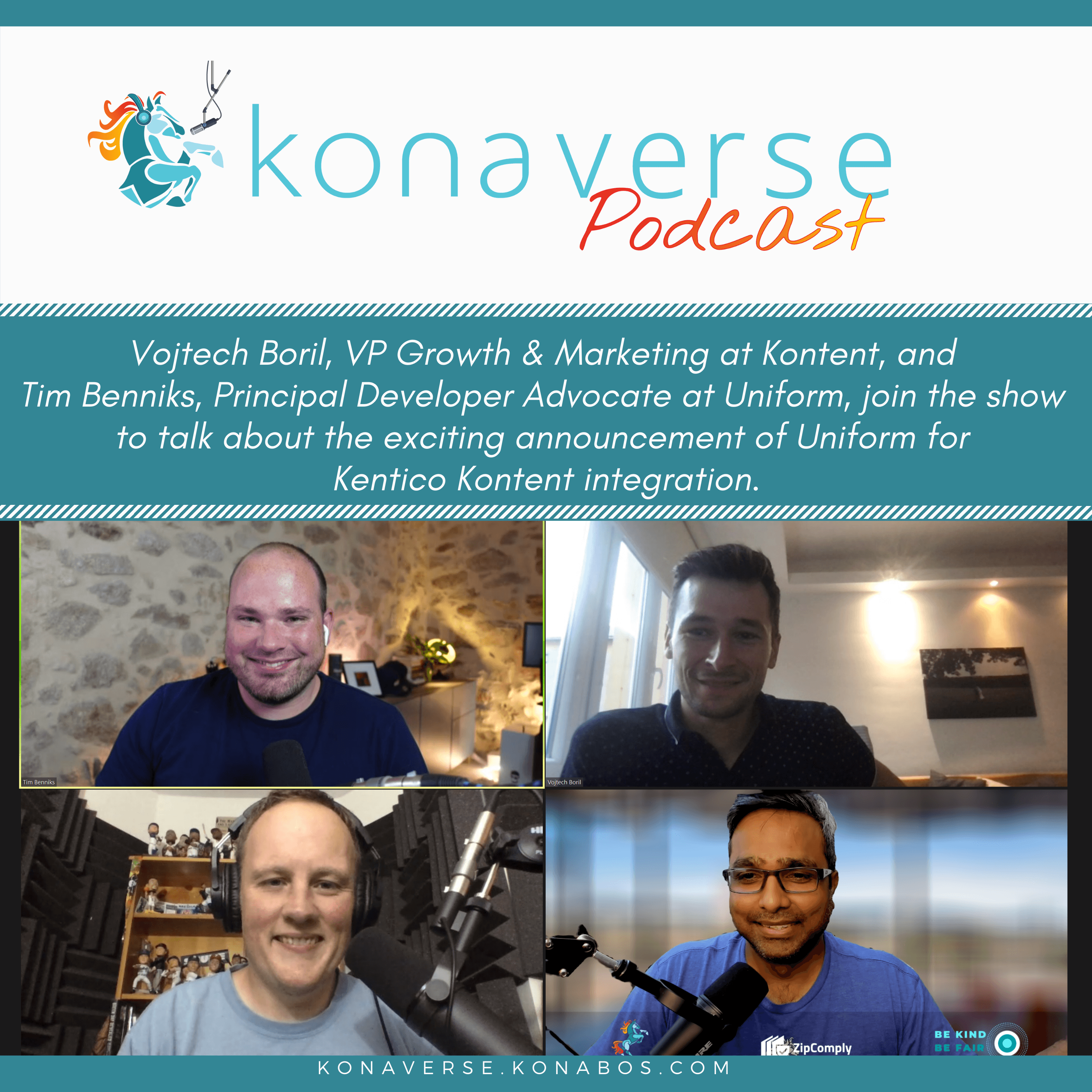
Vojtech Boril, VP Growth & Marketing at Kontent, and Tim Benniks, Principal Developer Advocate at Uniform, join the show to talk about the exciting announcement of Uniform for Kentico Kontent integration.

Intro  
Welcome to Konaverse, a conversation experience platform hosted and curated by Konabos Consulting. Konabos is a global technology leader and while this podcast will be connected by technology, the glue is human stories and narrative. Technology can bring us together, it can make our lives better and more efficient in a myriad of ways. But it cannot replace human discourse and the magic that can happen by the interchange of ideas.

Akshay Sura  
Welcome to the Konaverse. This is Akshay Sura

Matthew McQueeny  
And this is Matt McQueeny.

Akshay Sura  
Today we have Vojtech from Kontent and Tim from Uniform to talk all about the newly released integration with uniform and Kontent. Welcome, guys.

Matthew McQueeny  
super happy to be here. Absolutely. Why don't we get to the, why don't we get to the to the heart of it, the the news of the integration of Uniform with Kontent, and we'll come from both angles. And why don't we start with Vojtech? What does Uniform kind of officially coming into Kentico Kontent mean to your organization and platform?

Vojtech Boril  
Sure, sure. So hello, again, everyone. It's great to be here. Thanks for having me. Yes. So first, if I should provide very quick asnwer, Uniform is just a great technology partner for us. And that's the first thing because behind all those products, there's always humans and people who we work with. So that's very important to say. But if I go a little bit deeper, you guys know that Kentico Kontent is a headless CMS and if we consider a whole technology stack its just like one component of the composable DXP, you might say. Soo for us, it's very critical to work with other vendors who cover those other parts of the puzzle. And if we take a look on our customers, like large organizations, large global companies, they always have very simple needs to deliver not only the great content that is served from Kentico Kontent, but also deliver the content at the right time, to the right audience and with the right context. So for us, it's really important and great to integrate with platforms such as Uniform, because this is exactly what are the partnership of Kentico Kontent and Uniform does. Really providing contextual content at the right time.

Matthew McQueeny  
Yeah. And then Tim, probably from your angle, I mean, you know, you go to the site, we know the product, we'll probably talk a little bit about it, of course, because not everybody knows the greatness of Uniform. But when you look at the introduction, you look at you look at the drop down, you know, you got the integrations with a lot of the a lot of the platforms, we all talk about headless and  head full, so are with head. How about from your end? What does the partnership here the announcement mean, on the Uniform side?

Tim Bennik  
Well, what we are, as was just said, We are kind of in the context of the DXP, right? We are not the website, we are not the content, but we are in the context around it to make the thing successful. Right, so we are like an extra block on top that make that work. And without our partners, that doesn't really happen, right? We kind of need to be integrated with the places that actually offer up the content, but also at the front end site or the CMS side. And so we are looking for partnerships with people that we like, and that have great systems, and Kontent or Kentico Kontent is one of the top ones and when we heard about this, like, should we partner we're like, yes, please. This is amazing. And so this kind of helps us accelerate our story. But also it helps customers that have always, you know, asked about, Hey, can we do personalization? Almost all CMS? say "Yes, sure." But there's all these extra things around it that makes it a little complicated traditionally, that is, but now that we have composed DXPs and API first stuff, we jumped on that. And then we are basically really well, we hope to be an easy extension to make these things work. Right. And, yes, we're very happy with that partnership means the world to us.

Akshay Sura  
Yeah, no, we love both of you guys. So it's, it's an awesome marriage. For us. It just makes it so seamless. And it's right in time. So we've been going back and forth with the Uniform, a little bit about this current customer is moving over about 25 brand sides. And it's just just in time to get the Uniform integration because I don't have to do anything custom. So that's awesome. 

Tim Bennik  
Nope, I did that just now for you. 

Akshay Sura  
So Vojtech, what does it take for like a tech partner to become a technology partner for Kontent? Like what's the process? You know, how do you typically work with technology partners?

Vojtech Boril  
Yeah, that's a that's a great question. So maybe let me take it one step back. The first important thing is that we have two partner programs. The first partner program is for implementation partners, digital agencies, typically large agencies that work with bigger clients, let's say such as Konabos, such as you guys and that's one of the programs. But the second one, which is more like ecosystem, that's our technology partner program and does the program where we now welcome to Uniform. So the typical process is that it's a little bit of both dimensions, we always prefer to work with people we like and this product, we enjoy. This, by the way, also why I'm so excited personally about Uniform, because I always enjoy when I get to a new product, and I can't wait to use it myself and it's a good time. So that's very important. But to sum up the process. So we in our ecosystem, we have technology partners, ranging from different disciplines, from ecommerce to marketing, automation to personalization, you name it, you name it. So for us, there are a couple of critical criterias the obvious ones, or if it simply works together, if it's API First, it makes sense to integrate. And then also, to be completely honest, it's also about the market fit. If if the partner targets the similar customers, and because of course, we are not volume driven. We are not like for freelancers, for example, we have seen before bigger companies who have the need. So even though we would love to integrate with everyone, that's clear, we need to choose our battles. And it needs to make sense. Yeah. So that's, that's quite about it. And then, from a process perspective, we do have our Technology Partnership manager, who typically oversees the process for integration. And then it depends really, if the integration happens on the partner site or on our site, it depends on the use case. Yeah. And then of course, also, we, we cooperate with the partner on co-marketing and sales and all the things and in fact, just today, I send an offer for new partnership marketing manager. Anyway, long story short, the partnership is not only about the integration and the technical aspect, it's also about relations, sales, marketing, you name it.

Tim Bennik  
And it's really on our end is great, because we're learning how your system works, and how you guys approach your clients, how you work together, what you value in a partnership, and for us being a smaller company, we get to learn from that a lot. Right? And so when I started to work on this integration, I just went to your Discord. And I asked one question, and in two minutes, I was up and running. So that means you value that partnership. And that is great to work with people who think alike in that sense.

Matthew McQueeny  
Tim, what is the, I'm interested in like the technology aspect of deciding and then building for new platforms. Like how long does it take? Was it pretty seamless with Kentico Kontent?

Tim Bennik  
With Kentico Kontent, it was definitely pretty seamless. Like the thing is, we have done these integrations before. So we came up with the initial idea of how you could do personalization in an API first world. And that means no origin, right. And so I won't go too deep in all that tech now. But we have had a couple of systems where we had to try this and with some clients and trying it out ourselves. And we figured out, we don't need that much of data adding to the CMS, because we try to be truly, truly headless and API first, right. So the only thing that we add with our integration is a little bit of Jason that goes into the model of the the content component, basically. And then the rest is dealt with in the front end on the client side, as it should be, right. So we are not imposing a whole bunch of rules and regulations and a whole bunch of stuff into the system. However, the stuff that we do add in that you can add to a model in Kontent can be quite complex. So that's why we decided to do a field because we work with something called intense and signals and enrichments for personalization. And on an intent is basically the goal that the user can have on a website, right? So you can tag certain pieces of content with that intent. And then in the front end, our SDK is smart enough to figure out what is the goal of the user and show I will show that piece of content. So the only thing that our integration does is tagging that piece of content basically in the CMS. However, there are so many granular rules that you can apply because you can say, this piece of content can only be shown when you have seen three times, right, there's a threshold to how much information needs to be sent. Or, you know, if you find a certain thing, you give a certain signal, we have to actually remove personalization score for that piece of content. And so, in essence its very simple you just stack a piece of content with it but in the context of that piece of content, you can also add some variations. So that's why you don't you don't want to be building your own custom integration for that. Because we know all our user journeys. We know every rule. And so luckily, the SDK of Kontent is super easy. Right? You just give it you have a you have a bit of JavaScript that deals with the size of the iframe, and how you actually add it to the model. And so yes, this was to us that was relatively simple to integrate, luckily, and knew all the business rules, and then suddenly just goes, 

Akshay Sura  
That's awesome. Tim, from a marketer perspective, how easy is it to get access to Uniform? Do you guys, I know you provide a free version are you used to, like is it easy for them to jump in, set things up and play around? Do you have enough document 

Unknown Speaker  
Yeah clearly. This is the thing, right? We are a company that works a lot with enterprise. This is the same as Kentico Kontent, we're in the same level. But we are also next to being a company that deals with a lot of marketers, we also are, we're developers. So we give a free account. So people can click around. And then when they love it, they can convince their boss to actually then move forward and maybe use a content, CMS and our integration. And so what we've done to get started quickly and to feel a bit impressed, basically, we have an onboarding flow and right, so you can just go to Uniform dot app, create a free account. And then you can actually click the CMS that you want, then you can click the CDN where you want it to host you can click, do I want to start a site in Gatsby? Or maybe I want next year, or I want next? And do I want to integrate my analytics tracking for personalization, it used to click click, click, click, hit play, and then it actually puts it on netlify or forshell for you. And it creates you a GitHub repo and all of that stuff. And so we just did that. So it's easy to get started and to see how this thing works. And then later on, you can do that again, and do your own thing, of course. But yes, it's actually very easy to get started. Because we just want developers to see this thing that that's also my journey at uniform, right? Because that's the interesting bit about personalization. I've worked at agencies my whole career, we're talking 15 years, working for Chanel, to Heineken to Nike, these kind of brands. They all wanted personalization. But we almost never did it, because it was kind of complicated to set it up in a traditional way. And you know what, they didn't have headless CMS back then. So it was all quite complex. And so developers are not used to the fact that personalization is actually relatively easy now. And so that's why we wanted to make it super easy to get going and see that black magic in action, like six minutes after, right deployed and all. So there you go. That's, that's what that came from.

Matthew McQueeny  
That was a great question in our last one was going to be which may be you answered Tim, but we'll give you the chance to answer it again. Start with Vojtech. You know, coming off of this podcast, with this partnership, this integration in place now Vojtech, what, what do you want the customer to do now?

Vojtech Boril  
Yeah, that's a great question about maybe before I before I answer, let me just follow up on things that because I think Tim mentioned some very good points. And I feel as I mentioned, my own team in my department uses of course, Kentico Kontent, but now they can't wait to use Uniform, right. And I think what's very importantly, for this partnership and this integration, the thing is that for marketers, the reality is that it's still a little bit challenging to get used to the headless CMS and Jamstack, right? It's just very different approach for them. And for marketers, being able to personalize simply by clicking and setting up some intent and signals, it's so so easy and they finally understand what is going on and now I'm not under estimating them. It's just like, they want to see the work in front of them. And they want to see click click, and it works. So that's, I think, a little bit of game changer to the Jamstack architecture, because they don't need to go to developer mode to set up everything every single day. So just wanted to emphasize that because that's my own experience from my team. Yeah, and to, to answer your question, Matt, I need you to repeat it to be honest.

Matthew McQueeny  
Of course, you know, a lot of exciting stuff that's probably answered much of it but kind of what what would you like the, what would you like the customer to walk away from this podcast with and do other than buying? 

Vojtech Boril  
You know, I mean, to be completely honest, for me, the buying step is the last one right for us is the first thing is to really solve some customer pain and problem and make sure that it helps them with the way of things how they are doing. So really, the buying step is the very last one. Well, I would love for customers first to really think of all of the operations and whether it makes sense or not to move from traditional way. I mean, just don't approach, really all in one solutions to composable DXP, whether it makes sense. I'm not saying that it's a fit for every single customer but we are definitely seeing more and more large organizations moving to the composable DXP, because they realize is that simply typical customer already uses multiple micro services. And it simply doesn't make sense these days to buy one huge monolith and then use only 20% of that. So I would love to recommend and encourage all the customers to give it a try. And, and really, don't be afraid to use best of breed services for things you do and for things to love. And then don't be afraid to to experiment. Because people who don't experiment in 2021, I don't want to be too harsh, but you simply need to innovate, whether you are a customer, vendor or partner or agency or you need to innovate. So I think that's a good conclusion.

Matthew McQueeny  
Absolutely. And then I'll just give Tim the final say, which I'm guessing is going to be a play on that a bit. And how much work it sounds like you've put into the the trialing of the of the systems, right?

Tim Bennik  
Well, the thing is, we our goal was to make this personalization thing and also with that AB testing because the tech is really similar to make that so much simpler now that people can actually start to think about their story again. Right? What is the story of my site? What do I want? Am I a cosmetics brand? What can I do with personalization to make sure that people get the right stuff with the right things? Because you can get it really wrong with cosmetics, right? And so what I really want to do is now that personalization is actually easy. Well, operationally, it might not be that easy, because you have to come up with a story. But technically, it's now easy. And so I would encourage people to actually go back to their marketers, and now actually make them happy rather than sad. Because you can now say, Come up with whatever you want with these products rather than oh crap, shall we do it in version 16? Should we just first deliver this thing? Like every job I had at agencies, for every client we discussed, Yes, let's do personalization. And then when later, later

Akshay Sura  
Phase two is what they always say, never happens 

Tim Bennik  
And, you know, and it's generally not even phase two, because that's bug fixing, right. And so now that and you know what the thing is that gives project fatigue a little bit. You want things you struggle, you can't really get it and then you're already put on the next project, but you haven't really finished the thing that you want to do for that campaign or, and so we're trying to battle that fatigue a little by making it easy. So, personalization, and all that stuff can now be in your MVP, which actually all I mean, to say by that is going think about what you could do with personalization and only then buy, right. So buying is again, the last step because I want to get people into that ecosystem and be happy. Right, and then see what you can do with these campaigns. And suddenly, people start to realize how cool an experience can be. And then they won't even notice it's personalized anymore. And then suddenly, you start to get cool things, right? So it's a bit might have been a bit of a different direction. But before I already said good, just go to Uniform dot app and try it.

Akshay Sura  
Yeah. Awesome. Thank you so much, guys for jumping on this podcast with it's really informative and useful. And I can't wait to do a bunch of things with the Uniform on Kontent. So I'm sure I'll I'll be very vocal and public about it so you'll be hearing from me soon

Tim Bennik  
That's what we like, honestly, if you guys have any questions, and you're trying this stuff, just reach us. Right? You can just, either on our Slack, but you can also just go on Twitter and complain about something, we'll be there. Right and I know the content guys do the same. And so with that we can build this community and actually make it happen.

Vojtech Boril  
Absolutely. Alslo want to invite everyone to our Discord. And as Tim mentioned I think both of our companies are very customer centric. So anytime you reach out, we are there for you.

Akshay Sura  
The best customer service on the planet is Kontent. That's so far that's my that's my experience every single time I had to use it and I haven't had to use the support for Uniform yet but yeah, they both they both at the companies are really sweet and very customer centric. So thank you for that.

Tim Bennik  
And we haven't had many complaints just yet, but we have customer service. We have a customer success manager. Everything is in place shoot him some tickets make him busy.

Akshay Sura  
Alright guys, have a good rest of your day. Thank you. 

Vojtech Boril  
Thank you. 

Tim Bennik  
Thanks again. Cheers.

Outro  
Thank you for entering the Konaverse. We hope these discussions gave you something to think about helped you learn something new and provided a window into someone else's story. Everyone's story is worthy and important. Until next time, remember to be fair, be kind and never settle.