
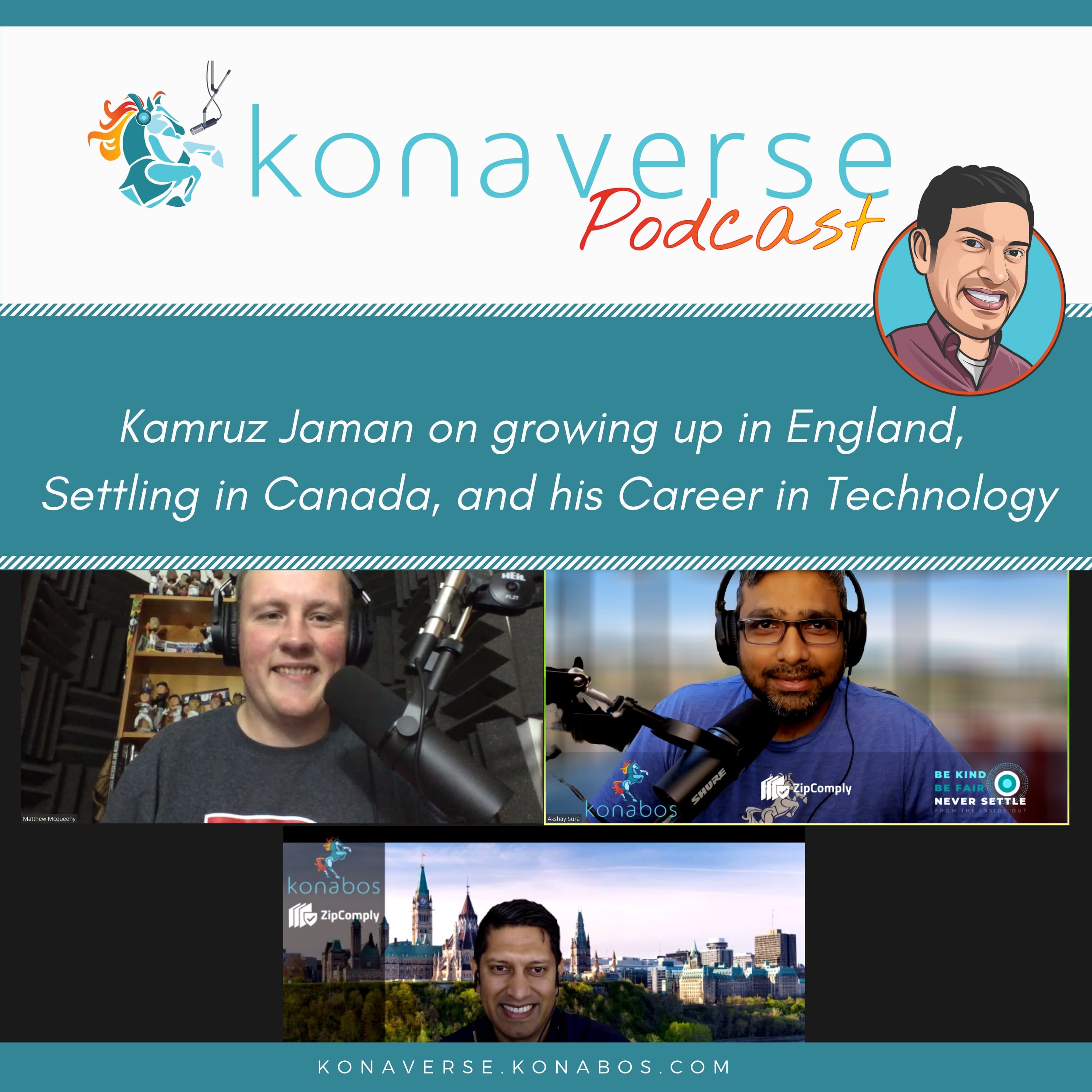
Kamruz Jaman on growing up in England, Settling in Canada, and his Career in Technology
KonaverseAugust 09, 202149:3239.69 MB

Kamruz Jaman on growing up in England, Settling in Canada, and his Career in Technology

Kamruz Jaman is a partner at Konabos Consulting Inc. and an eight-time Sitecore MVP. In this episode, Kam talks about his birthplace of Bangladesh, family, growing up in England, finding his way into technology, and growing his own family in Canada.

Intro  
Welcome to Konaverse, a conversation experience platform

hosted and curated by Konabos Consulting. Konabos is a global technology leader, and while this podcast will be connected by technology,

the glue is human stories and narrative. Technology can bring us together, it can make our lives better and more efficient in myriad ways. But it cannot replace human discourse and

the magic that can happen by the interchange of ideas. Hope you enjoy our podcast.

Akshay Sura  
Welcome to the Konaverse. My name is Akshay Sura

Matthew McQueeny  
and this is Matt McQueeny.

Akshay Sura  
And today we have my dear friend Kamruz Jaman, who's also my business partner and have known him as a fellow MVP for a long, long time. Hey, Kamruz, how's it going? 

Kamruz Jaman  
Hey, guys, yeah, things are going well. Busy as always, but yeah, enjoyable.

Matthew McQueeny  
So when Akshay says MVP, it's funny in the Sitecore community, right? Because you can be an MVP of anything. You have to say Sitecore MVP right, 

Kamruz Jaman  
minimal minimum, minimum viable product, right.

Matthew McQueeny  
 I guess that's what that's what life is. Kam, we'll we'll start where we always do. I think you have a really interesting upbringing and just in the all the places you've been, where were you born?

Kamruz Jaman  
I was actually born in Bangladesh. Most people think it was in the UK. But I was actually born in Bangladesh in some tiny little village, farming village, out in the north, northeast of Bangladesh. Fairly close to the border with India, right on that region that kind of loops around from Bangladesh.

Matthew McQueeny  
And what did your parents do?

Kamruz Jaman  
My dad actually emigrated to the UK when he was early 20s and then kind of found his way through life, if you like. My mother was, she just grew up in a village got married and then, like most women of that culture in that generation, she actually didn't work for the longest time. eventually moved to the UK and did some work in later life. But at the early stages, she didn't work. And I've from a fairly big family as well. So the fact she didn't work, like paid work, I'd say she'd probably worked a lot more than most, because I am from a big family. There's a lot of us.

Akshay Sura  
Yeah. How many siblings do you have Kamruz?

Kamruz Jaman  
I've got five siblings. Yeah, I'm one of six. Four are the brothers and one sister. 

Akshay Sura  
are you the youngest?

Kamruz Jaman  
No no, I'm number four. I've got a younger sister, and then a youngest brother.

Matthew McQueeny  
Wow, and what do the, what do they do in life? 

Kamruz Jaman  
So the oldest two are into kind of property and property development. They were in the restaurant trade because they followed in my dad's footsteps originally. My sister used to work in corporate banking. My youngest brother has probably had the most varied career of anyone. So having listened to Mike's podcast earlier there was some similarities of that as well. He's, he's done a multitude of different things and he was working as a he was working in finance as well as a stockbroker for a while. He went into IT as a Cisco engineer for a while. And he's kind of jumping between that and doing some property stuff at the moment.

Matthew McQueeny  
And how long were you in Bangladesh growing up?

Kamruz Jaman  
I wasn't there long. I was 13 months old when we had shifted over. I don't remember much of that, that part of life. So yeah, for the most part, I grew up I grew up in the UK.

Akshay Sura  
How was growing up in the UK in the place? You were fairly close to London, I assume.

Kamruz Jaman  
Yeah. We grew up in the suburbs of London. Most people, the nearest landmark that globally people recognize is Wimbeldon, where they have the tennis right, that was about five or six miles away from where we grew up. But yeah, it was it was considered right in the sticks and in those times, I guess where as expansion has happened. It's fairly close. But yeah, we grew up about 20 miles outside right on the edge of the greenbelt.

Matthew McQueeny  
And what was it like growing up in London? Or sorry, in the UK as a kid outside London?

Kamruz Jaman  
I mean, it was. Yeah, well, I mean, the son of a migrant growing up on you know, fairly low income. At that time. My my dad used to just work in a restaurant just as a, he eventually was a chef. And then eventually, in later life, he actually did own his own restaurant. But growing up, it was a son of a migrant, one of four kids when we first migrated over, none of us spoke thelanguage. My dad barely spoke much English broken English right so you kind of muddle through life, as you do in a low income, low income family. It was what we considered normal for those times. I mean, looking back, it's it's anything but normal. But times have changed, even from living standards, but also across to people's attitudes, people's outlook to foreigners, as well.

Akshay Sura  
Yeah, so it must be It must be hard. The reason I say that is, I have a cousin in England. So my aunt is English, she's Caucasian. He looks Caucasian to me. But he mentioned that he had to go through some name calling. I had to go through some name calling when I was there, I was called a Paki quite often. I'm assuming back in the day, when you were growing up, you had to go through the same stuff through school?

Kamruz Jaman  
Yeah, it's fairly normal to go through that, unfortunately. And to add to that, I grew up on a council estate. So it's what you would consider low income housing, right? So it wasn't, we weren't, we weren't we weren't affluent at all, we, you know, there's a tight squeeze fitting a fit fitting in a three bedroom apartment, essentially, for all of us. But it's also without a low, low income households, which, unfortunately, the attitudes are never, never great. So yeah, as a lot of name calling, got into a lot of scraps growing up, got into a fair amount of minor trouble, luckily. But yeah, it was, it was fun as well, you know, the the growing up in a state like that, there was lots of other kids around as well, you know, fortunately, the majority of the kids did not have bad attitudes, it was just a minority of the kids. But, you know, a minority is it's still the same that to this day, right? There's always that minority, that gives the majority a bad name, unfortunately,

Matthew McQueeny  
Did, did you end up in that kind of living environment being around a lot of cultures or were the cultures kind of siloed together.

Kamruz Jaman  
So where, so where we grew up, it was not very multicultural in those times, in those days. We're talking almost 40 years ago onwards, right. In the suburbs of London, there was mostly white neighborhoods. I was like one of maybe four or five foreign kids and in my entire year at school, so it was and that probably compounded on on the racism, right? Because there's not so much of those into cultural mixes and stuff. A lot of my cousin's, they grew up in central London, which there was a big, much bigger mix of foreigners and multiculturalism. But on the flip side of that, there was a lot more kind of counselor states, low cost housing projects, a lot more crime. A lot more, I guess, bad influences that went with that. So it's, it's kind of,  to our cousins, you know, we were the posh ones because, you know, we had the posher accents for them. And they were like, Oh, look at them all fancy with their accents and stuff. But it was just two sides of the same coin really, to a large degree.

Akshay Sura  
So when did you get into technology Kamruz, so like doing that, like when did you know that's where you want it to go?

Kamruz Jaman  
I tinkered with tech for a fairly young age. I didn't know that was what we wanted to get into, right? I mean, we could afford computers and stuff as a kid but a friend of my brother's, his mom used to work at a center that used to teach computing for, especially for adults and stuff. And we used to go down there occasionally at the weekends, this was back in the day when you'd have those five and a quarter inch floppy disks, right. So we'd go down there, because we'd have a few games on the floppy disk, and, you know, go down there just for a Saturday afternoon, just go and play computer games, eventually, that led on to sitting at the computer library, the library at school, Secondary School, where we'd have a free period every once in a while I would I'd I'd sit there and just pick up a computing book and just, you know, make some noises or make a few things move around. And that was on, I think, I think this was a UK specific thing was was on the BBC Archimedes, some really old arm wrist  based computers, that's all we had, right. There was a green screen, you know, with, with a little unit that that would go with it. And that's probably that's probably my first kind of intro into computing without really kind of thinking about it. And it was just, it was a basic, what they called basic programming language at the moment, you know, you'd have the do something and then go to line 50, and then do something else and go to line, you know, 250, or whatever. So I just sit there at it, you know, reading computer book, and just essentially just copying, copying and pasting the old fashioned way, as opposed to go to stack overflow.

Matthew McQueeny  
So your dad was in the restaurant industry. What was the, what was the kind of food? And then second off, is that why you ended up all coming to the to the UK? Was that like a normal, kind of migratory path for those in, I think Bangladesh was probably Commonwealth, right? At some point or no?

Kamruz Jaman  
Yeah, it would have been Yeah, it was Commonwealth. Back Back when it was part of India, up until 1947 was when they had partition right. And then Bangladash didn't actually exist until 1971. Because it was East Pakistan and West Pakistan. So and then you had an India in between, and then they had independence in 1971. But it was, yeah, was a fairly standard migratory path, I'd say for a lot of people from that region, especially. Just because it was people knew other people and relatives, friends who had moved and they come over, they don't know what to do, they don't speak any language. So that was like a "hey, yeah, cool just come. I know, somebody gave you a job in a restaurant" And it was an indian indian food, by the way, right. Which is, as it happens, like what they consider British food now, because it is the most popular food in the UK, people like the spicy food over there. So what would generally happen is people move over to the UK, and they would get a job in a restaurant, because you don't need to know any English, you can work in the kitchen as essentially just a kitchen hand. And if you start literally at the bottom, just washing dishes, peeling potatoes, chopping onions, and then you know, you'd eventually be able to pick up the trade or being able to cook food, he can actually serve people and was edible. But equally as well, they would, especially in those times. You know, the restaurant owners would usually provide accommodation, you know, there might be three floors in a room, but you know, there'd be a restaurant, there'd be some living quarters above. So it was a good way of earning some money and saving money as well. So a lot of people would use that to you know, they didn't have any money, especially as a essentially a single at the time, right? You don't have any bills to pay your food is all paid for. So the money you earn is largely saved. And people would then usually send that back to their families from wherever they came from.

Matthew McQueeny  
Remittances, right?

Akshay Sura  
Where did you go to undergrad, or college or whatever that is. I don't know anything in England what they call it, 

Kamruz Jaman  
University?

Akshay Sura  
University. Yeah, there you go

Kamruz Jaman  
So I actually didn't venture very far from home. It was the university that was three miles away from where I lived. I hadn't, I hadn't really thought about university like, I was actually the first person in my family to go to go to university or even to actually finish college, which is the 16 to 18 year old right. So I was actually the first person in my family to even complete my A levels, and university I applied at some places, but I, I didn't get accepted initially. So and then they have a process what they call clearing clearing in the UK, which is, you know, you didn't get into your university of choice. So you can then just look for whatever positions were open. I was actually not, I half and half considering not going to university and just getting some sort of a job. But yeah, a course, came up and was like, okay, that kind of fits with what I had done at what I had done at college, because I, I'd actually college I'd done Maths, Business Studies and Computing. So actually, then this course came up, which is, which was business and information technology. So that fit really well with the subjects I'd done. So I'd know. I knew I want to do something with computing, but I wasn't fully committed even at that point.

Matthew McQueeny  
Wow. And so was that a, was that kind of a normal mix in your learning? Because I think sometimes people, maybe it's a stereotype, but they think the IT people aren't that business savvy. And, you know, the business people aren't as IT savvy. What was that, like learning those two things at the time you did? Like did that set you up on kind of a good path of where where you've ultimately landed?

Kamruz Jaman  
I think so. Yeah, I think so. I mean, it was good to get the mix for me, instead of just going purely down the IT route or a computer science route, like a lot of people did. I mean, I, at that point, I didn't have that and I had a bit of an interest in IT. But I didn't have an interest in hardcore programming like they would with most computer science courses and degrees, I enjoyed the mix, mix of the subjects, even like the mathematics that I had done at A level, I enjoyed doing that at the time. It kind of felt, if fitted with the analytical part, right of the computer science part. But the degree I'd done was a big mix of subjects. You know, we did, we did economics, we did marketing subjects. We did like social engineering type courses as well. So it was, and the computing part of it, part of it was just an aspect of it. And towards like, the second and third year, people were able to specialize a bit more. Some people dropped the majority of the IT courses, particularly the program programming ones. Others went into more kind of generalist IT stuff, you know, non programming side, and others went into like, more of the marketing focus. So it was, it was good to have the variation. It was good to be able to figure out what you wanted to do without committing yourself. When you're 18, and you don't really know what what you want to do. Exactly.

Matthew McQueeny  
Yeah, it's funny, actually, because a little a little later in life than then I would have been educated in the normal college time. Like I've gone for an MBA, and I've been like, wow, this is a lot of those same subjects. I'd be like, wow, this is really useful. Maybe, maybe it's like a good time to be learning this having some experience too. You know, and some of the basic, especially those, like you said, the social engineering and the organizational behavior stuff and like, negotiations, you're like, yeah, this is kind of useful. 

Kamruz Jaman  
Yeah, it was, it was pretty good. There's some of the techniques, I think, still extremely relevant, you know, things like mind mapping and, you know, trying to figure out different groups of people at play within an organization during any decision making processes as well.

Akshay Sura  
Nice. So what happened after university?

Kamruz Jaman  
So after university, even going through university, I still wasn't sure exactly what I wanted to do. It wasn't until I did my internship that I actually really was like, okay, this is this is cool. This, this is what I actually want to do. I ended up doing my internship at an investment bank. You guys probably know this, because you're in the US. They were not so big in the in the UK. But I did my internship at Fidelity Investments. And I was on their intranet team, which was which was super, super cool, because I wasn't doing the public facing .com type stuff. I was doing internal stuff. And the good thing about that was we weren't working on you know, websites, so to speak, we were working on some internal stuff initially started off doing a lot of stuff, a lot of work for the HR team. So getting their handbooks and their documentation online and accessible to the entire organization. But then slowly as I kind of figured out how to program move more towards developing applications. So we were building internal apps that the business could use for doing their day to day job. And that's where it got really, really interesting. Because, you know, you're looking at trying to automate complex, sometimes fairly complex processes.

Matthew McQueeny  
And that was a really integral time, where, you know, you're saying it wasn't as much a part in the UK, the investment banking, right, but it almost became, it almost became enormous, right, during that period of time. And then maybe into the future years as like this kind of the central banking place of the, you know, like the world jumping point almost.

Kamruz Jaman  
Yeah, I mean, the banking was big, right? It's always been big in the UK, just Fidelity Investments, as as an organization wasn't wasn't a big player in the UK at the time, right? I know, they're huge in the US, they just don't have that kind of market space in in the UK. So it's probably good, right? Because then I got to go and work at an organization where it wasn't extremely crazy. And I could actually learn at a at a fairly decent pace, as opposed to in chaos, right?

Matthew McQueeny  
Absolutely. What and what did you What did you end up gravitating to after that opportunity?

Kamruz Jaman  
So I, I then, after, after graduated I, I worked for a pharmaceutical distribution company, that was actually in a fairly similar ish, position. So you know, it's in their, their web team working, doing some other .com stuff. But again, mostly working with the internal business units working on business applications, working with sales teams on CRM systems and that was, that was an interesting project. And again, just working with other business, internal business teams to automate some of their processes, even down to building like, billing systems. So taking taking in data from their internal systems and being able to do print runs for for their billing that they could send out on a monthly, they also mailed out, right, so they were able to then print those bills out and actually email them out to the customers. Yeah, that that was, that was one of the it was a compnay called Unican that was one of the largest pharmaceutical distribution companies in the UK, they had like 13 warehouses throughout the UK. So it was working with units from different locations at the time. IT, this was an early 2000s right, so yeah, the IT systems were still fairly rudimentary, still fairly basic, and not everybody was hooked up to, you didn't have cellular data at the time even right. So different times.

Akshay Sura  
What brought you to Canada, the first time cameras.

Kamruz Jaman  
So the first time I moved to Canada was 2012. And so at that point, I was just looking to just go do something different. So I was looking around and figuring out and then I found out that actually, as a UK citizen, they had a reciprocal program with Canada, where you could go for a year and work on a working holiday visa. So you know, you just get this visa just turn up and you can just look for a job. Otherwise, obviously, the immigration processes are quite long, quite convoluted, right? This was just, Oh, cool. Like, I can just go and check it out for a year. And if I get a job, I get a job. If I don't, then I I'll guess I'll just travel around for a bit and come back after after a few months. But yeah, that was a reason I moved the first time. And then the second time was, I met my wife in the first visit. And then we got married, she moved to the UK for a couple of years. And then we had decided to move back to Canada and see how things go, essentially. And so we back in 2017. After a couple years of being out. 

Matthew McQueeny  
How did you decide where to go in Canada? I mean, I think sometimes when we're in the US, we're like, oh, the US is so big. But Canada is basically the whole expanse like how do you decide is it similar to those early days where, you know, coming from Bangladesh to UK you know where to go

Kamruz Jaman  
Yeah, so I think, so although Canada is a big country, there's actually not that many places to live especially In the kind of tech industry, I know that has changed over the last 18 months. But regardless, probably not that many places you want to live, apart from the major kind of population centers, right, so to speak. So, Canada is a big country, but if you look, most of it, most of the major cities are more along the south and closer to the US border. Because the further north you go up, the more colder it gets, right? Yeah, initially, we were thinking about moving to Vancouver. And, you know, it looks extremely, it's extremely beautiful out there. It's, you know, very mountainous, very picturesque, good quality of life. But it ended up when we were doing more and more research into it, it ended up being that Vancouver is one of the most expensive places to live in North America. I was like, okay, you know, we can, we could, we could probably go there, and we'd be doing okay, but then we'd probably just be spending all of our money on rent, or trying to save up enough to buy somewhere. My wife is, I didn't want to go to Toronto because I'm from London, and if I wanted to live in a huge, huge city, I would just stay in London. And before we had moved to back to Canada, we were actually living in Cambridge in the UK, which was a small little sleepy university town with a population of 120,000, or 150,000, when the students arrived, so I kind of liked the smaller city quite a life with being just an hour or so from London at the time. So we eventually settled on Ottawa. It's a small, its one of the smaller, smaller cities in Canada. So like a population of a million, still quite big, but it's relatively small for most cities. And it had the benefit that my wife was originally from Montreal, it was just just around two hours away, so she could easily go and visit family, as well. And I still had a lot of friends as well, right from my, from my first time in Canada. So I had a lot of friends over there. So that obviously was going to help with the transition across as well.

Akshay Sura  
Now, you've traveled quite a bit from what I know. I know that, that's a lot - you're very adventurous from what I what I know of you. But can you tell us a few of the places you've visited over the years? And what what are some of your favorite places?

Kamruz Jaman  
Obviously being from Europe, it's easy for us to travel as well. I think again, Mike, kind of alluded to the fact that, you know, there's 30-40 different cultures within a fairly short span. So we've done all the usual cauliflower spots within Europe itself. But further afield, yeah, I'd love to travel, I do love to travel. I actually took when I was 28, I actually took six months off, took six months off from work and booked a flight into India, and then booked a flight out of Thailand six months later, and then kind of just muddled my way through from from India and then around Southeast Asia. There was some good, good places that I went to, which was, you know, just on a backpack and meeting a bunch of people along the way. Living in hostels, there was som really, really good places I went to. I think my biggest surprise initially was how awesome India is like, you kind of do see it in movies and stuff. But for me, I didn't really think of it as a vacation spot growing up. But there's so many different variations of cultures within India different food, different scenery is really impressive. And I've gone back a couple of times as well. Since then, yeah, went through Thailand, went through Cambodia, went to Lao went to Malaysia, Singapore, a few other spots along the way. Still wanted to do more, but obviously ran out of time, started running out of money. It also started getting into the hot season, and I figured I'd come back later on, and some of that happens. Some of that didn't happen. So it gets harder and harder as you get older to travel as well. right? For long periods of time at least so, but yeah, Cambodia was fantastic. If you've never been a short trip, I'd say that at least out to Krong Siem Reap and Koh Rong really, really amazing place. Traveling through Lao was fantastic. I know John West was out there for a while, right? But yeah, really, really nice people really humble, being able to live. But for me it was just backpacking through but being able to see that kind of simple way of life and being able to enjoy a slower pace of life, right? Remember one of the other ladies out there and it was Lao PDR right Lao People's Democratic Republic, you know, but she was referred to it as Lau please don't rush. So I kind of stuck stuck with me for a while. Take life at a simpler, simpler pace and try not to rush through it.

Matthew McQueeny  
It's funny how, especially those in technology we like seek those places that can get us away from it as well. Right. It's like an important part of the acts of being in this profession.

Kamruz Jaman  
Yeah, it's funny because listening to Ani and Kanda's podcast and they're talking about the farming. I don't want to go to that extreme like that. That really is not me. But my family from Bangladesh. So we are from the village, most of them are farmers and had grown up farmers. I have a lot of relatives that still farm to this day, right? Yeah, that that's not something I could ever do. It's a lot of hard work for some time, very little reward.

Matthew McQueeny  
Akshay, what a great guest named dropping previous podcasts left and right here. 

Kamruz Jaman  
Yeah it resonated with me because I have obviously I've been back to visit relatives and stuff. We had been come like growing up our, our holidays, so to speak, we're just trips to Bangladesh, visiting family, right? We didn't do normal holidays like everybody else who had like, Oh, I went to this holiday, I went with my family during the summer to to Spain, and we went to the beach like no, you get you get dragged back to visit family that you'd never met in your life. But it was fun, right? It's it again, it's it's when I was backpacking through Southeast Asia, it's quite funny, because a lot of people that I was meeting, that's what they wanted to see. They wanted to go and live in a village to see how those people actually live the not in the touristy spots. And, you know, for me, it was just like, yeah, that's just like what we used to do as a kid. You know, that's not what I'm really here for. I'm really kind of just here to see the other other different cultures and things.

Matthew McQueeny  
One thing that really fascinates me about both of you, is the ability to just like move to new countries, assimilate. You know, I think Akshay lived in like five places in this country and I've probably grown up and I, you know, I've traveled but I've probably grown up within like a 40 mile radius, pretty much of where I live now. In terms of like, gaining comfort in a new place, when you moved to Ottawa, and it was going to be like, you know, this is home now. Right? Like, how long does it take for it to feel like home? And what are the things you need to do for yourself to make it feel more like home?

Kamruz Jaman  
Yeah, it's a tricky one, really. So with even in Ottawa when we first moved we used to do a lot of trips back to Montreal. It was just myself and my wife, we used to do a lot of trips back to Montreal, that's where we had our friends. That's where we had our family. We didn't know that many people in Ottawa, even when we had moved, we knew just a couple and then from there, we obviously met other people along the way. But it wasn't until I moved to the suburbs, that it actually started to feel more like the neighbors in this suburb that we moved to were super awesome, like super friendly. And that kind of became more like a family than when we had been living in a downtime apartment. And people are nice, and they're friendly, but they're not really you're not really gelling with them you're not really bonding with them and you're not really spending any other time with them. But when we had moved here that started to feel a bit more like home where I can actually just go out and speak to some neighbors and to the point where I was speaking to someone the other day where we got, I was saying that during this pandemic we got we got away largely unscathed. I was already working from home at that point. So wasn't that much different. But the neighbors themselves were obviously at that point also then working from home so people were actually around a lot more. We were speaking with their neighbors a lot more. We're actually able to just even just during the winter, go out and have have a winter or the summer just go out on our driveways and on our front front lawns and have a drink. So for a lot of people, they were like extreme isolation for us. It was actually the neighbourhood got together a lot more. So things like that help. Definitely. Obviously, having being married, coming over with my wife that that helped a lot, right? We at least, if we didn't know anybody really at least to had each other to hang out with and go to places to explore, explore new places and things. First moved to Canada it wasn't so bad I moved to Montreal, I had relatives there. So I kind of initially had them with a jump point. And then I got a job at a at a consulting firm in a small consulting firm. And then, at that firm, I met a lot of a lot of people. To this day, really good friends of mine, I still keep in contact with with several of those. And even when we go to visit Montreal, we will I will go and visit them. So having those friends nearby really, really does help and make helps make those transitions easier. I think.

Matthew McQueeny  
You know, we opened up in this company on the Slack a new health channel, and I know that we had a discussion one time I forget what led to it, but about working out and you had said that you were a big cyclist, right?

Kamruz Jaman  
I used to be a big cyclist. Yeah, I used to be a big cyclist. Yeah, the pandemic. I think that's the one thing that's really hit me during the pandemic is, is my fitness has definitely gone down a lot more than it has that it was and it wasn't super good to begin with, like, not in any bad way. Just just you know, IT worker, bad way. I'm not overweight or anything like that. But I also sit and have my desk a lot of days. So when the gyms closed, that was the first thing that went out the window. But yeah, I used to be a lot lot fitter than I am. Right. I had been and that's something that I'm trying to get back into. But I used to. I used to love cycling. That was that was that was my thing. Like, I guess just over 10 years ago.

Matthew McQueeny  
Was it like the tight, was it like the tight clothes, thin bike going hundreds of miles?

Kamruz Jaman  
Ohh nooo. Yeah, I wasn't I wasn't that extreme with a tight clothes, I would wear looser pants. But, but yeah, it wasn't hundreds of miles. But it was actually if it was probably close to it was hundreds of miles a week. At one point, I would actually I got to the point where I was trying to do exercise and trying to fit that in with working, living in the suburbs and working in central London. Finding time, right that's always a problem for everybody it's finding time. So there's a few of us that I was working with. And people started to cycle in even from shorter distances. So I say okay, I'll give this a shot and started off by you know, doing okay, maybe I'll cycle in and then I'll take the train home. And then eventually, it was like, okay, well, maybe I can just actually just cycle in and home. And it was about 20 miles each way. And yeah, it was it was good. It was it was also great to kind of be able to time myself as well to cycle into work. And, you know, when you're starting off, you're like super tired by the time you even get into work. And it takes you ages. And then after a few after a few weeks, a few months, you just see that time dropping down, and you're getting faster and just better and healthier. And the other thing that helped with those actually, before this time I actually I used to smoke in my early 20s. So that was the other thing it really helped to was actually being able to stop smoking, and have added a couple of bouts on and off in between where I have started. But for the most part now I haven't smoked, I haven't smoked in years now. But that was the initial beginning of actually being able to quit for good because one of the things I you know, one of the things I do is I stopped and the cycling really helped to cut that out. And then I'd like go out on a weekend and get drunk and have a few cigarettes and then I go out cycling. Like all the crap that that really that that really done some, you know, just just a few cigarettes on a Friday night or a Saturday, I really affected that that next cycle. I'm like, okay, that this this, this has to stop.

Matthew McQueeny  
It's always those, those couple of drinks that get people to get that cigarette or two. It's like you feel like the world's yours you're like yeah, I got it. So the the one other thing I wanted to ask is, you know, we've all gone through the COVID-19. I mean, we're saying that you were saying that you're relatively unscathed, still able to, you know, maybe experience more of the neighborhood and stuff. But you also have a child, which was probably pretty close to around when this was all happening. What is the process been? Like, you know, kind of having a child aligned with that timeline?

Kamruz Jaman  
Yeah. So yeah, we, so we had a child last August. So it was, what, four or five months into the pandemic, I guess, to the pandemic again. And yeah, that was that was weird, right, that's, uh, I think it's been a weird time for everybody. But it was both a weird time and also a blessing equally grateful to have had the child during this time as well. So it was weird, because you know, you wouldn't be able to do the normal things that you would normally do. Right. So we had to let all our families know that we were having this kid on, on zoom, right, like, like a lot of like a lot of people and like the baby shower, they couldn't have a baby shower for my wife, but again, have a living in this awesome neighborhood, they through her baby shower. So they arranged something in secret that we'd arranged having a secret, she just came out the front she was like "oh, my God" But it was just the neighbors that had arranged this thing for her. And then things like, you know, being going to doctor's appointments and things, you know, there's, there's some points where I was able to go in for some of the scans, and then somewhere I was towards later stages where I wasn't even allowed to go in. So she's had to go into the scans and stuff herself. Thankfully, I was actually got to go in for the birth because there was even points at that point. During that time where you're like, that's it, nobody can come in. Luckily, at the time of the birthdate, they eased those restrictions off a bit. I you know, I wasn't able to go in until she was actually in labor. So she was in the hospital for several hours before as he wanted to join us. So there was a lot of strange things like that, you know, not being able to have her family come over and visit then, you know, coming home, you'd normally have a family members there to help and, you know, help get settled in and things and notice. Yeah, we came, we came home to just us. Yeah, looking back at it, you know, it was we It was tough at the time. But looking back at it, it was also nice to have those memories and just that time for us to figure things out between us as well.

Matthew McQueeny  
Yeah, the final thing I would ask before Akshay probably asks his philosophical question. But like, I think on top of it with these times, and then being an entrepreneur where it's kind of like, as you push the company pushes, right. So like when you have to slow for the normal things, of having a child not having the ability to have family help. Really not having like daycares. I mean, we've all had to kind of deal with this, but it it puts like, it puts quite a bit of stress mentally, right, when you're thinking about the balance of it all.

Kamruz Jaman  
Yeah, for sure. I mean, fortunately, up in Canada we have actual decent maternity leave for people. So my wife got a year's matleave, unfortunately, she got on early mat leave because of COVID. And no jobs being put on hold and things. So she probably would have been I've carried on a bit longer than than she could have. She really wanted to. But equally, you know, it's a lot longer than the US right? Where you get some places, though, you know, the first six weeks, trying to think back when when my kid was six weeks. And it's no way in hell I'd be able to 

Matthew McQueeny  
It would of been daddy daycare

Kamruz Jaman  
Yeah, it's no way in hell. I mean, there was a few days where I was actually just had her in in the sling. And I was able to kind of stand and take a few calls or do a little bit of work, right. But I don't know how how we would have done handing her over to an actual daycare. Yeah, still tough not being able to visit family, being able to take take her to the UK to visit my family as well, right. And we've even though my wife's family is two hours away, they've seen her a handful of times, most of time, it's like zoom and WhatsApp calls. Whereas if it was normal times, it would just be "Hey, it's a Friday evening, you know what I'm just going to head over and see her for and stay over for a night and come back the next day" or, you know, somebody could just be you know what, I have a day off, you know, or it's a public holiday today. So I'll just leave in the morning and come back in the evening. You know, it's a two hour drive. It's easily doable. Yeah, so those I think are the toughest things. Not being able to visit the neighbors as freely as we'd like right? Being able to just go in and have a coffee in someone's house. Right? So those are the kinds of things that we've been missing. From my wife, it's being able to meet up with other mommy baby groups. This is such a big part of I think, raising, having a newborn or having, having kids and just being able to figure things out, right. I have a lot of nieces and nephews, but I didn't raise them, you know, I'd go there and have fun with them. And everything else is just like, Oh, yeah, the baby's crying, you know, off you go. It's very different when you're a parent, right? Where being able to go and speak with other mommies about stuff, right? And get just getting that reassurance. That Hey, you know, this perfectly normal kids do this, kids do that. Fortunately, you know, we do have the internet and she was able to ask on some groups and things which just adds a lot of reassurance, right.

Akshay Sura  
Yeah. So what's next for Kamruz? 

Kamruz Jaman  
What's next for me? I think we're obviously busy with work, Konabos, growing this business, growing this other family that we have. So I think there's a lot of focus on that family life at the moment to try to get work life balance back again, we go through our little growth spurts and things looking forward to some normality now that I have my second COVID shot and yeah, just life getting a bit more back to normal for for all of us. But otherwise, yeah, I'm in a, I'm in a fairly happy spot. I don't think I need to overly think and analyze things at this moment in time in my life. We're quite happy with where things are and how things are going. Just trying to borrow for life at this point.

Matthew McQueeny  
So Akshay, we can turn off the therapy part now. You could just

Akshay Sura  
Knowing what you know, Kamruz, what advice would you give the 18 year old Kamruz?

Kamruz Jaman  
Ah, I think like most people, we kind of overanalyze a lot of stuff at the time. I think the one thing looking back at everything is things have a way of working out for the best. As bad as something might seem at the time one thing I could say is, you know, some of the things that we all go through if we hadn't gone through those I don't think we'd be where we are right. In both a good and a bad way. Like they could have been a bunch of things that changed my life and I would have I would not be in Canada you know, I would not have met my wife I would not have, I would not have met you guys even, down to that right? Because if things have worked out, even just losing a job right, you think at the time Ah, my God, that sucks, right? But that losing that Job had actually led on to that next job right, which had meant that I did a certain thing and I'd met a certain bunch of people. So you know, life has a way of working out as as bad as things may seem at that moment in time.

Akshay Sura  
That was a, that was a good - 

Kamruz Jaman  
Was it philosophical enough for you 

Akshay Sura  
It was 

Matthew McQueeny  
Akshay needs therapy now. 

Akshay Sura  
Thanks so much Kamruz for coming on. I know it took a while with all the all the stuff going on. But thanks for coming on and being on this podcast.

Kamruz Jaman  
Yeah, no, no, it's good good to be on. I think it's also nice to just hear the stories that other people as well. You know, being able to see see that before. Before I dive into my own one. 

Matthew McQueeny  
Let the Kamruz  book club begin right when we release.

Outro  
Thank you for being entering the Konaverse. We hope these discussions gave you something to think about, helped you learn something new and provided a window into someone else's story. Everyone's story is worthy and important. Until next time, remember to be fair, be kind and never settle.