

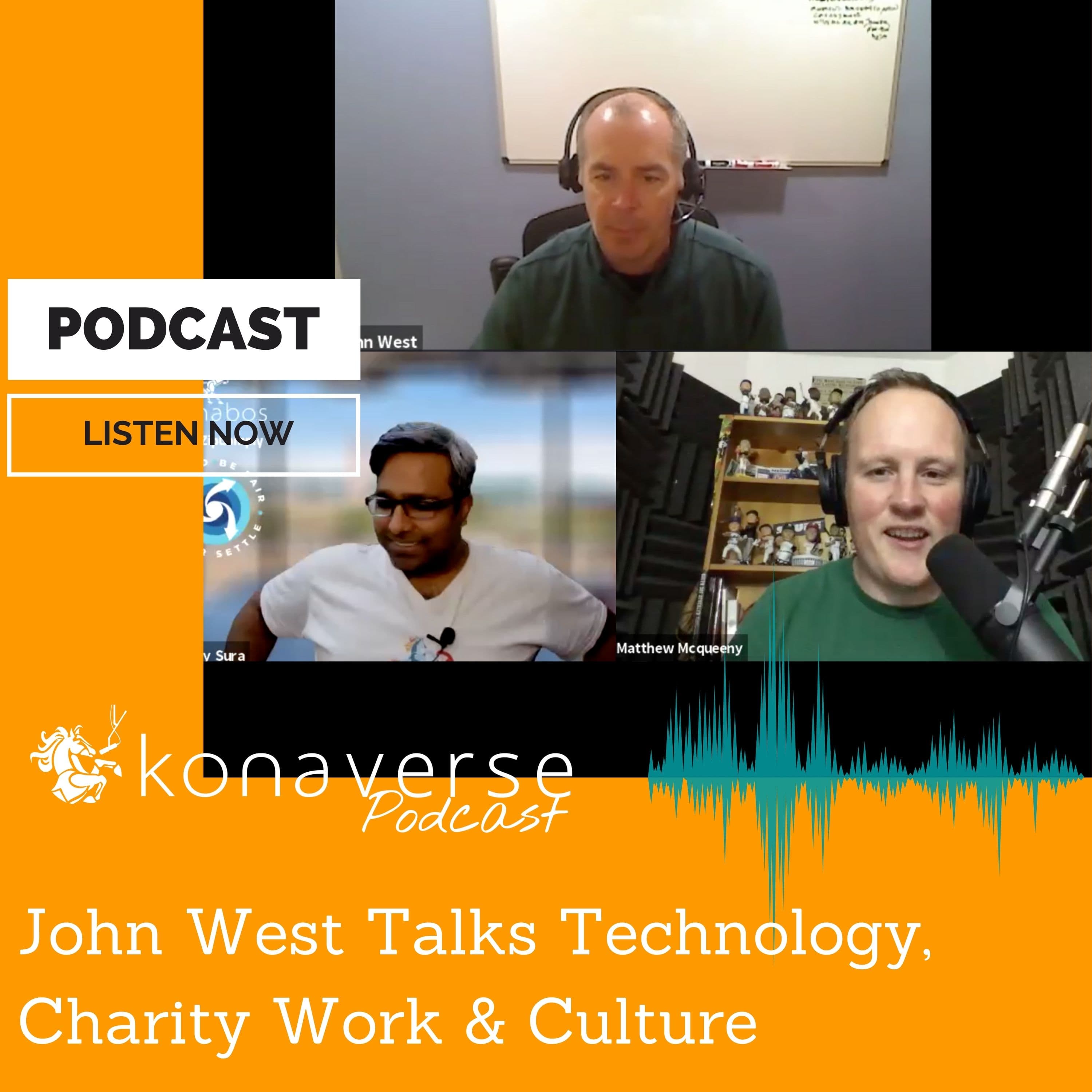
John West - Technology, Charity Work & Culture
KonaverseMay 24, 2021
1
44:3835.76 MB

John West - Technology, Charity Work & Culture

John West is a consultant for Contentstack, a headless CMS platform, and a Sitecore Lifetime MVP. John talks about his history in technology, his charitable work in Laos, and so much more.

Akshay Sura  
Welcome to the Konaverse podcast. This is Akshay Sura,

Matthew McQueeny  
and this is Matt McQueeny.

Akshay Sura  
And with us today, we have John West. John works as a consultant for Content Stack, which is a headless CMS provider. I've known John for a long time through the technology field. So John, how are you doing today? 

John West  
I'm feeling great. Glad to be here. Thanks for the invitation.

Matthew McQueeny  
So John, it's nice to meet you actually, for the first time as well. I'm going to go right to the heart of it. What What about technology, you know, working in the technology sphere, as long as you have what is made you kind of stay with it, from when you were a little kid to it be in your career.

John West  
Okay, so when I was a little kid, it was really a hobby. And it was like solving puzzles and kind of challenging myself at my own pace and figuring things out as I went along, doing a lot of troubleshooting and figuring things out maybe the hard way. And then I kind of dropped out of computers in high school and through the early parts of college. And came back to it. I mean, the whole time, I was reading books on like c++ and stuff, but I wasn't actually doing any work or study around it. So at the end of college, I didn't have very good career prospects and decided I'd spend, I go for a second major in, in computer information systems. And what I figured out from there is that you want to keep it as a hobby, something that's interesting and exciting, and not just about not just a career about making money, because otherwise, it'll take your passion away for it if it's really just about the money. And I think the passion is what makes life worthwhile. So if you're doing the right thing, and you feel passionate about it, it's fun and doesn't feel like work. And trying to keep it that way. The thing that keeps it interesting over time is really just the infinite application or the domain is just always expanding. And what I'm really looking for are the paradigm shifts that fit across the industry. So things like SQL, you know, when SQL was revolutionary, or even earlier than that, you know, trends moving from punch cards to other systems or, or the protocols like HTTP or XML, or JSON or now everything being service oriented, these kind of shifts. And now it's really exciting because it's so easy to stand up these amazingly powerful systems and the infrastructure is in place. And all you have to do is like assemble components. Basically, it's, it's the kind of program that I do now is completely different than what I did when I was a kid, the level of abstraction. I was thinking the other day about a call stack for if I'm waiting for a call back on an Ajax from a browser, what is the call stack look like from the boot process from the BIOS load all the way down to where I am, how deep is that call stack? Because I know what it looks like within my application. Sometimes it'll be 15 or 30. levels deep. What does it look like within the the overall framework? And then when you multiply that across the entire planet, and and you know, systems that are in space with internet connections? It's just It's unbelievable. So again, just the infinite expansion and potential.

Akshay Sura  
Yeah, that make sense. Yeah. And I can, I can tell you can go on and on about technology, as you say to yourself. That's the passion which comes through which is awesome. So just to learn a little bit about you John, where did you grow up?

John West  
So I was born in Sonoma, which is just north of San Francisco, and lived there until I was about 17. Went to college in Northern California. And then I've lived in a bunch of different places since then. So I moved down to San Diego for a while I lived in San Jose for a while, moved north to Portland and I lived in Ireland for a while and I lived in Singapore for a while. I was on a, did i meantion I was on a project in Iowa for like nine months, and then now I live in Portland, Oregon. 

Matthew McQueeny  
Yeah, and you know, one thing really getting into looking at you, John is I'm a content person and a marketing person more in tech. And I have to be honest, the amount of content you're able to produce is pretty astounding to me on your on your delivery stack .NET blog, you know, what, how do you do this? Like how do you produce this much do you have a schedule, it's almost like you have a staff I'm guessing you don't but

John West  
No, so I there are a lot of pieces to that. One is being able to type fast. Two is that I have a really bad memory and so if I don't write something down, then I'm never going to remember it, or I'll remember oh, yeah, there's that API that you can do that with but it'll take me a long time to figure out the same problem again. So writing it down first, it helps me structure the problem and state the problem and sometimes that'll point out better solutions or other things, it'll lead me to research. What I really enjoy doing is researching and prototyping. So it'll lead me into prototyping and researching other things or exploring other things that I wouldn't have had a need to explore. And then always trying to abstract things and make them reusable for other developers and trying to find the most common use cases or patterns and address those. But basically, now I feel like, if I don't blog about it, then I probably shouldn't have done it. And so it's just a habit at this point. If if I solve a problem, and I'm the only person that has the solution to that problem, what really is the value of that, especially since most of my code is not going to end up in production anyway, so to that what's important is the solution to the problem as it applies to the problem space as opposed to my problem domain that I'm sitting in. So I think it's really critical for developers to like, if you have an exception that you haven't seen before, write a blog post about it, because somebody else is looking for that exact same exception message. And if you have two lines of code that will fix it, then, you know, and especially in .NET, especially over the last few years, things have been shifting pretty quickly. And so you, as you're dealing with these paradigm, not paradigm shifts, but as you're dealing with the kind of the impact of that, you face these issues. And, and everybody faces the same issue. So if, yeah, it's documented somewhere by somebody. But that doesn't mean that the person that experiences the issue, gets the search terms that will bring them to that piece of documentation. So putting what people would be searching for in the documentation that has the answer to that problem is a big piece of it. I'm just always learning. So I it's embarrassing to code in public. Because I don't feel like my code is very good, when I write it and then I look at it a couple days later and it's even worse. So, at the same time, it's the only way I can learn at this point. And if I have to put my code in public, it's going to be better than if I just put it into a library somewhere that nobody ever saw.

Matthew McQueeny  
Yeah, and I love the idea. I was I was looking through the blog, again, I've been a writer on and off for several years. And just being able to write every day is a real discipline. And I liked one thing that you wrote, in particular, I think you had your 100th blog post in April. And I think you only started in July. So it's, it's pretty astounding. But you said that I highly suggest that everyone blog, you do not need to invest much. And the result can be far from perfect. Just write whatever you want, whenever you feel like it. Could you just talk about that a little.

John West  
I mean, I have a lot of perspective on that. And that's not the first time that I've posted something like that. And I didn't really want to repeat myself. But everything that you consider to be common sense is not necessarily common sense to somebody else. So it's really easy for you to write down your common sense, based on your experience. There are a lot of other people that haven't had similar experiences that can benefit from the common sense that you develop from that. And it's really that first encounter with a problem that that leads them to that need. So, it's so easy to write about what you know, and and so any piece of code that you've written that you're comfortable with, if you think that it applies to other people, then then blog about that, if you have an architecture, just a concept that somebody might benefit from, like, you know, there are a lot of people in our space that are we're always falling behind, it's impossible to keep up. So leading people to the information that they need. And I'm not trying to appear as a subject matter expert, what I'm trying to do is point people in directions so that they're enabled to do to use these technologies to get more value. Because what where we're sitting right now with the cloud infrastructure and the service oriented technologies, there is so much value available at low cost. And the people that are doing things in older ways are going to really suffer because we're going through a huge paradigm shift to service oriented and SAS. And if you don't get on that, and if you don't do it, right, so I looked at a bunch of these platforms, you know, had this content management platforms before I picked a vendor. And if you're not focusing on the key architectural considerations, but also the functionality, and in our space, it's really data modeling. And you're not applying that architectural approach of doesn't have to be microservice, but at least a service oriented architecture. It's not just wrapping services around a monolithic product, but is really lets me integrate with web hooks and the ways we do things currently. Those kinds of solutions have a limited lifespan, let's say, going into the future. And they have a limited market, which is really going to be the high end of the market that has the budget for those kind of technologies, and also has the legacy I can't get off, but the new customer is not going to be going towards those platforms, from my perspective, and especially the small customer. 

Akshay Sura  
So John, this is a pretty generic question. But I know you changed, or you joined a new company towards the beginning of COVID. And you had to travel back and the whole shebang. So how did COVID affect you and your family and your career in the last year and a half or so.

John West  
So, I mean, it's definitely been difficult, but always trying to look for the positive sides of things. So before COVID, I was trying to do as much charity work as I could in Asia. And with COVID, that was just completely unrealistic. I mean, it was kind of scary flying out of Asia, at the last minute, flights were getting canceled, and there were all sorts of concerns in like, February, March. So I couldn't do the traveling anymore and it's the kind of charity I want to do is not just spending money on things and distributing resources. That way it's not, that's I'm more interested in actually interacting with people and building capabilities and other people developing a scaffolding to let other people help themselves up. So you can throw money at problems, but it doesn't actually solve the problem. So it was really hard for me to find somebody to reconnect with. And I ended up building a trail on my property, or the neighbor's property that they don't really care about. So and I call it the COVID Trail, because in 2020, I spent a good part of the year building this trail, and then the plan is to, for it to be a memorial to people that I know that have had you know, have been impacted by COVID in various ways. So to put benches under specific trees and things like that along this trail. Then my kids have been home all the time. So that's been good and bad. It's been great to spend more time with my kids and, but it's also been great to have the school, take care of them occasionally, when you need to work or you know, all the other things that get in the way of spending time with your kids. So those have been the two biggest impacts really is the lack of travel, and then the difference of my kids being home, and now they're back in school full time. But I would say that it's still it's probably not a permanent effect on them, which has been probably negative in a lot of ways in terms of Zoom meetings, and all that kind of stuff. But it's also been good for our relationship in terms of just spending more time together in you know, in various ways.

Akshay Sura  
So is the trail, in Porland, John, or in Laos? 

John West  
Yeah, it's like, it's right next to my house the condos next to my house own this unbuildable land. And so they don't even most of the people that live there don't know they own it. So I just kind of landscape the forest, and go through there and take care of stuff. And then these trails kind of eventually built themselves. And then I just put wood chips down on top of them.

Matthew McQueeny  
Wow, always developing, even in the real world.

John West  
So I really like to watch things grow. You know, it doesn't matter whether it's my kids or a pet or an organization or developer community or, you know, sales numbers, whatever it is. Watching things grow is really fascinating. And nature is definitely part of that. So the outdoors, 

Matthew McQueeny  
Or you a big hiker?

John West  
No, no, no. My family's pretty sedentary. So I, I go out with my boys occasionally. But we do a lot of more city like things than what I was raised on a farm. So I my life now is completely different. Not on a farm, but on a farm property. So you know, the things that I did had nothing to do with the things that I do with my kids. 

Matthew McQueeny  
I know Akshay is going to talk a little more, or ask some questions about some things he knows you're doing in terms of giving in Asia, and a lot of that, but I was when you were talking about the COVID the onset of COVID. Were you literally in Asia right before it was happening? 

John West  
So yeah, so I flew into Korea, I flew in to Laos through Korea, which is the cheapest best route. And the flight was empty, going from Korea to Laos. And I was like, well, that's unusual. They're not going to make any money. And which is a bad thing for the Laos airlines or the Korean airlines, the small periods there. So and that was probably early February, maybe. I mean COVID was, there might have been some news about it, but there was there wasn't an issue. And then they canceled my flight out. That's a little weird. And that was also through Korea. And then, so I tried to rebook, they canceled my rebooked flight and then I called and asked to rebook again. And they said, we're not booking any flights back to the United States. Okay, so anyway, I ended up getting on a flight out of there and so yeah, I got back and then I You know, my life had been going back to Laos back and forth, like every two months. And that just completely seized up. And then I have, you know, commitments and stuff in Laos that I can't meet. And I'm involved with a school there that we had just started on a huge, not a huge, but on a campaign to, you know, she's trying to build a new property, and they need to increase their enrollment. And so what I figured out by going to Laos, is that whatever I wanted to do in charity was insignificant. The only thing that matters is teaching English, it's like, if you don't have English, you can't use the internet, you're just disadvantaged from the day you're born. So that's the most important thing is education.

Akshay Sura  
So John, I think we talked about this at a conference a couple of years ago. That's the first time I think we sat down and spoke for at length about your thoughts about giving. And we talked about commercialization and how it is different. And not a lot of people share this in common. But we had that in common at that moment, which is, when you give something yourself, not momentarily, but your service to someone, or some people the satisfaction you get from seeing the reward, which is the person benefiting from it is different than throwing money at it, to use your own words, right. So what, what was your trend of thought at that moment in time, and your whole journey in Laos, and then coming out of it coming back home?

John West  
Oh, yeah, it's definitely been an educational experience. But the things that we take for granted in this country, and the way that the rest of the world or most of the rest of the world lives, it's so incongruent, and unfair is probably the biggest thing that you would say. And then you look at the way the global financial system is set up. Now that just propagates things that are really unfair, that you just become so much more aware of the injustice on a planetary scale of the human race, and you feel like really compelled to do something about it. And the further you go into the experience, the less you want for yourself. And the more you just want to do and give for other people. And it's really hard to explain how that happens. But you a lot of people go into charity, not realizing that they're trying to fix themselves or something like that. And sorry,

Akshay Sura  
No, I know, it's pretty emotional for you, because you actually invested a lot of time and effort into it. I know you traveled to Laos. First of all, I don't know why you picked Laos.

Matthew McQueeny  
Yeah, that's an interesting question, actually.

John West  
Yeah, yeah. So that was probably partially selfish. So I'm interested in how human beings would have lived without globalization without technology. So trying to find relatively isolated societies that are living in an agrarian manner that is sustainable, and is not impacted by the tremendous the pace of change that we're going through today. That's, that's, I don't know, not always advantages. So that plus I just really liked the Laos people and the Laos food and the culture and the environment. And it's right next to Thailand, which I also have connections to Thailand, and I've been living in Singapore, and it's just a in terms of doing charity work in Southeast Asia, it's probably the place that's most in need. We're one of the places that's most in need. And I guess I have some guilt about the United States actions in the Vietnam conflict or the Southeast Asian conflict. So probably all those factors together the level of need just unbelievable. I mean, it's hard to explain you'd have to go and see it.

Akshay Sura  
Yeah, no, I and I used to get almost daily reports not weekly reports, I should say remember, we used to have conversations but you ended up purchasing a house there. And then I know that you know, I wanted to come there because I wanted to be part of the thing of being able to help the person in need in person rather than again throwing a bunch of money at them and hoping that it sticks right and I went from providing like pencils and basic basic things which they didn't have you know into you finding out that hey, the way I can help these locals is by teaching them English. English will get them into service jobs, right which will help them into get a paying job better paying jobs, educate them a little bit. So and you you had mentioned earlier as well about and it ended up transforming your thought of what you will what you will do so you purchase the house you figured out Hey, the only way I can help these guys because it's much bigger than I thought it would be into teaching. So what did you actually end up doing in Laos when you were there?

John West  
So relatively little, I would say I spent a lot of time researching What was possible to do? So how to connect? Do I really absolutely have to connect with one of these ex-pat charities that's got the concrete bunker wall and the you know, everybody's driving around SUVs? Do I really have to be part of that thing? Or is there a local structure that can be assembled and I didn't want to do the ex-pat thing. So trying to work with the locals, without speaking the language was extremely challenging, and then trying to connect even with those that spoke English. Because there I don't mean this in any kind of biased way. We're just there are cultural differences. And there's a scale that has developed in western civilization around bureaucracy and a competence around bureaucracy that doesn't exist in other parts in other cultures, necessarily, it's just never been needed. In an agrarian society, you don't have the need for an IRS and those kind of things. So it's pretty difficult to build a large scale organization, there are any kind of organization and so and what you end up with is you end up working with people that are living in the house, because they love Laos and want to help. But they're expats, you know, it's very hard to to actually come up with, and and most of the people there are so heads down feeding their family and taking care of business that they can't go to English classes, you, you have to go through that kind of traditional system, which is the school system, and you have to get people when they're young enough to to actually make a difference. And so, you know, it was really harsh learning in that process. Because again, we take so many things for granted in terms of schools and all this compulsory stuff, like vaccinations. And it's just not there. They're just where do you even start with people that are burning plastic garbage left and right, and what what I came up with a list of like, 40 different things that I could prioritize, and it all comes down to education, and education is at least half of it, there has got to be English.

Matthew McQueeny  
Now, I'm not very familiar with Laos. I mean, I, you brought up the Vietnam stuff, that's probably a lot of my own kind of exposure to it. And I think this is a great kind of opportunity to learn about other cultures having conversations like this. You've brought up agrarian like, what is Laos? What is their society like, and so

John West  
it's basically Buddhist rice farmers. So the Buddhist animist rice farmers would be historical, traditional Laos. They have really hostile territory, why, which is partially why it's never been really interesting. You've got kind of plains people, and then you've got mountain people. But basically, they're all growing rice and vegetables, and they're eating the stuff that comes out of the Mekong, and they're, they're living in that kind of manner. So the United States spent 10 years basically dropping from my perspective, testing munitions. So every 10 minutes, approximately, the United States was doing a sortie into Laos, to end dropping these munitions. And so a lot of those didn't go off. And so they're sitting around in the land, and there are charities, they're something, they think that there are probably almost 100 million pieces of unexploded ordnance sitting in the ground and lost. So charities go in and take those out, because if the villagers find them, you know, they try and make wheelbarrows or whatever it is that they can make out of it. And in some of them get have detonations and, and people need to have prosthetics or lose their lives. So another charity there does prosthetics. And I was working on connecting that charity with another charity that does make prosthetics with 3D printers. So there's just so many different angles in which to help but um, so I don't know if that answers the question. But United States really did some damage there. Kind of admitted it,  it's called the secret war in Laos, if you want to research it on Wikipedia or wherever, but never really did any cleanup and never paid any reparations and kind of really treated some peaceful people pretty badly. And like the Vietnamese people, they, you know, the Vietnamese people are relatively proud because they won the war but the Laotian people they don't have the animosity or the resentment towards Americans that you might expect for for people that have been treated like that. They do you know, if you, if you talk about it, they'll say, Oh, those are war stories, and they just kind of put it in the past and discount it, which is kind of a Buddhist approach to life, but also just, it tells you who the people are there

Akshay Sura  
Have you, I know we had this converstation John, but have you been following some of the same beliefs like the Buddhism beliefs to help you with your thought process your feeling? 

John West  
So I don't know, I might say something offensive so we  might have to cut this part out. So I'm looking for the intersection of all faiths. What is it? That's what I define as humanity. So if I look at all the religions and all these superstitions and belief systems, they can all possibly True. And in fact, you can basically prove every single one of them false. So what are they really trying to say? What is what they're saying be a better person, they're saying there are certainly certain core beliefs that what it means to be a good human being or what it means to try and better yourself or better the world. So I don't know if there's a name for that. I wouldn't call it pantheist. I don't believe in all these things. But I, I would call it basically, I mean, if the term was already used, I call it a humanist, what does it mean to be a good human? And so you know, and I've talked a lot to people about lots of religions, I don't have any biases or preferences, really. But there are basically two things that probably I mean, if I look at Taoism that, you know, you can't really deny it. If I look at Buddhism, there's a lot of sense in Buddhism, you know, about, especially around discipline, and, you know, controlling your mind and those kind of things, all of these systems of belief, basically have value in them. And, you know, I spent some time looking at Hinduism is probably the, you know, one of the biggest faces in the world, and I never, I can never understand it, and it's huge. And then, and then I kind of was introduced to Sikhism, and so now, I'm kind of, that's the one that for me addresses some of the, I don't want to say flaws, but one of the challenges in Hinduism in really good ways. And so I'm kind of in that place, somewhere between Buddhism, and Sikhism, and I don't really know Hinduism well enough to say that I, but from a lot of perspectives, Hinduism is just incredibly inclusive. And that's what I'm looking for.

Akshay Sura  
Yeah, no, I think you you hit the nail on the head, right? The Common Core, if we can call it of every single religion is they want to, they want to give you guidelines to be a better human being. But over a period of time, decades, centuries, it's been watered down, superstitions added stories added and they, you know, if you really look back, what's the true first known origin of religion is the Zoroastrianism, right, it's the oldest religion on the planet. But when you look at it, why do we have so many religions to begin with, there must be a reason someone made created them, right?

John West  
It's interesting that you mentioned Zoroastrianism, because there's so little source material from that religion, and yet at the same time, you don't need it. Because when you're when you encounter it, you just know that it's true in a sense, or it's as true as it can be for you. So that's, you know, I don't really, I don't really believe in religion, I believe in philosophy. So, and to me, it doesn't really matter what I believe what matters is how I behave. So I can say, I'm a Christian, and I go to church, and I do these kind of things. But if I'm not really a Christian, in my mind, or in my act, my actions, or my relationship with my wife, or whatever it is, then, you know, what does it mean to go to church and say, you're a Christian. So I think it's irrelevant, what we say how we categorize ourselves, it's how we treat each other in our day to day, in, you know, a lot of religions like Christianity, I went to a Catholic school, I have a lot of, you know, understanding of Christianity and kind of the guilt aspect of it and how that's used to control people and how important it is to cast off that guilt and kind of forgive and move on with your life. And so focusing on the wrong things and calling it spirituality is also kind of something that has happened in human culture. And these churches are basically power structures, and any human power structure gets corrupted, it's just, it's there's there are certain bad elements or forces that make that happen, especially over time. So I don't like organized religion. I like people to do critical thinking and be out there. representing an understanding philosophy and applying logic to philosophy and figuring things out for themselves and questioning things and not ever believing something because its in a book or because somebody else said it.

Akshay Sura  
You should write a book about that, john, you can

Matthew McQueeny  
Write a blog every day,

Akshay Sura  
Post about it, because I it's similar lines, right? Like I feel exactly the similar line. 

John West  
It's the only logical conclusion, right? If if we're all here, I look at some of the religions if we're all here, we have good one. I looked at some of the religions that say the world was created this way a man was pretty well, you know, what, if this God created us, you know, I go to the bathroom every day, did he create me to do that? And what did He create me to do before there were toilets? It's just you get into these weird questions like, oh, that doesn't make a lot of sense. And so everything's changing every day. So clearly, it wasn't always this way. So I'm not arguing with any religion or belief. It's just I have to question it.

Matthew McQueeny  
Yeah. So the interesting thing to me when I'm tying some of the things in this discussion, is that you have this kind of undergirding to help people right, in Laos. I mean, I'm not going to equate the two but like your blog, the way you talked about it was that in some ways, you're helping people, you're helping people find answers that maybe you have something that'll get it to quicker. I mean, Where does that, I mean, you think hard on these things philosophically. Do you ever wonder where like, where that comes from?

John West  
I mean, where it comes from. So I think that at this point human beings are, I mean, I think life is much more capable of programming itself than we give it credit for. I think genetics are incredibly more complicated than that, I think that we can pass experience and knowledge through our DNA. I think we inherit a lot of things from our ancestors. And so we have this, on top of that physical structure, underneath us we also have this cultural thing influencing us to who we want to be. So I think that those are two things that are, whether it's because of my Protestant you know, history or upbringing, that the heart You know, work and guilt and all those kind of things, or, or something more intrinsic, or just my unique personality, or wherever it is, I just always want to be doing something, and I don't want to be bored or waste my time. So that's a piece of it. And then when you get the positive feedback, which is really rare, actually. So if you're a blogger, or if you're helping people in forums, people ask a lot of questions and you answer them, you never know, if you help them or not. And so you get kind of used to that. But when you get the positive feedback, it's even more rewarding. And then, so I have one blog post about a problem with Microsoft Word, and it's got over 100,000 views. And it's, to me, that's just crazy that something that I wrote may have helped 100,000 people. So that's probably my most significant contribution to the internet. Regardless of all the things I've written about any content management system, something about Microsoft Word has been looked at, by almost every country on the planet, you know, so. So it's there are certain rewards to go through it, but there are psychological rewards. And then the kind of career or success rewards are all like, for me really an after after thought, or an artifact of doing something that I enjoy doing. So yeah,

Matthew McQueeny  
I'm sure, so the other one I wanted to ask across these kind of two dynamics. I mean, from from where I'm watching, it's almost like the two polar opposites of the world, right, you're at, you're at the forefront of tech. And then you're in the agrarian Laos, right? Do you ever find that either help inform the other? 

John West  
Absolutely. Oh, absolutely. So, you know, I think it's really important for human beings to not be logical all the time. I think that logic, if we are logical all the time, and there's only one of us, because there's only one logic, and so we have to step outside of that. And so, you know, mysticism and magic and those kind of things, you know, belief in spirits and ghosts. So that's the other end of that spectrum. And I'm, I'm not denying it there. But the hybrid of those being able to see all the different possible beliefs and not evaluate them critically, non judgmentally, and say, Hey, guys, it's possible, it's possible that your belief is true, and that I'm wrong. And neither, you know, that that's a really fascinating thing. I just love exploring mental constructs. And I like arguing, which is, you know, I, if there's somebody that disagrees with me, I want to be proven wrong. And if you say something, and I counter it, and you don't counter me and move on to something, that is one of the most frustrating things for me, you either need to admit that what you said was false, or you need to prove that it was correct. So I'm a combination of logic, but I'm also a very emotional person. So you know, the that drive to do things for other people is a very emotional drive. It's really illogical. It doesn't benefit me at all. But I also think that the survival of the species is more important than the survival of the individual. And so that's part of our evolution is, if I'm doing everything for everybody else, then I've got 7 million people, or billion people doing everything for me. So if we were to all think that way, it is more productive. But I think, you know, human beings have to evolve to be most adapted to all the different possible situations that they can encounter. So some people have evolved from other situations and they're on the other side from me, you know, and they're not necessarily trying to make the world worse. They're just their survival depends on them behaving in a different way than me. So and I'm not trying to go, say that's an enemy or something. Again, it's about education, it's about us all coming to a common understanding of, hey, we're all on the same boat here. There's no point in you taking that space and me not having any, that's not gonna work. So let's figure it out.

Akshay Sura  
So the next is I have a part statement and a part question. So I know the struggles you went through in Laos, and basically an information overload, right? How the heck do I help these people and you were coming up with these lists, and you shared some of those with me. And then you came up with, you know, what you could possibly do, which is teach English. So in my mind, it feels like we don't have to worry about the bigger impact in the sense you know, it's great if you have an impact of 100,000 people, but there's nothing wrong in starting with impacting three people and then going from there, right? So that's the statement part part of it. The question part of it is, what's next for John West? And what's next for Laos?

John West  
Yeah. And so my original goal in in Laos was trying to scale to use technology to scale, right? And what you find out like, you could use a smart TV, you could put a smart TV in every school for relatively cheap, put a USB stick on there with videos, that you know how to learn English, really, I could have done all of that work really well. The problem is that that TV would end up in the, you know, the village head man's house, and it wouldn't be in the school. So you can't, you really can't change things in that kind of way. You have to use the existing system. And so how do you use that system? How can you develop that system. And my perspective is if I can teach some people and originally my one of my goals was to go to help women and children that were disadvantaged in a disadvantaged culture. But if I can teach children, especially girls, English, so that they can teach other people English and teach other people how to teach English. And really, you don't need that much English, a few 1000 words, and you are in really good shape. Everybody in Southeast Asia is used to dealing with broken English, once you get those few 1000 words, then you can start watching TV and doing the things that will get you the rest of the way and help you develop the right accents and idioms and all those kinds of things. So putting that easy, easy scaffolding in place. So there's a woman there that I've been working with Didi, she's part of another kind of religious organization, I don't remember the name of it, but it's a it's kind of related to the stuff we've been talking about. But that organization does schools in, you know, in, you know, poor countries, there's a guy in Europe that does school specifically in Laos, he builds and runs schools. So I'm trying to connect those two people she's looking for, like $60,000, to build a school on a property that she already owns. So that's probably the most significant thing that I can do is campaign to get her funded for that operation. So short term, that's, that's where I'm going.

Akshay Sura  
So um, is there a good service industry in Laos, John? So if pepople were to learn English right and grow up as adults like right after high school. Would they be able to get decent jobs in the service industry in Laos? Or would they have to go into neighboring countries like Thailand?

John West  
So the service industry in Laos is growing, there are three major industries in Laos, the number one industry is probably still rice farming, then they export rice to the surrounding the second biggest industry is electrical. So they do electrical and then makhan and power it and sell it to Thailand and stuff. And then the third is actually tourism. So because Laos just opened a relatively recently opened, it's just a fascinating place. And it's right next to, you know, Thailand and other stuff. So it's, it's and it's still kind of considered a remote place, even though it's right next to Thailand, it's completely open and easy. People still think of it as kind of, nobody's ever been to Laos. So there, it's, it's one of those destinations, really easy to add to a trip. And it's got probably three cities that are worth visiting. So they're really working hard to develop the tourism industry. And it's, it's got a lot of unspoiled, it doesn't have any beach, you know, so it's not going to bring those kind of tourists, but it's gotten to the unspoiled wilderness and then unspoiled cultures. So if they can follow a model from the region, like Thailand has done a good job of, of tourism, and promoting its culture with its tourism. So if they can do things like develop the Queens gardens, or I don't know what the what it would be, what would the equivalent would be, but if they can have those things that bring people to the country and keep them there and generate revenue, then I think there's a there's a service industry that can be built. I think it's risky to build an economy around tourism. I mean, you can see it during COVID, or financial. COVID has been terrible for Laos, I don't want to get into it. So you've got to look, you've got to build some other industries there over time, short term tourism can bring passion to the country and fund other operations as long as it doesn't get siphoned in the wrong direction. So that's teaching English and building the tourism industry, I don't want to build hydroelectric. And I'm like, you can't really scale Rice Farming any further than it is. So I think you have to start with tourism, and then figure out what what the capabilities of the local inhabitants are, what industries those can support. So how can those skills be adapted to It is sad because one of my original goals in going there was to prevent the change, but it's inevitable. I mean, people are selling their land to buy trucks, you know, their families own this land for generations, and they sell it to buy a truck and then what, you know. So everything's shifting really quickly and smartphones are everywhere, and I really wanted to, but I was at least 20 years late and even trying to get started. So it's more about how you adapt That change to the culture, how do you adapt the culture to the change with so it's not more devastating than everything that's already happened there.

Matthew McQueeny  
John, I've I have one more question, I think before I say, takes us home in the Konaverse here. So we have this kind of stock question, which is going to be really interesting here because of these two polls that you're almost existing in. And it's this idea of, "Hey, where's technology going?" Right in 2021, and beyond. And there's one obvious thing, right, where you could talk about systems and SAS, and all this. But in this conversation, you're probably thinking about the myriad ways that technology has to catch up around the world. So you could take with him take with it as you will.

John West  
I don't know, I'm kind of hoping that we'll develop a culture that rejects some of the aspects of technology. There's a little bit of it, you know, digital apostasy on the internet that you can find. And it's not like crazy tinfoil hat peoples, it's people that are doing the research and seeing the you know, there are some bad things happening. It's not just happening in India, it's happening across, you know, depression rates, and children, all these kind of things that we've really experimented on human psychology. And we haven't really planned for the implications of that. And it's been driven by advertising and, and kind of, if you think about who is most likely to troll, or you know, who's like most likely to post, it's usually, you know, it's going to be people that have something negative to say, and so they dominate the conversation. And we have to find ways to deal with this. And I'm a free speech person, I think everybody's entitled to their speech. But I'm also concerned about the impacts of other people. And so I'm not the right person to draw that line, I tried to keep my mouth shut on the internet, basically, I just put information out there. So, yeah, it's, it's really scary in a lot of ways. Because if the people that leverage the technology are going to have such significant advantages over the people that don't. And yet, in a sense, it's dehumanizing and we need to find a balance. So we need to find a balance between, you know, music that is actually played on instruments and you know, where we're going with digital stuff, which is the machines make the music. So I, you know, I we'll see. I am I'm really concerned about what we're calling artificial intelligence, and because it's actually just machine processing run by human beings with algorithms that are based on data sets and all of that is flawed, every single step in that is flawed. Let's start letting that system make decisions that affect human beings.

Akshay Sura  
So Alright, final question. John. What's your advice to the 25 year old john West?

John West  
So interesting question, I would say that if you follow your passion, you are going to be successful. And when you feel like failure is right in front of you. Success is right around the corner. And yeah, there's a time where you have to throw in the towel. But I mean, if it's not killing you, you're gonna, you should just keep doing what you're passionate about. If it's not hurting you in some way, it its hurting you then you've got to, you know, if you're working 12 hour days and getting calls at night, you got to move on to something else. But if you're doing what you love, and if you love take those 12 hour days and calls at night, then do that. I mean it. So really follow what is important and interesting to you. You know, my second piece of advice is don't spend all your time working. And I know that those things might be in contradiction, because I love to work in my 20s. But I probably should have made more time for my family and stuff. But it just, you know, the money is the money because there's always a way to make money. 

Akshay Sura  
Yeah, that's great advice. So, thank you so much for taking your time to be on this podcast, John and have a good rest of your day and hope this podcast helps someone.

John West  
Thanks. Thanks for having me on.