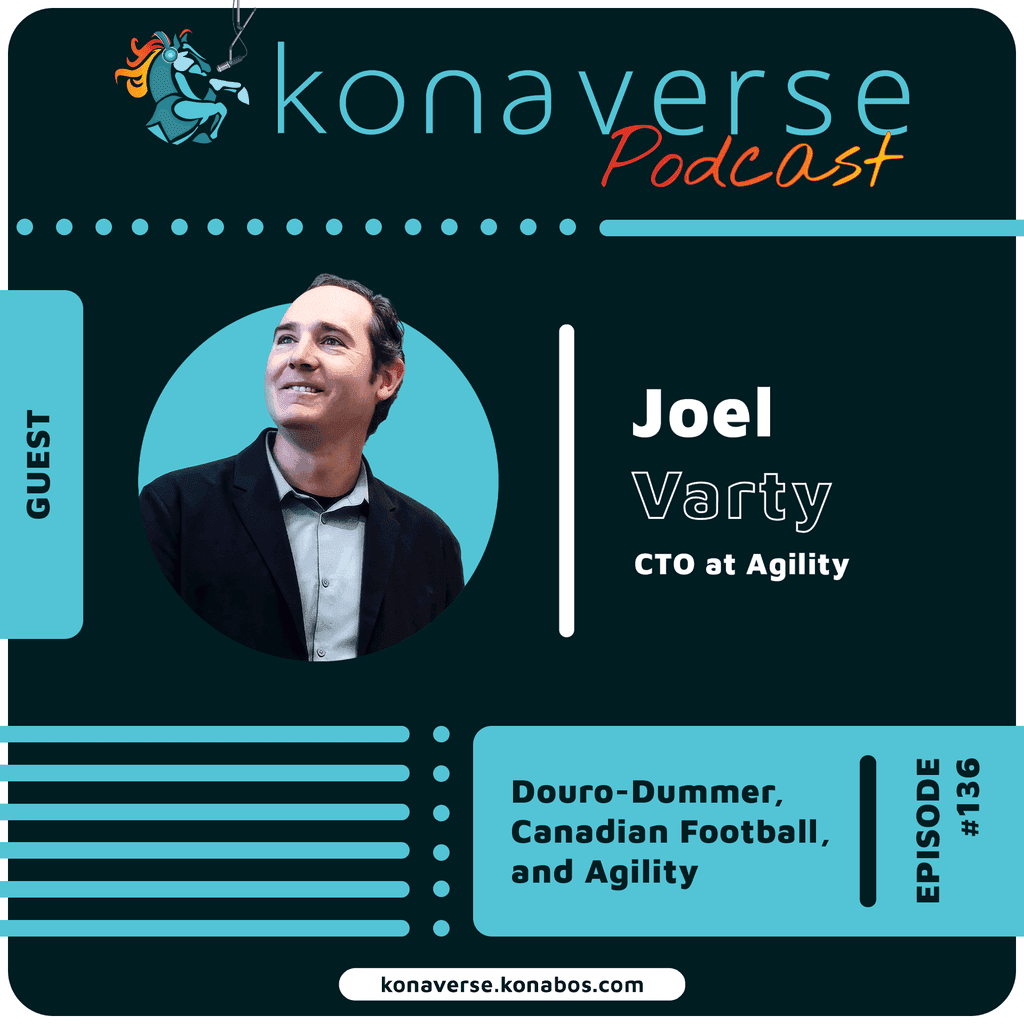
Joel Varty on Douro-Dummer, Canadian Football, and Agility
KonaverseMarch 11, 202453:0048.55 MB

Joel Varty on Douro-Dummer, Canadian Football, and Agility

Joel Varty is the Chief Technology Officer at Agility. In this episode, Joel talks about growing up in Douro-Dummer, Ontario, living and working on a farm, music and playing guitar, The Canadian Football League, building a career in technology, Toronto, the Agility story, advice to his younger self, and much more!

[00:00:00] Welcome to Konaverse, a conversation experience platform hosted and curated by Konaverse Consulting

[00:00:06] KonaBos is a global technology leader and while this podcast will be connected by technology

[00:00:12] the glue is human stories and narrative.

[00:00:14] Technology can bring us together

[00:00:17] it can make our lives better and more efficient in many ways

[00:00:20] but it cannot replace human discourse and the magic that can happen by the interchange of ideas

[00:00:26] Hope you enjoy our podcast

[00:00:30] Welcome to the Konaverse, this is Matthew McQueenie and I am so pleased to be joined by Joel Vardy, the CTO of Agility

[00:00:39] Joel, welcome

[00:00:41] It's great to be here, thanks Matt

[00:00:43] So we always go back to the beginning Joel, I know you're a Canadian man right now and I'm guessing you were born and raised as one

[00:00:50] Where were you born and raised?

[00:00:53] I was born and raised actually I grew up in a dairy farm just east of

[00:00:58] It's okay

[00:00:59] The municipality is like the dumber side of Durham

[00:01:02] So I was from Dumber

[00:01:04] And Durham was right next door and I always wish why couldn't I be in Durham?

[00:01:10] Very very small town, dairy farm, very very rural

[00:01:13] Like old school childhood

[00:01:15] Oh my gosh, so you actually are from the dumber side

[00:01:18] Of a city

[00:01:21] Yeah, so name name you're why would you name it that but they just did is the spelling the same?

[00:01:28] No, it's d-u-m-m-e-r. Okay, but it doesn't matter what the way it's said anyway. Where is that?

[00:01:35] We were good at hockey. It was just east of small town called Peterborough and you know Midland Nowhere

[00:01:40] Wow

[00:01:41] So did you

[00:01:43] Did you play sports growing up?

[00:01:46] You know what I didn't when I was really young I didn't that much because my parents weren't that into hockey

[00:01:51] They they saw a lot of my friends, you know from a very very young age were really pushed into hockey at like, you know

[00:01:57] H3 and 4 you're doing that and my parents and I was working on the farm

[00:02:01] So I became very athletic from working on the farm. So when I went to high school

[00:02:06] I played football and rugby I ended up playing football at college

[00:02:10] Because I loved it so much and you know, I had two older brothers too

[00:02:14] So we're always beaten up on each other anyway. So it's just like this was just a natural extension of that

[00:02:19] So you had a farm I always ask

[00:02:21] What did your parents do?

[00:02:23] I'm guessing they were farmers

[00:02:25] What was their backstory

[00:02:28] Funnily and well, my dad's backstory he grew up on a dairy farm as well. And so that was like him living out his dream

[00:02:33] Um, you know, my parents were teachers by profession. So my mom was a teacher from from Toronto

[00:02:38] She's not a country girl. She became a country girl when they moved out to the farm

[00:02:43] But they you know to make a living

[00:02:46] They they were teachers as well. So to be a farmer

[00:02:50] It's like really hard to like have enough money to raise kids and stuff. So they did both essentially

[00:02:55] So those must have been really long days

[00:02:58] Oh, yeah, yeah, you wake up you uh help with you

[00:03:01] You got chores, you know, you do whatever you do you throw hay and muck out stables and things like that

[00:03:06] And then you go to school and you come home you do it all again. Then you go to bed

[00:03:10] Wow, so what what were your interests when you were off the farm when you were in school?

[00:03:15] Um

[00:03:16] Music my so to get us to get us out of you know to get the hay seat out of our hair

[00:03:21] My mom took us we did music lessons. So I learned to play guitar starting at like age seven six or seven

[00:03:25] So we did that and we tended like music festivals and things like that

[00:03:28] So I played guitar from a very young age and and did that right up through, you know, still play as well

[00:03:34] There's something about learning the guitar that almost helps anything

[00:03:37] You're gonna do in life right because only a few of us can become rock stars, but

[00:03:42] It probably hangs with you even to this day, right?

[00:03:45] Yeah, well, you mean you got to keep with it, right? You can it's like it's slow to learn and as a kid

[00:03:49] It's like, why am I doing this my fingers hurt and then when you get then you get good at it

[00:03:53] Then you teach your friends a little bit and things like that

[00:03:55] So everyone has their kind of like origin story from for music and uh for me

[00:04:00] It got me into musical theater as well, which I started into as an adult as well

[00:04:04] So I enjoy that and just music has always been a part of like my kids life as well. So that's pretty cool

[00:04:09] Were you in bands?

[00:04:12] I did uh, yeah

[00:04:13] So in high school I was it was interesting because playing football

[00:04:16] It always it always conflicted with band practice

[00:04:19] So I would go to band practice to like we had a jazz band that I played like a stand-up bass for our jazz band

[00:04:24] Um or that were guitar so I'd play that but I would always wear my equipment to practice

[00:04:29] And then run out to practice, you know when that was done so I could get both of them at the same time

[00:04:35] Wow, and so when you started playing it it's a lot of like I started playing guitar because

[00:04:42] The music I was listening to led me to do it and then my parents took me yours actually

[00:04:47] Like helped you do that early

[00:04:49] But were there yeah

[00:04:51] Was it jazz or was there rock like what what was the thing where you would take the songs to the teacher

[00:04:56] And be like show me how to play this

[00:04:59] Yeah, it was everything, you know what because I had such a weird childhood of like, you know

[00:05:04] In different influences like I'd be influenced as much from like a hired man who would bring records

[00:05:09] Or or tapes or whatever and I'd listen to you know

[00:05:11] I remember the first time I heard like I had a tiger in the 80s. It blew my mind

[00:05:15] I'd never heard anything like that when my parents listened to country music

[00:05:18] So it was all different stuff my my teacher was like a steel guitar player like country music that way

[00:05:24] So he did a lot of country music. I like more sort of rolling stones

[00:05:28] Led Zeppelin that kind of thing so more standard kind of rock music

[00:05:32] But there's all kinds and there was jazz music I got from school from jazz teacher

[00:05:36] So it was like every kind of thing either a classical guitar as well because that was fun just just whatever

[00:05:42] So this this might be a stretch to you, but I like to stretch things you're in

[00:05:47] You're in product

[00:05:48] You're in tech

[00:05:50] When you're talking about the bands you liked

[00:05:53] I don't know if you've

[00:05:54] Felt this when you would end up learning the songs, but they're such great musicians

[00:05:59] But then when you learn the songs you're like, oh my gosh, they're so

[00:06:03] Simple. I actually could have been taught this when I was starting

[00:06:07] But they needed to go over the mountain of complexity and difficulty to to land there. Did you ever

[00:06:13] Feel that?

[00:06:15] Yes, so much so my brother and I we listen to acdc a lot

[00:06:19] Um amazing, you know anguish on amazing guitarist him and his brother played in the band forever

[00:06:25] One guy was rhythm the other guy played, you know all the crazy solos and it was like the best music

[00:06:30] And then when I started I was like, I want to play that so I did take that to my guitar teacher

[00:06:34] And he's like tool assist like this is the easiest music ever like this is not hard

[00:06:38] And then he showed me how to do so many things because he was a real wizard and uh

[00:06:44] Yeah, that was just the amazing thing. You do have to like spend the time learning it and go through it and repeat it

[00:06:48] Um to get it, but it's like it's just a simple set of patterns and then you figure it out and then

[00:06:53] You kind of take it apart and put it back together and then you can do it

[00:06:57] Too much complexity confuses

[00:06:59] consumers in an audience often right

[00:07:02] Right on. Yeah. Yeah. Yeah, so how many you said you had two brothers?

[00:07:07] Two older brothers and an older sister. So I'm the baby of four

[00:07:11] Wow, and so when you were coming up in school farming

[00:07:15] When did when did tech start to come into play?

[00:07:20] Yeah, great question. So I was if I if I wasn't in sports

[00:07:23] I don't think I would have done post secondary like I wouldn't have gone on from high school

[00:07:27] Like I I would have gone back to the farm. I was good at it. That was the thing

[00:07:31] Um, but being the youngest it was like well, my oldest brother's going to get the farm

[00:07:35] so I got to figure out something to do

[00:07:38] And more I had a teacher actually my English teacher said, you know, you're pretty good at football

[00:07:43] You could play at college and

[00:07:45] He invited some coaches to come watch us play and my best friend and I

[00:07:49] We ended up basically having our pick of whatever

[00:07:52] College we wanted we went to like there's one in canada not not quite the same level as the u.s

[00:07:57] But this is back in the 90s. I didn't even know there was no youtube

[00:07:59] I didn't even really know about college football

[00:08:01] I just knew that it sounded like fun and I want to keep playing sports

[00:08:04] And so that took me to university of guave

[00:08:07] Who had a computer science program where if you were as in every student had to take one english course

[00:08:13] And one like how to use a computer course and how to use a computer course had a little bit of programming in it

[00:08:18] And I loved it and my friends all hated it, but I loved it and I said, oh, I want to do that

[00:08:24] I don't want to do english

[00:08:25] Although I still have an english degree as well

[00:08:26] But I wanted the computer science stuff was what really I actually did much better in it and it was more fun for me

[00:08:33] It's funny. We have a we have a team member

[00:08:36] In cona bo's a lot of there's a bunch of us or not us

[00:08:39] I'm not in can't I'm not in canada, but there's a bunch of cona bo's people based in canada

[00:08:44] And I was randomly talking to him today

[00:08:46] About about football and then he told me that uh that he played football

[00:08:53] In I think high in in high school and then I think he said in college

[00:08:57] And there was something really strange to me

[00:09:00] Where nfl is everything college football is everything here

[00:09:04] Like that friday night lights is happening in canada with canadian rules football

[00:09:09] Like yes

[00:09:10] I mean, what was it? What's it like? Uh, what was it like learning that?

[00:09:14] game

[00:09:15] And was was american football always there was it always noticeable that it was just a little different

[00:09:21] Was it did warren moon turn get people excited dug fluty?

[00:09:25] Yes, yeah, you nailed it. So I grew up watching so we

[00:09:29] We had a tv one. I like I don't remember when we got a tv

[00:09:32] It was a big deal getting a tv

[00:09:34] I'm that old but also grown up on the farm like we're a million miles from everywhere. We didn't have cable

[00:09:39] So like didn't even matter that we had a tv

[00:09:41] We would get one station it was called cbc, which is like the national broadcaster and they used to broadcast cfl

[00:09:48] It's not on there anymore

[00:09:49] But they so I watched so that was one of the sports I could watch hockey and cfl football

[00:09:54] And war moon was my first hero and dug up fluty was my second hero

[00:09:58] And I that's how I became a buffalo bills fan. I'm like

[00:10:01] Man, how's this guy not playing and then you track his you know, we played for boston college won the heisman kids like

[00:10:06] 580 times that happened

[00:10:08] And then you know, we played for buffalo and I thought he should have played more for buffalo and

[00:10:13] I'd be I've been a buffalo bills fan ever since for better or worse

[00:10:16] And that's that's kind of how I got into it while I was playing right?

[00:10:20] But also as a kid, you know war moon was like then when I was a little little kid and like

[00:10:25] He never lost he won every single year that he won the great cup and he was definitely in the wrong place

[00:10:30] You know, I loved watching those

[00:10:32] highlights with

[00:10:34] You know, I was even talking to the guy in our company about hey, it's the bigger field the bigger end zone

[00:10:40] It almost looks silly to americans. Oh, yeah

[00:10:44] Totally like and war moon could throw the ball like 80 yards

[00:10:47] But that's like the field is 110 yards and it's 65 yards wide

[00:10:51] It's ridiculously huge because only and you only have like three downs

[00:10:55] So you throw the ball almost almost 80 percent of the time which is super fun if the team is good if they're bad

[00:11:01] It's super boring

[00:11:03] Well, it's funny bringing back music because I've been going back to when I was a kid like green day was everything

[00:11:09] Like that was the perfect age and they still they still and they're still coming out with stuff

[00:11:14] But I saw that the gray cup which is kind of like the canadian football league super bowl, right?

[00:11:20] I saw a whole thing come up where it was like oh wait green day played this year's gray cup and it was like a 20 minute set

[00:11:27] Yeah, where they're just on a stage. They're not doing all like the dance move, you know

[00:11:30] Like they're doing ours, but it was so cool. I was like, oh they have their own their own thing like that but

[00:11:37] So is it as intense uh as I mean, well, it's all relative because you're living your own life

[00:11:42] But is the football culture when you're in it as intense as it is almost here or

[00:11:50] Is not it is nowhere near my son

[00:11:52] Um, my son went to school. He's a much better football player than I ever was probably because you know, we've been he didn't do it

[00:11:59] Get much more. Um, so he went to high school in Connecticut to play football

[00:12:03] Oh, I'm trying to scholarship and all sort of stuff and even high school football even in Connecticut

[00:12:07] Which isn't like it's not texas

[00:12:09] It's much different much different culture the it's more like hockey is in canada where kids play 24 seven

[00:12:17] Um, but football never really caught on as much. So it's not this the level of coaching isn't the same

[00:12:22] It's just not the same

[00:12:23] Um, so college football is close. It's kind of like more like maybe a d2 like, you know d2 colleges

[00:12:30] But like division one especially like the top, you know, power five football in college

[00:12:35] That's a whole another problem. No, it is so he actually came to america to play

[00:12:40] American college or american

[00:12:42] High school and college football

[00:12:44] Yeah, oh wow was that like a

[00:12:46] It must be a bit of a learning curve after you're playing on those other fields

[00:12:51] huge culture shock for him and but also like he just loved it because it was football 24 seven

[00:12:57] And he just he loves playing and he loves working out

[00:13:00] And so for me as a dad it was like really tough because I was his high school football coach

[00:13:05] I was a coach football

[00:13:07] But i'm like this he's too good to be here

[00:13:09] I had coached another kid who now is playing for houston actually

[00:13:12] Who went to pit and he kind of mentored him a little bit and said look you you know

[00:13:16] If you really want to get a shot then you got it

[00:13:19] You got to go down here to high school and see see if you're any good kind of thing. So wow

[00:13:24] My last I told you we'd be talking about something completely

[00:13:27] Unexpected about five minutes into doing this

[00:13:30] what

[00:13:32] Only my interest here

[00:13:34] What happened to uh cfl? I mean it's still it's still there

[00:13:38] It's all but it felt louder in america. Maybe it was they were getting certain players and it feels so quiet now

[00:13:46] I think maybe the usf l now the ufl and so there's like there

[00:13:51] It was the the cfl was the other pro football right you you know

[00:13:55] There's like european something like that

[00:13:56] But it like cfl was probably like the second best after the nfl and a place to go where you can still make a living playing your sport

[00:14:03] Whereas now I think the is that the united football league the ufl isn't new is that thing?

[00:14:09] Although I think you actually still get paid more in the cfl not really sure

[00:14:13] Hard to say although you're paying Canadian dollars. So that's a big a bit of a hit. It's just not quite the same

[00:14:18] But also I would say the caliber of players

[00:14:21] Coming from like you know

[00:14:23] There's not just the caliber of players hasn't been as good. I'm hoping that it kind of you know picks up a little bit

[00:14:29] but I know as like I haven't watched as much the

[00:14:32] He just didn't seem to be as kind of loud

[00:14:35] I don't think it's as well organized and they didn't come back from cove it that well either

[00:14:38] Like they shut the leak down for cove it

[00:14:41] And then I think that really hurt hurt the viewership

[00:14:44] Wow, and do you are you still interested in sports? Do you watch anything nightly?

[00:14:49] Oh, yeah, I mean I'm a key. I watch every level of football

[00:14:53] So I watch if like and there's more there's more out in the u.s. But I watch every college football as much as I can

[00:14:58] Um, obviously nfl and cfl as much as as much as I can too. I just love it

[00:15:03] Oh, that's that's awesome. So so you'll be interested in the super bowl coming up

[00:15:07] Well, I will although the fact that the bills aren't playing in it is driving me crazy, but I've been

[00:15:12] You know been watching Patrick Mahomes since he was at Texas Tech too. So that's a lot of fun

[00:15:17] Oh, yeah one heat actually he

[00:15:20] The buffalo

[00:15:22] Kind of is a Canadian team in a way right?

[00:15:25] Definitely they they actually have played some games in Toronto

[00:15:29] Before I wish they would come back and do that

[00:15:31] Because like that definitely fills that I do it at the what's called the sky dome here

[00:15:35] As about 60,000 that's the only time that ever like

[00:15:38] You know when the blue jays who also used to play there

[00:15:42] When they won the uh the world series in 92

[00:15:45] I remember it was full then but it's like the other time was when Miami and Buffalo played there

[00:15:49] So that was pretty great. My favorite sporting moment with Toronto was that

[00:15:53] When kawaii went there and just won a championship like the one year and and then I was it was so

[00:15:59] I knew he wasn't going to stay

[00:16:01] But yeah, and it was kind of boss to just roll in win and walk out, but

[00:16:06] That was something being around that, huh?

[00:16:09] Oh, it was crazy. I mean I took my son that year to watch a regular season game

[00:16:13] And which is like first time going to see like pro basketball and that was that was nuts

[00:16:17] We were watching a lot of raptors at that point. I would have to say for sure. Yeah

[00:16:22] so

[00:16:23] When you started getting into

[00:16:26] computer science

[00:16:27] What was the and you had all these different backgrounds as well with like sports

[00:16:32] Arts guitar, you know

[00:16:35] literature

[00:16:37] Where were you coming to?

[00:16:39] Computer science from in your mind. Did did you think that it would be something you could build a career on?

[00:16:45] Yeah, it was a creative outlet for me. Um, like when I was taking English as like I like to write things

[00:16:50] I'm a creative writer. I like to create things when you take an English degree

[00:16:54] You spend all the time reading and you really don't do you do analytical writing?

[00:16:57] It's not as creative whereas computer science like you're constantly creating things. You're always writing

[00:17:03] Um, and you're always taking it apart and building it back together a different better way

[00:17:08] um, and that was really fun

[00:17:10] At the time so to me that was like, oh my god, I can be creative in this new way and

[00:17:16] Also, I can potentially get a job and actually make some money, you know, that's not I didn't want to be a teacher

[00:17:21] My parents are teachers and that seemed like an easy being a farmer or being a teacher was like the easy career

[00:17:27] That was like the obvious one and this was oh wait, this is something completely different. I have no idea where it's gonna go

[00:17:32] um

[00:17:33] And then

[00:17:34] Yeah, the the things I learned in the other sides other aspects of my life really served me well as I sort of came into like

[00:17:41] A business career building products things like that, you know stick with it be a leader or that sort of stuff be coachable

[00:17:47] Be a coach

[00:17:48] Those are huge skills that you can really take with you when you sort of leave school and they sort of go out into the world

[00:17:55] Well, that's an interesting point when you talk about

[00:17:59] Not wanting to be like a teacher

[00:18:02] because when you look at your life

[00:18:05] just

[00:18:06] By the nature of where you grew up how how the how you were nurtured you were like the routine of farmer

[00:18:13] football

[00:18:14] You know guitar is creative, but in those days it's very rootinized and so in some ways

[00:18:20] Like going into business is the one shot to be

[00:18:23] And you'll bring routine, but it's the one shot to just be like I don't know what's gonna happen

[00:18:28] Yeah, yeah

[00:18:29] Yeah, for sure and then this like it's still it's still like that still like that because you still especially with in when in product development

[00:18:35] You build a thing

[00:18:37] And sometimes you don't know, you know, we always say we're customer driven. Everybody says that but it's like

[00:18:42] You still build it for like a couple people ask for something and you build this thing

[00:18:45] And it's like is anybody going to use this or how are they going to use this thing?

[00:18:48] Then i'm building and then you kind of iterate on that and it's like it's becomes a part of your

[00:18:53] It becomes a part of your routine doing that thing and kind of put that out of the universe

[00:18:57] It's funny. It's a lot like

[00:18:59] It's a lot like being a musician or a band

[00:19:02] And they would put out albums because then there's 10, you know, there's 10 songs. There's 10 features

[00:19:08] There's a good book, you know when we get CDs

[00:19:11] You put out a single it better be good

[00:19:14] So, you know, you almost you almost build out these products features in the form

[00:19:19] Yeah of songs

[00:19:21] Yeah, totally. Yeah, that's good

[00:19:23] I like that

[00:19:24] So what was the first when you came out of school? What was the first break for you? What was the first job?

[00:19:30] Well

[00:19:31] My parents were a little crazy about me getting a job

[00:19:35] I think it really stressed them out that I wasn't going into teaching or farming

[00:19:39] And they're like have you got a job yet? Have you got a job yet?

[00:19:42] And I really should have gone back to finish because I still had I didn't use all my eligibility for football

[00:19:46] I probably should have gone back done like another year. I probably wasn't really quite ready

[00:19:51] But it was like my sister's roommate's brother worked at a company where they were a consulting firm

[00:19:58] But they also had a CRM product that they were trying to like bring to life

[00:20:02] Um, and they needed someone to do like web development, which was brand new since 1999

[00:20:08] At the time and I had done some stuff with like Java and like Java applets

[00:20:14] A little bit and new so a little bit of web development from school. And so they hired me

[00:20:19] Site pretty much site unseen. I did an interview but like they just said we need a developer your developer

[00:20:24] Okay, good. When can you start? And then so I got into building and it was right into product development

[00:20:29] immediately on

[00:20:31] Something called lotus notes

[00:20:32] Which has something called the domino server and I was building the web client for for that

[00:20:37] Which was super fun super challenging

[00:20:41] Wow, what do you remember about those late 90s times with

[00:20:44] The internet just like working with it also being just a consumer with it

[00:20:51] Man bra remember the like the browser wars like it

[00:20:54] Like just having standardized browser things now is such a new concept

[00:20:59] We used to do so much in like Java applets and active x controls and other things like that

[00:21:05] Where we kind of circumvent the rules to make it work well for for users and things would change like that and you'd have no idea

[00:21:13] Why why, you know, oh my gosh all the stuff I just wrote now. It doesn't work. Why did you change that?

[00:21:18] Okay, now I got to take it all apart and build it back together again

[00:21:22] There would been

[00:21:23] I wasn't ready for that and no one like there was no sort of precedent for that like cars don't change that often

[00:21:28] And like other things have standards. There's just no standards. It was like the wild west

[00:21:32] So on one side it was amazing because we could just do whatever we wanted to but on the other side it was like

[00:21:38] You have to be on top of your game to be constantly changing and evolving and kind of coming up to where the

[00:21:47] To where the industry is kind of kind of going to go, you know state to where the puck's going to be kind of saying

[00:21:51] Oh, there you go. You got the hockey illusion

[00:21:55] Did

[00:21:56] Was was aol as big there? I have to I know it's called america online

[00:21:59] But it what how did you navigate the web back then like that was our life here was aol

[00:22:05] There was aol there was msn

[00:22:08] It was more

[00:22:10] I think it was more of the small providers

[00:22:12] You could be an isp just by like, you know get a bunch of modems and it's a one line kind of thing

[00:22:18] And so it didn't see it wasn't as dominated. I don't think by a well

[00:22:22] It certainly that was a thing like shipping you get the cd and you dial the number and all sort of crap

[00:22:27] Oh my gosh

[00:22:28] I remember being a big deal once I got hired on

[00:22:31] It was called united system solutions back in the day because you could dial into them for internet

[00:22:36] They had a t1 line

[00:22:37] So I didn't have to have an isp anymore and all that sort of junk

[00:22:40] But like and everyone had a second line

[00:22:43] For for internet and a lot sort of stuff and then high speed was just kind of just kind of coming out in the sort of early

[00:22:49] 2000s late 90s, right? Yeah, it's so strange when you think back

[00:22:52] pre

[00:22:54] smartphones

[00:22:55] Right like where I just remember like your computer at your desk even at college would just be on

[00:23:02] and

[00:23:03] Like the aol

[00:23:05] Instant messenger would be there. That was basically how you talk to people and if they were at their computer, they were there if they weren't

[00:23:12] You didn't talk to them. It was like

[00:23:14] Yeah, it's kind of nice

[00:23:16] It was a very untethered away from it for a minute. Yeah. Yeah. Yeah. Yeah

[00:23:21] so

[00:23:22] You started going was this in toronto

[00:23:24] At the time. Yes, it was yeah

[00:23:25] So I was I was actually commuted from the farm for the first few months because I wasn't sure it was a crazy commute two hours

[00:23:33] Two hours

[00:23:34] Yeah, and then I moved to within sort of train distance

[00:23:36] I couldn't afford to live downtown

[00:23:38] But I lived just outside the city and then it would take that what's called the go train into Toronto did that for

[00:23:44] Like a decade. It's like to almost well probably 15 years

[00:23:47] until

[00:23:49] I'm started to do work, you know to work to work from home started to become a thing

[00:23:53] Um after that so I then moved a little further inside at Toronto

[00:23:57] And what what are your recollections of the big city back then?

[00:24:01] Did you if you were two hours away, you probably didn't go there much right growing up

[00:24:06] To me

[00:24:07] Toronto was like because there's like the corporate financial district was where the offices were

[00:24:12] That side of it was like I go to Toronto work

[00:24:15] Everyone said a while ago for a sporting event and maybe the theatre, but that's like the weekend thing

[00:24:19] I was there during like working hours when it was like jam packed with people and that was you just like like fighting through the crowds

[00:24:27] That sort of thing

[00:24:30] And everything is kind of right there all within like about a 10 block radius

[00:24:34] That's that's my recollections of like, you know from the year 99 to like 2015. That's just kind of how it was

[00:24:41] and so you were going from

[00:24:44] As you were evolving in here, how did you move to your next

[00:24:48] Your next positions and what led to it or was it relationships? Was it an opening you saw?

[00:24:53] The dot I don't know if you remember the early 2000s. There was the dot-com boom

[00:24:57] Um that happened so a lot of a lot of small companies got sort of big purchased by bigger companies and or or died out

[00:25:04] Um luckily the company I was working for called united system solutions was purchased by

[00:25:08] A company called gosh, I can't even remember what it was Cogni case. I think uh from Quebec

[00:25:13] Yep, it was like it was traded on the stock market and then they were purchased by CGI in another few months

[00:25:19] So in a very short period of time I went from

[00:25:22] Like building a product and speaking at conferences and you know, Vegas and also sort of san francisco

[00:25:27] like all sort of stuff and like, you know big big

[00:25:31] Sort of big dreams of of that and then you know two purchases lots of layoffs

[00:25:37] Um, I didn't get laid off

[00:25:39] But it was like oh, we're gonna move you to new jersey and we're gonna do this

[00:25:43] And you're gonna do that for us and all of a sudden it was like all of a sudden a much bigger company

[00:25:48] Not product development. It was going to be a consultant

[00:25:51] which didn't

[00:25:52] Didn't I kind of like the idea of oh, I get to work on a different project all the time

[00:25:57] But I would have no say in what that was and all of a sudden that didn't really look as much fun to me

[00:26:03] So I I left I left there and went to another small company that was from from folks who had been laid off actually

[00:26:11] They were like and they went to some of the clients that have been let go from CGI who they weren't big enough

[00:26:16] They took on those clients and were and so I actually was a consultant again

[00:26:19] But for a much smaller company and then I didn't really like that. I really like product development

[00:26:24] So I joined what was called identity. This is 2005 now

[00:26:29] um identity a couple years after that where

[00:26:33] My current CEO was the co-founder. He's like we're you know, we're we're doing custom app development

[00:26:38] But we have this idea for a product that we really want to do as like a SaaS product

[00:26:42] And we're going to make it work and that was a kind of a brand new idea. We're going to do cms

[00:26:47] And we're going to fund it with consulting

[00:26:49] So that was kind of interesting way of doing it

[00:26:51] and that that was really exciting to me it was on dot net which was a lot of fun and

[00:26:56] Yeah, we we we went whole whole hog into it

[00:26:59] That so that was John Voight

[00:27:01] And I was like the first full-time employee to the to that company and then we changed the name to agility in 2008

[00:27:07] When it's like he started to sort of pick up steam in the Toronto area and we started to get some more customers

[00:27:13] And and really the idea of a SaaS product and and the idea was like the product will be the company like this is what it's going to be

[00:27:21] We're we're gonna we're gonna go go all in on this as as what we're building

[00:27:26] Well, you did a good job not saying what moving to new jersey means

[00:27:30] Because I live in New Jersey. No kidding

[00:27:33] Um, and honestly I thought about it for a second

[00:27:35] It wasn't it wasn't the first of all moving to the States would have been a big deal

[00:27:38] But it was more of do I want to be a consultant my whole life? Do I want that to be my career?

[00:27:44] Um where it's like, you know buildable hours and that sort of thing

[00:27:47] And I understand that's important and it did a lot of that at agility as well

[00:27:50] But having the creative outlet for a product is is really drives me the product mindset long term vision of what you're building

[00:27:57] That's what I wanted to have from any company I was with

[00:28:00] There was something interesting you said

[00:28:02] back from the early days before

[00:28:04] the acquisitions

[00:28:06] and I think there's a lesson there for people where

[00:28:10] You know, you're kind of in one place in one context

[00:28:13] And it feels like it's going to go on that way forever. You're speaking at conferences

[00:28:17] You're doing all this stuff and there's that thing about

[00:28:21] How fast especially in these industries, right?

[00:28:23] But how fast things can change and you probably have a moment where you're like

[00:28:27] Am I ever going to get back there again? Man, I love that

[00:28:31] Yeah, yeah, it's it's a it's a really big deal to kind of see to be part of that and to be like

[00:28:37] Turn around I literally remember it was a Friday in June

[00:28:41] And half the company got laid off and this wasn't this wasn't just like it wasn't people that had been newly hired

[00:28:47] This was everybody it was managers

[00:28:49] It was like CEOs of other companies that had been acquired

[00:28:52] It was it seemed like everyone within a certain pay bracket because they're all you know more senior than I was

[00:28:58] I was only like

[00:28:59] Maybe 24 25 at the time and it was really scary time and people were crying working at the doors and freaking out

[00:29:06] And oh my god, am I on the list?

[00:29:08] And uh, you know, you get invited to the meeting meetings named brainstorming and uh, you know

[00:29:13] The person says well, uh, I got good news for you guys

[00:29:17] Bad news for everyone else in the company

[00:29:19] But this is the room you guys are staying in the company and that's what is happening

[00:29:23] Everything just turns out upside down in the instant and I've seen that happen

[00:29:27] Recently with companies where you know, all of a sudden there's like this sea change happens where you know, maybe they're

[00:29:33] They're funded by some by some, you know, whatever however they're funded

[00:29:37] If that like it's like a cutoff point

[00:29:39] I love a sentence like boy, by the way, we need to start making profit right now

[00:29:42] And so that means we're gonna work completely differently from how we have been

[00:29:46] in moving from there to here and

[00:29:49] That's a big change for people and it's psychologically. It's hard to deal with

[00:29:53] But it's a reality of just doing business, right? Well, and it's the danger of

[00:29:58] Almost waiting for quarters to come out to see what happened as opposed to just like

[00:30:04] living it

[00:30:05] Every day and making sure you always have your ear to the ground because

[00:30:09] Like you said in in situations like that big funding might come in they hire the best people

[00:30:14] There's a lot of sports connection with this kind of thing too

[00:30:19] Nobody's doing anything wrong people are

[00:30:22] Doing they're doing their function very well

[00:30:26] And it's kumbaya. We're having our like

[00:30:29] kombucha shakes and all this stuff and then all of a sudden

[00:30:33] Like a quarter comes out and that's when they see and it's like, oh, sorry

[00:30:37] As of this week, you know and and you probably oftentimes they'll get a really inflated salary because of the

[00:30:44] money that came in and you want to just get people in without even thinking about that and

[00:30:49] Yeah, there's something a little bit

[00:30:51] There's something really amazing but a little unfair. I think

[00:30:55] With how those things can work out and it really comes down to

[00:30:59] You brought up the word leadership like it's hard

[00:31:03] It's hard to to lead

[00:31:06] In a true way, right?

[00:31:08] Well, I found during covet especially

[00:31:11] When people were being hired so fast and so many inflated salaries that were out there

[00:31:16] You could inflate your salary just by hopping from job to job

[00:31:20] And for me, you know, it's trying to be a leader trying to hire folks trying to build a team

[00:31:26] Trying to grow a company

[00:31:28] With folks that are that are doing that first of all, I would feel very hurt

[00:31:31] So I take it personally and I do like do a lot of learning there

[00:31:34] Because you have someone that would accept a contract on a Thursday and then on by, you know

[00:31:39] They're supposed to start with a couple weeks, but by the next Tuesday. There's like, oh, I accept another offer

[00:31:43] And thinking what what happened and you're just you're making plans and doing all these things

[00:31:47] So that I found that to be very difficult time, but I also

[00:31:51] Try to keep in touch with some of those folks first of all just to kind of see where they were

[00:31:55] But also like

[00:31:56] You're not necessarily doing the doing

[00:31:59] You're you know the best for yourself in the short term it might seem like a great thing, you know

[00:32:03] Yeah, maybe you got what you seemed like a better offer

[00:32:06] But like

[00:32:08] That money could run out or you know, you don't necessarily that kind of way of growing isn't necessarily a good long-term

[00:32:15] sort of strategy

[00:32:17] yeah, there's a

[00:32:18] I took a leadership class in the mba and one of the

[00:32:22] You know, there's like in all those kind of sayings like nature nurture

[00:32:27] All that kind of stuff there was mercenary versus missionary

[00:32:30] And I think you brought up a good point with the covid stuff when everyone went home

[00:32:37] It feels natural. It's like a video game. It's like it's like you're putting on those apple glasses and you're going into a virtual like

[00:32:44] Being a mercenary was easy like you it's like why not just keep jumping

[00:32:48] But you also lose context of where even somebody is like i'll have i'll follow people right

[00:32:53] Because i'm like oh that's an impressive person and those are the people who are moving and then if you talk to them over two years

[00:32:59] They might be at like three companies. I'm still talking to them in their same office room

[00:33:03] Like you lose the context of who they're even

[00:33:06] With anymore and so sometimes that whole return to office thing

[00:33:11] uh

[00:33:12] it's

[00:33:13] That's the part that gets me more than it it's it's the idea of everyone just feeling untethered from

[00:33:19] From everything and they could be working for anybody. It's the same chord. It's like playing in the bubble the nba or something

[00:33:27] And that yeah, that's something that's tough

[00:33:30] Yeah, and so like you know

[00:33:33] If you're constantly a free agent

[00:33:35] Then you're not necessarily building a program and I think about like having a product mindset

[00:33:40] it's

[00:33:41] I want to bring people on to work with people who have a product mindset

[00:33:44] I actually want to work with customers or partners that have a product mindset because

[00:33:48] Our product is our relationship to each other and sometimes there's software that helps us do that

[00:33:54] But more often than not than than anything else. It's like how we work together

[00:33:59] And how in what we do together, you know, yes, somebody's paying something for a service

[00:34:04] But like the value that's exchanged in that partnership is really really important as that's what the product is

[00:34:11] And so it's like regardless of what business you're in

[00:34:13] That kind of business relationship

[00:34:16] That you can continue to have no matter what company you work for is really important

[00:34:20] and I think that if you show loyalty to like a product or to that mindset or to that relationship

[00:34:27] That takes a lot of grind over like years months 10 years

[00:34:31] But if you put that work into it then especially if you're if you're seeking out other people that are

[00:34:36] Also putting that kind of work into it and they care about it like you do

[00:34:39] You can really build something great both as a team like that work for the same company

[00:34:44] But also as a as a like networking to build, you know a customer base or a partner base

[00:34:49] Or just your own sort of industry base

[00:34:52] Like what we've seen, you know with some of the conferences that you and I have both been to where it's like

[00:34:56] Nobody's trying to sell anybody anything

[00:34:58] It's more just about trying to build a community within an industry

[00:35:01] Those are really important parts of to me. What is the product mindset?

[00:35:06] Yeah, no, and it's there's a relationship based mindset. It's this I'm going to do another verse thing

[00:35:12] But the I love the idea of transaction or transformation over transaction

[00:35:17] Uh, I heard someone tell me the the one I would tell love outcome over income, right and

[00:35:24] I think much to the point which when we talk about conferences like the the boy in comfort

[00:35:29] Boy in company conference

[00:35:31] Which we probably sound like it's like drinking a kool-aid that was one of the better conferences

[00:35:35] I've ever been a part of this like they always are but this one was just

[00:35:39] It was like whoa speaking of music. It was like being at a great concert. Well, literally there were people playing music but

[00:35:47] You know the idea

[00:35:49] that

[00:35:50] There has to be more value

[00:35:53] Available than just the close of a deal at the end of a funnel

[00:35:56] If you know, I was trying to say like you can't spell funnel without fun, right? But like at the

[00:36:02] There's just too much engagement and interaction

[00:36:05] outside of

[00:36:07] Even the best companies

[00:36:09] Can only close so many things, especially with so many competitors. You have to have

[00:36:14] value elsewhere because otherwise what

[00:36:18] What are you pushing for?

[00:36:20] Yeah, well all the success that I've I've ever had

[00:36:23] professionally has always been from a relationship a personal relationship with someone at a company and

[00:36:29] Oftentimes it just ended up being you know at a personal relationship with the person at one company

[00:36:33] And they go to another company and bring that with us and that

[00:36:37] You know they bring in the products and the technology and the things that have helped them be successful

[00:36:40] And you just keep on doing it and those have been like more than a decade long

[00:36:45] A lot of those sort of relationships where and if you're in sass, you know

[00:36:49] The hardest thing is to bring on that new customer and the best thing to do is just like keep providing value forever

[00:36:56] You know always find some way that you can keep doing what they need

[00:37:01] From you and and that has to evolve all the time as well too, right?

[00:37:05] Sometimes it needs to stay the same for some aspects

[00:37:07] But it's like what the the value proposition that you can you can provide for a customer is always going to evolve

[00:37:14] And usually with the relationships of how that organization is changing, you know

[00:37:19] For whatever maybe how it's doing business who works there, you know, that what's happening at their

[00:37:24] In their industries too, I mean you have to kind of be part of that

[00:37:28] Yeah, we're almost

[00:37:30] Like when when you think of what is content exists and it it exists to

[00:37:35] entertain it exists to inform it exists to

[00:37:40] Call people to action

[00:37:41] But it also exists

[00:37:43] To sell

[00:37:45] Right and in some ways a lot of what we do at these conferences speaking engagements connecting

[00:37:51] It's

[00:37:52] To essentially create the how I met your mother

[00:37:55] If we could all be so successful, but you know, I mean like to create the to create the television show that brings people in

[00:38:02] And then there's the commercial break

[00:38:05] In it right and uh, and and it's like the sports

[00:38:09] We're both the front of the uniform and the back of the uniform

[00:38:12] And you have to be cognizant of both because you're trying to win championships

[00:38:17] People are also trying to win batting titles and rbi titles and it's all in service

[00:38:22] of itself, but that's

[00:38:25] That's kind of the place where

[00:38:27] relationships, you know carry. It's like we're all walking around with our uniform on

[00:38:32] But we're also connecting as one-to-one individuals and expanding the scope of what's possible now

[00:38:39] because of those

[00:38:41] nodal connections

[00:38:43] Yeah, and I look at I look at great athletes great coaches and look at how they

[00:38:48] Especially a great athlete. They're not afraid of anything. They're not afraid of someone else being good too

[00:38:54] You know someone who's a great athlete or a great coach

[00:38:57] They want to hang out and be friends with and learn from other people who are great in their

[00:39:04] respective field

[00:39:05] Whether it's as a player as a coach and what I learned from that is like there's room enough in this universe

[00:39:11] For an infinite amount of greatness

[00:39:13] And so as a leader I try to teach folks that whether I'm working with them like whether they're working for me or just with me

[00:39:21] I'm like, there's no it's not a zero sum game like that

[00:39:24] I know doing transactional business is like that and so I really like what you said there is like

[00:39:29] Let's not necessarily think that way

[00:39:31] Let's think about

[00:39:33] relationships in a different way as in there's an infinite amount of space in the universe for all of us to be

[00:39:37] Better and greater and like the more that we help each other do that

[00:39:41] That's just only going to bring positive outcomes

[00:39:45] I like it

[00:39:46] So you were talking about kind of going starting with agility back in

[00:39:51] 2005

[00:39:53] yeah, I

[00:39:54] First time I heard of agility was from the boy and uh boy and company

[00:39:58] conference. I think meeting you and so in my

[00:40:02] Feeling it's like it's just as modern

[00:40:05] A company recent as any of the others

[00:40:09] But 19 years and to be seen to be felt that way from somebody

[00:40:14] You know me looking in on it. That's pretty cool. What has that evolution been like if you could

[00:40:20] Tie up 19 years now, but like some of those

[00:40:23] evolutions

[00:40:24] well essentially

[00:40:26] We were struggling to be just a product company

[00:40:30] From 2005 even before that to 2018 because it was being funded by the consulting side of the business

[00:40:37] So like building websites building apps for folks

[00:40:40] Doing, you know billable hours that kind of thing which was the bigger side of the business. We were you know, I think

[00:40:45] 40 people at one point

[00:40:47] Which is like, you know decently sized in Toronto company building stuff

[00:40:53] And a very few of us were on the product side of it

[00:40:55] And and sort of stealing hours from all the consulting side just like whatever building a product

[00:41:00] But it was very much a product mindset trying to run it, you know

[00:41:03] Like a real SaaS business and try to run it like two separate businesses really and in 2018

[00:41:08] Um

[00:41:09] We made the really difficult decision to split the company because we were competing with our purpose

[00:41:14] And we did that with a rebrand

[00:41:17] Um, so there was like the previous logo was like a cat and some other stuff. And so we kept the name

[00:41:23] Um, but we totally rebranded change change website change colors and like

[00:41:28] Basically sold off that side of the business to a partner

[00:41:31] Um, and and and just went in 100 sass

[00:41:35] The cool thing was we did have all these customers. And so we were bootstrapped

[00:41:39] Um, which is cool. So we never took any funding

[00:41:42] We paid for the company with the revenue from the company

[00:41:46] And I think that has made all the difference in the fact that first of all, no one knew who we were because

[00:41:51] You know a lot of times just getting funding kind of like people use that as a way to talk about the company

[00:41:58] Hey, this is our big splash announcement. We just took series a whatever didn't do that

[00:42:02] We just kept doing the work which was a little bit quieter

[00:42:06] Um, but then you know in the last couple years, I think we've started to grow a little bit more globally

[00:42:12] A lot more global customers and sort of started to show up on on the radar for other folks who are saying

[00:42:17] Okay, what is agility? Who do you know? What are you guys doing and whatever?

[00:42:19] But we just been growing steadily trying to just stay who we are

[00:42:23] Um, which is cool not not a high growth company just low and steady and stable and building long-term relationships

[00:42:30] So from a product mindset and then when you decoupled

[00:42:33] When you made when you made the two companies headless

[00:42:36] From each other, right?

[00:42:39] How did

[00:42:41] How did you attack?

[00:42:43] marketing

[00:42:44] sales

[00:42:46] business development uh, because that can be a bit of a

[00:42:49] Of a change between services and

[00:42:52] product, right? Yeah

[00:42:53] We had almost no marketing really we were marketing by referrals by

[00:42:58] relationships people moving from company to company and taking us with them and who do you know and

[00:43:03] Try to do a little things try to get into a little bit of vertical marketing with like some other stuff

[00:43:08] That didn't really work out. That's really hard and you're competing against

[00:43:11] You know a lot of players that have a lot bigger marketing dollars and budgets

[00:43:14] And honestly, we didn't really want to get into there. So we started marketing to developers

[00:43:19] We started just doing developer advocacy because that's where

[00:43:23] Headless folks developers kind of get headless. Um, so we started that in 2019 2018

[00:43:29] um, you know just using your frameworks doing

[00:43:32] Teaching um one of our core values is teach it learn and teach it

[00:43:35] So we just started putting out videos about hey, this is how you do this not trying to sell you anything

[00:43:40] This is how you work with something and if you want to use agility to do it cool

[00:43:44] But this is how you use gatsby next j s 11 t all these frameworks that were coming out as sort of blowing up at the time

[00:43:50] How do you host it? How do you make your website faster? How do you you know, what is ahead of the cms?

[00:43:55] You know, how how do you kind of as a customer?

[00:43:58] How do you sort of choose or as a developer? How do you choose what you want to use as a tool?

[00:44:02] And that really worked well for us. Um, and has continued to work well

[00:44:06] We've expanded a little bit more into like the the tech, you know

[00:44:10] Thought leadership kind of ideas a little bit higher ideas of composable and orchestration and things like that

[00:44:16] Those are fine. Those are good. I really I really like talking to developers people and marketers who are actually doing it

[00:44:22] Doing stuff. I feel that those people

[00:44:25] More so than ever are their decision makers in the industry, especially the developers

[00:44:30] I think developers are more and more becoming decision makers, but they get sort of ignored

[00:44:35] By a lot of marketing. Um, so to me it's like talking to those people. That's when that's where you can really make an impact

[00:44:43] You bring up a good point about the audiences and I feel

[00:44:47] at this point

[00:44:49] The term headless hybrid headless composables a bit commercialized where

[00:44:53] Uh, or weaponized if you will by uh by everyone

[00:44:57] Do you find that that talking because and then the other pieces we're telling marketers

[00:45:02] You can now do your job a lot easier. So you have to talk to them and I think they're ready to be talked to

[00:45:07] Do you find that a difficult?

[00:45:10] Proposition to in terms of how much do they need to understand this?

[00:45:14] How much do I have to really use these words? How much is it just

[00:45:18] We have the solution to what you need without going into the dictionary of these acronyms

[00:45:24] Yeah, developers are pretty good at kind of getting it how though how the you know

[00:45:28] Where all the wires are kind of thing how things are connected

[00:45:31] Non-technical folks. They don't care and most folks and like and if they do they really just care about

[00:45:37] Is it going to make my job easier or harder?

[00:45:39] Like do I still get to work with tammy and johnny like, you know, do I is my you know

[00:45:43] Is my team going to change like um, you know, do I have to use excel more than I used to?

[00:45:48] Like questions like that are more often or I used to have a button that said, you know

[00:45:54] Add to sitemap. But do I still have that button? You know like things like that

[00:45:58] That's what they care about and how much did their life change and like are my skills still relevant?

[00:46:03] So that's when we on board folks

[00:46:06] That's it's like that that's right like the training is usually geared more towards that

[00:46:10] Whereas the marketing is usually geared towards developers because developers kind of get it

[00:46:14] And a lot of folks come saying yep, we need I need I need head the cms

[00:46:17] And the way I need a lot of it really fast

[00:46:19] Um, and really they have no idea what head this means. They just think they need that and

[00:46:24] Sometimes we'll tell folks, you know, you don't really need to have the cms

[00:46:28] That's not that's not your core need. Um, that's what you've been kind of sold

[00:46:32] But you know, we don't really align with what you need

[00:46:35] And so we'll we'll kind of move on from that because that's not going to be a good long-term relationship for us

[00:46:39] We want customers that are going to be around for like 10 15 years. That's

[00:46:43] That's where our bread and butter is um with this like slow steady growth, right?

[00:46:48] And in sass like the economics of sass alone

[00:46:51] If you might spend, you know 100 dollars to get a customer for a 50 dollar sale, right?

[00:46:56] Obviously, that's not the prices that of enterprise software

[00:46:59] But like that's kind of how it is but then over the next several years

[00:47:03] That you know the long the lifetime value of the customer is like much much higher than that initial thing

[00:47:08] So i'm not going to waste time selling to a customer where like they don't even need even if I couldn't sell it

[00:47:13] And i'm not really a salesperson, but i was like, i'm not going to bother why you're not going to be around in 10 years

[00:47:18] And you're not going to want the thing that much right whereas really you need some other solution because there's lots of rooms for other solutions

[00:47:24] Yeah

[00:47:25] Did the agency primarily use agility or the cms? Is that how that's where the build came from?

[00:47:31] Yes, yeah, yes

[00:47:32] So we and so a lot of the a lot of this stuff was like hey

[00:47:35] We need to build things this way and this is how we build a product to make our lives easier

[00:47:39] So it was very tailored to how we built stuff in 2018

[00:47:43] Educating talking to developers and seeing how they did stuff was a great thing for me personally because there's all these new

[00:47:49] Wide range of opinion opinions people coming into like code camps

[00:47:53] Whether they know front end skills and they know figma and they know like css and html

[00:47:57] But they have no idea on the back end and they don't care

[00:48:00] They said well, I just want to use the cms and and build this website real quick and why did I you know now?

[00:48:05] It's like I thought I knew php, but my site's really slow. Can you fix it?

[00:48:09] um

[00:48:09] So that that's where we so uh the idea of meeting people where they're at

[00:48:13] Developers were at that where they had great front-end skills

[00:48:15] But this like we can just take care of the rest with good stks and good apis and sort of

[00:48:20] Good starter kits things like that and front-end developers can pretty much do a lot of this stuff

[00:48:25] Now that you needed a full stock person for before you can't do everything, but you can do a lot

[00:48:30] Yeah, that part's that's amazing. So

[00:48:33] 2019 feels like last year, but somehow we're at five years

[00:48:38] Everyone always talks about a five-year plan when you concocted what

[00:48:42] Your five-year plan was going to be how did you guys do?

[00:48:46] pretty good um part of it was

[00:48:48] Is

[00:48:49] As an agency we had decided hey, we need a commerce package. We need a search package

[00:48:54] We need all these other things personalization

[00:48:57] We were trying to build all these things into a sass product trying to essentially compete with dxp's when really

[00:49:04] Content was our core and lots of other products were coming out

[00:49:07] Especially from the commerce side of things and this commerce was a new concept

[00:49:11] So we built ahead of this commerce piece and use it for some some folks and it worked great

[00:49:15] But then they're like hey, can you do can you add drop shipping into that and they know all these other logistical things like

[00:49:22] No, I don't want to

[00:49:24] So we kind of threw away those products

[00:49:27] We still we still have customers that are on them and who still service them

[00:49:29] But we're not adding new features to them

[00:49:31] But the the core like cms features we doubled down on that made it is like and just have refined and refined and refined

[00:49:38] What that offering is

[00:49:40] Trying to make it easier for developers to build stuff and for marketers to

[00:49:43] Have, you know the kind of rhythm that they need for solving their problems

[00:49:48] So what's your next five looking like you probably just had your big conclave? You had the smoke coming out of the

[00:49:55] Whatever the pope plays

[00:49:57] We were lucky enough last year. Um, Gina who runs our customer success

[00:50:01] Who's head of our customer success? She brought it

[00:50:04] She brought to us a lot of value in terms of just a different mindset from like this is what customers are saying

[00:50:10] This is what so they she introduced something called called the feedback loop, which actually one of my development team

[00:50:17] Champions so our connection to customers is tighter than it ever was and so listening to what they're saying like building those

[00:50:24] relationships has become a lot tighter

[00:50:27] And so we've become I wouldn't say less about technology

[00:50:29] But and as we grow it is more about like how can we enable building relationships personal relationships through our software

[00:50:37] And we've been looking at how other software does a good job at that

[00:50:40] Like I think figma does a really good job of it like hey you and I are both using it

[00:50:44] I can follow you around and I can kind of talk to you through the software

[00:50:48] And we've been doing that a lot with our like you've got it's called live preview

[00:50:51] It's like a club and just collaborate collaboration features so that you don't feel like you're alone

[00:50:56] When you're working with the software. So trying to bring more of a personal

[00:51:00] touch into the software

[00:51:02] But also just listen listen to people and listen to their problems more

[00:51:06] And trying to be better at doing that kind of the side of the business

[00:51:10] That's really really helped us in the last year and want to double down on that

[00:51:14] So our last question

[00:51:16] If you were to go back

[00:51:17] And give some advice in your in your delorean back to

[00:51:21] 14 or 15 year old joll. What would you tell him?

[00:51:26] Uh

[00:51:27] Finish finish your eligibility

[00:51:29] Just play play football as long as you possibly can it's the one thing that I wake up dreaming about still

[00:51:35] Um from sports. I don't know about you. Um, so we'll try to be the best guitar player in the world just have fun with it

[00:51:42] and

[00:51:43] uh sing more

[00:51:45] Do like do the artistic things that are not like the work stuff it will always be there

[00:51:50] You know what I mean?

[00:51:51] But it's the other things that we do especially as young people

[00:51:54] Like the artistic endeavors the sports all the fun stuff. That's what like

[00:51:59] Builds you as a per as a whole person and then you will lean it on that more throughout it

[00:52:04] So I wish I had known that's like snow rush to grow up

[00:52:07] It the work the work world will be there for you. Um, and uh, so that's that's that's the one thing where it's like now

[00:52:14] Having had a little more time my kids are you know older? I'm I'm like, oh man

[00:52:19] The works the work stuff is there and I'm glad that I have the other things to lean on but I wish I'd done more of it

[00:52:26] I love it. Oh joel. Thanks so much for coming on

[00:52:29] Uh, it's great. It's great to talk to you Matt. This has been fun

[00:52:32] Thank you for entering the connovers

[00:52:35] We hope these discussions gave you something to think about

[00:52:38] Help you learn something new

[00:52:40] And provided a window into someone else's story

[00:52:43] Everyone's story is worthy and important until next time remember to be fair be kind and keep exploring