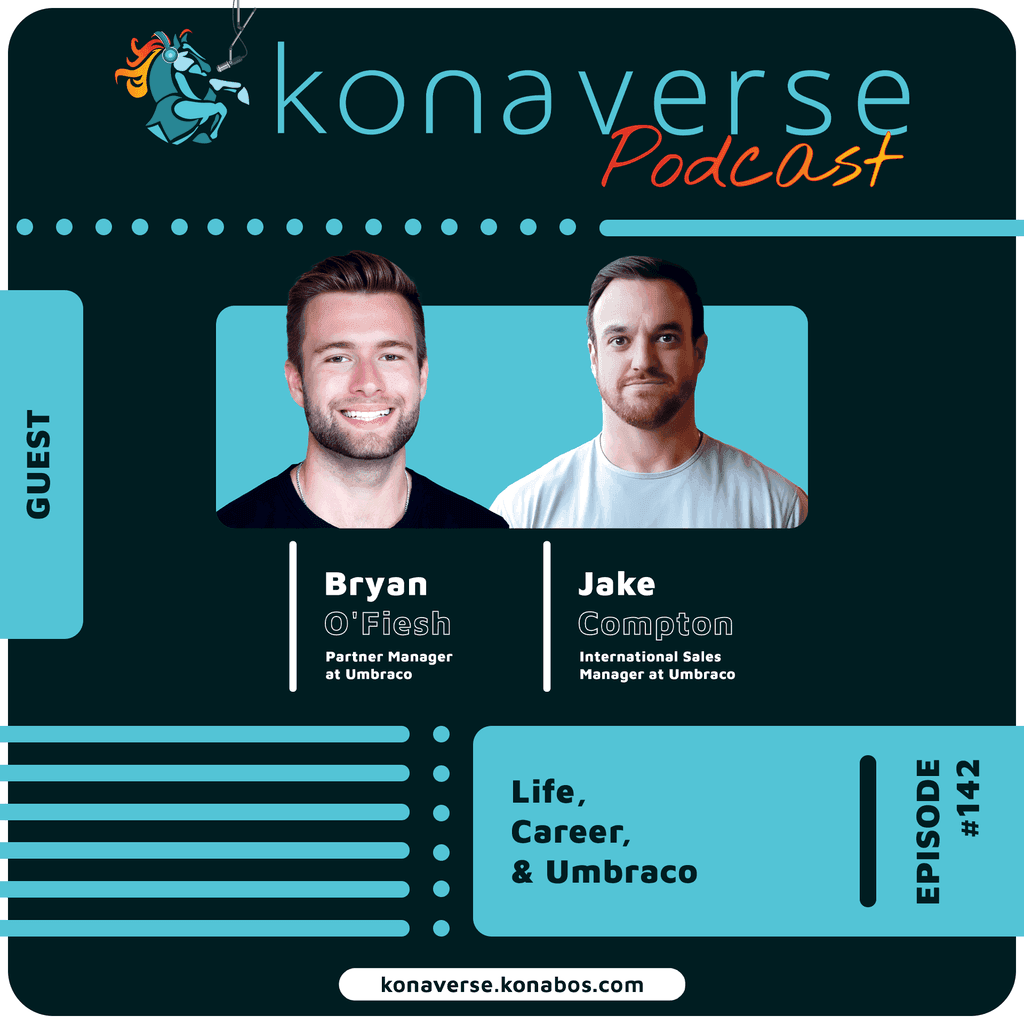
Jake Compton is VP of Sales US and Bryan O'Fiesh is Partner Manager at Umbraco. In this episode, Jake and Bryan talk growing up in North Carolina and Maryland respectively, childhood, education, career, sales, partnerships, Umbraco, and so much more!
[00:00:00] Welcome to Konaverse, a conversation experience platform.
[00:00:04] Hosted and curated by Konaverse Consulting, Konaverse is a global technology leader
[00:00:08] and while this podcast will be connected with the technology.
[00:00:12] The glue is human stories and narrative.
[00:00:14] Technology can bring us together.
[00:00:17] It can make our life better and more efficient in mid-advise.
[00:00:20] But it cannot replace human discourse and the magic that can happen by the interchange by deers.
[00:00:26] Hope you enjoy our podcast.
[00:00:30] Welcome to the Konaverse. This is actually a surah and this is Matt McQueen.
[00:00:34] Today we have with us two friends, Bryan and Jake. They're probably real life friends but they are friends of ours.
[00:00:42] So let's put it that way.
[00:00:43] Welcome to the show guys.
[00:00:44] Thank you. Appreciate it going to be here.
[00:00:47] Thanks for having us on today.
[00:00:48] Yeah, this is a lot of fun because we've done about 150 Konaverses.
[00:00:53] And this is the first one that we've ever done like this with the two guests in one remote location at the same table.
[00:01:00] So we're going to have a lot of fun but of course, Jake and Bryan will not of course because no one knows this yet.
[00:01:05] But we're going to find it out. They're the first and second employees of Embraco in North America.
[00:01:11] We will get there.
[00:01:13] But Jake, I'm going to start with you.
[00:01:15] Where were you born? Where did you grow up?
[00:01:18] Yeah.
[00:01:20] Yeah, with the two people.
[00:01:21] We do things differently so we had to make it different on the 150th episode.
[00:01:26] Now I was born in Atlanta, Georgia.
[00:01:30] Didn't spend a lot of time there.
[00:01:31] I was only there for about three years.
[00:01:33] And then did about a two year stint if you will and Vermont.
[00:01:38] I would say I was a little too young to remember that because that was what four and five.
[00:01:42] And then moved to Charlotte soon after that.
[00:01:45] I've been in Charlotte pretty much my whole life.
[00:01:48] Even through college, did college in the mountains of North Carolina so not too far away.
[00:01:52] So yeah, Charlotte, Charlotte's what I would consider home and something's kept here.
[00:01:57] I love it here.
[00:01:58] So yeah.
[00:02:01] Same question to your Bryan.
[00:02:02] I wonder if we'd be the whole thing.
[00:02:05] Amazing. Yes.
[00:02:06] So I was born in race in Maryland a little bit of North of here in Charlotte.
[00:02:12] Just right now.
[00:02:14] Born.
[00:02:15] It was raised in Davis and Go Maryland about 15 minutes outside of the capital of anapolis.
[00:02:21] You know, it was their mind-world life once at the University of Maryland for school.
[00:02:28] And then staring at typically my parents owned crab, shacks, restaurants,
[00:02:32] seafood restaurants up there.
[00:02:34] So aside from being from Maryland quite literally using with old bay.
[00:02:39] I would say.
[00:02:41] And then moved down to Charlotte when I started out in Brocket a little over three years ago.
[00:02:46] And I've been loving Leather down here and in the Queen City is that's the road.
[00:02:54] So Jake, you've been in Charlotte for longer than Bryan.
[00:02:57] What brought your family down there after ping pong and around from Vermont to Charlotte?
[00:03:03] Was it a business opportunity? Was it the open new life of North Carolina?
[00:03:10] Yes.
[00:03:10] My dad was always in finance.
[00:03:13] And he was in sales much like I have been through my career so far.
[00:03:18] So he moved around to a couple different cities. He had actually lived in Charlotte prior to me being born.
[00:03:25] And decided that once I was born and in old enough to start in school, he had already previously decided if you could end up back in Charlotte.
[00:03:31] That was the perfect place to raise a child.
[00:03:35] So once I got to five years old and starting the school age, they found an opportunity back here.
[00:03:43] They're still here.
[00:03:44] And Charlotte, I'm just going to ask one on that one actually.
[00:03:47] Charlotte is very known for banking right?
[00:03:49] Don't they have the two major banks that are fighting each other for the tallest skyscraper?
[00:03:54] Yeah.
[00:03:54] The health town is like Wells Fargo, they can learn which ones taller.
[00:03:59] Let's add another one if we're not beating them.
[00:04:02] Very much so.
[00:04:04] It's a brand you talked about, perhaps, checks and all being.
[00:04:08] What do you think?
[00:04:09] What do you think?
[00:04:10] When you were growing up.
[00:04:12] They started off my dad, started off as, you know, started an insurance company.
[00:04:18] And my mom was a special education teacher in Maryland sort of as they were building up their lives.
[00:04:24] They go with one of the colleges in Maryland as well.
[00:04:26] And I'm just a little bit older than my dad came across a business opportunity to start some seafood restaurants.
[00:04:35] And our hometown there and, you know, that kind of took off from there and one restaurant led to another.
[00:04:41] And then, you know, my mom started working with him super close.
[00:04:44] And it was the pretty typical family owned business.
[00:04:48] I'm running the boat and everything my dad doing.
[00:04:50] Lunch of the other stuff for the restaurants. So they, they just said that until about a year ago.
[00:04:56] They sold the restaurants. They were doing the seafood restaurants out there for strong almost 15 years growing up.
[00:05:05] Wow. So Jake, what?
[00:05:07] What is it like growing up in Charlotte? What was childhood like?
[00:05:10] What did you, did you know what you wanted to be, you know, seeing your dad and sales and banking?
[00:05:16] Like, talk about your childhood a little bit from the personal and what you thought about professionally.
[00:05:22] Yeah. So growing up in Charlotte is interesting because when I was younger it was certainly a very small city.
[00:05:30] And it's a very fast growing city.
[00:05:33] So as a result of that, I've seen significant growth over a short period of time.
[00:05:39] And like, I've largely grown up in the same area of Charlotte my whole life.
[00:05:44] Even now I live in that area. So when I was younger it was all trees.
[00:05:48] And now it's building everywhere. It's pretty wild.
[00:05:53] But I would say that the unique thing about Charlotte is it's kind of the melting pot within the United States which is its own melting pot, right?
[00:06:01] It's very rare to meet people that are actually born and raised in Charlotte.
[00:06:05] Most everyone here is from somewhere else, which I think is cool because a brand new unique culture if you will to the city.
[00:06:16] So yeah and then knowing what I wanted to do growing up, not at all, but had no idea.
[00:06:20] I don't even think I knew what I wanted to do. It's like graduated from college to be honest with you.
[00:06:25] And I don't even use my what I majored in in college.
[00:06:29] Specifically, like that's not the field that I'm in right. I was an international relations major, which is a PR major.
[00:06:35] So I've shifted a little but I still use something that international obviously working with a Danish company or working for Danish company now.
[00:06:42] But I kind of started to explore things that my dad was doing and talking to people that he knew in the field and sales field, etc.
[00:06:52] And exploring that a little bit and found that I just enjoyed interacting with people up and kind of had a niche for a skill for it.
[00:07:02] And the rest is history so far so yeah.
[00:07:06] Awesome, so Brian growing up, well with what were some of your hobbies.
[00:07:13] Yeah growing up, going out on the homagespeak bay doing a lot of fishing with the family right. I mean we kept a little fishing boat over there on the chest beat bay that we would get to drive over and those spring and summertime do rock fishing per fishing over there.
[00:07:30] So big on on fishing, growing up there going into watching the DC watching the national games going to watching Commander's games and the follow with my family team.
[00:07:43] I'm not going to get those, I mean big DC sports family through and through. I mean across the board, commanders, captors, wizards aren't doing so hot.
[00:07:54] But yeah, so a lot of sporting events, both my parents are super into supporting the scenes we try to get as many of those games as possible.
[00:08:04] And then yeah my dad's a big fish of it. So a lot of memories going out there growing up doing some rock fishing there in the bay.
[00:08:13] So Jake, PR was that just like I don't know what else to do. It seems about right.
[00:08:20] But what we think of this? I think I had gone through like a story different majors at that point.
[00:08:25] I went into school and said like a lot of people do them to be a doctor quickly found out how much schooling that takes and said you know I don't want to be in school that long ago.
[00:08:34] I think did some criminal justice, did all kinds of stuff. I was always really good at writing and expressing thought that way.
[00:08:45] There's a lot of writing and PR.
[00:08:48] And then I kind of like understand in the inner workings of businesses and PR is usually involved in the disaster portion of it.
[00:08:56] You know the day to day, the portion of it, the announcement portion of it. So I did like that aspect.
[00:09:02] But I quickly discovered the PR is behind the scenes a lot of time and I like to be talking to people a lot of the time. So yeah, I think I still use some of the skills just not directly the degree.
[00:09:14] You're still well. So yeah.
[00:09:18] Brian growing up what line of work did you want to be?
[00:09:23] Oh man growing up. I had no idea.
[00:09:28] I had always, I mean thought about going into maybe the restaurant industry with you know my mom and dad running those but really what I was always focused on is my dad was always an entrepreneur coming out of school and even I mean he was a general business major in college and so he was always sort of inspiring that entrepreneurial and you know just discovery spirit and
[00:09:53] going out and trying to figure out what you want to do he always told me like he kind of bounced around a couple jobs before you know finding out exactly what he wanted to do. He never graduated college and realized he wanted to own a seafood business right.
[00:10:09] I mean that kind of things just sort of worked their way out in that sense or with different opportunities that that came across his table and so I've always carried that same mindset.
[00:10:20] So I didn't really, I didn't really know. I was, I know I wanted to do something business related. I was you know a business major in Maryland.
[00:10:29] But in terms of specifics was sort of keeping up in mind because that worked out really well for him and you know it's sort of sort of preached that to me as well.
[00:10:38] So, jigs with the kind of bouncing around the different majors when you were coming out of college and then you landed on I guess call it ping pong PR or something. You landed on that one there was were you and you don't seem like an anxious guy to me but were you was that worry some to you coming out and not knowing really what to do or did you have the confidence you were going to kind of roll into something and what was that something.
[00:11:05] Yeah, you know I'm kind of very open minded when it comes to a lot of things so I came out of college with the idea that if I don't land on what I'm going to do right out of the gate eventually I will.
[00:11:18] So I wasn't really concerned about that I think it was more and looking at the different majors so it was more like I'm not really going to know until I'm hands on you know until I'm actually doing it out in the working fields that I'll discover okay this is where I'm supposed to be and.
[00:11:35] Yeah, I never I didn't come out and do PR at all I immediately went into sales and immediately got the edge for immediately loved it and then I just progressed from there so.
[00:11:50] When when did you get a liking towards technology obviously your intertechnology and partnerships and stuff but like was technology something was even on your radar in school.
[00:12:05] Yeah, it's definitely was so in a university and Marondite I majored in business analytics so we were basically doing big data statistics you know to solve.
[00:12:17] Real world business problems are set up was super interesting.
[00:12:23] But we were always using different technologies to you know work with big data or you know display the calculations we made and lots of different things so I thought that.
[00:12:34] You know the aspects of using technology to kind of translate into real world business applications and how back at work obviously I wasn't doing any web development or.
[00:12:48] You know technologies like like a rock or like we were with now but I always didn't think that that was pretty interesting.
[00:12:54] And how you know technologies can can work sort of in the warrior world.
[00:12:58] So in this time's the problems and how that integrates.
[00:13:04] Jake I did look up in that college in the mountains is Appalachian state right.
[00:13:09] We're yeah I'm going to I'm going to actually slightly say Appalachian state sorry no.
[00:13:15] I don't know what you said.
[00:13:17] It's like half the country says Appalachian now the country says Appalachian but yeah well and of course of course what what did I look up when did they beat Michigan was at your first year.
[00:13:27] Yeah.
[00:13:29] Now it was actually so I had originally gotten to a different school before and transfer to Appalachian state so I missed it by a year.
[00:13:37] So yeah and then I heard about it the next three years I was there once and all you missed the best thing in the history of the school so.
[00:13:46] Yeah, I still I still claim that I you know was a part of the mountain near experience so I had pride but didn't see a person.
[00:13:54] So the you talked about coming out having your first job then you were at a spot for.
[00:14:04] Quite some time seven years yeah how did that come about how did you become a gold level master sales agent that sounds serious.
[00:14:14] Yeah so the company that I worked for actually at the time it was very under the somebody was there that long.
[00:14:21] And it was the sales culture that a lot of people are used to or it's people are coming through the door and going back out very quickly.
[00:14:32] So I got in and.
[00:14:35] I hadn't really already had an exposure to that type of sales culture prior in my previous job.
[00:14:43] But in my previous job I was driving around everywhere so that was a different different piece so.
[00:14:49] With this when I got in and really kind of put my head down and figure out okay how do I master this.
[00:14:56] How do I become the best that I can be at it and that's what I really just going to read.
[00:15:00] Mentorship to sales is one of the most important things in my opinion because I think experience.
[00:15:06] And hearing how other people do it is something that's untitial on pin and paper right sales is very much by experience and hearing other people do it.
[00:15:15] So that's what I did and I watched on the people that were really successful with it.
[00:15:19] Listen to how they did it and then kind of made it my own and ran with it and snuck with it.
[00:15:26] And yeah, where I worked they had a promotional level space on your success as a sales person.
[00:15:32] Of course all the other stuff that comes with it with a promotional levels and you get up to the highest that you can and that's why I achieved that and I sat around because I was happy I was good at it and.
[00:15:44] So yeah, no reason for me to leave.
[00:15:47] Until I don't know how much of course that's a great reason to say.
[00:15:51] So Brian taking you back in your memory lane.
[00:15:56] Do you remember your first job interview professional job interview?
[00:16:02] My first professional job interview.
[00:16:05] I don't know if it was exactly the first but one of the first like when I was in college applying for internships.
[00:16:14] I do remember one of those.
[00:16:18] It was for a technology company and I was applying to be like a data analyst for them because that lined up with my major at the time.
[00:16:29] And I remember when I was in a full suit.
[00:16:33] This interview and I showed up and I like I didn't really know what to expect like from an actual first interview at that point.
[00:16:43] And I ended up interviewing me. He was super like back, super like very casual about the interview and like I was wishing I like maybe wasn't wearing a tie with a suit or something but.
[00:16:54] I just remember coming out of that interview and thinking like okay like the next interview that I have because I was interviewing for a couple internships at the time right?
[00:17:05] I remember being like okay like ruining his interviewing.
[00:17:08] There are real people too like they just want to see if you're going to come in and put in you know have a good work ethic and put in good work and make sure.
[00:17:18] But I come in and do good work so yeah, I do that pop dryness my head.
[00:17:22] I can remember a picture of the room right now and.
[00:17:27] So Jake you brought up the evolution of sales you know driving around mentorship.
[00:17:35] Still in sales probably all different kinds of things you're selling technologies maybe real things.
[00:17:43] What most try to true sales people and I'm not saying you're not one wouldn't sit here for an interview for an hour they'd be like,
[00:17:56] What sales that have stuck with you when you said you make it your own what are you know some of the top things you've learned about how to be a good salesperson through your vantage.
[00:18:07] I say number one is accountability sales is really a job that you have to make yourself accountable for what you do if you put in the work and you put in this time to learn it.
[00:18:20] Then you can be successful a lot of a lot of other jobs.
[00:18:25] They can say hey here's the task complete the task and you're done with sales it's kind of.
[00:18:31] This is your number.
[00:18:33] You don't know 100% how to hit the number you don't want you have to sell but every sale is different in every sale requires a different approach.
[00:18:41] So you really have to kind of make it your own book of business you really have to kind of make it your own and work.
[00:18:47] I can ask for newer towards that towards a goal and work hard and take ownership for it.
[00:18:53] I would say that and I would also say keeping an open mind.
[00:18:58] You know it's something that you don't always know everything when it comes to sales somebody is going to know more somebody is going to have a different approach to it.
[00:19:07] And the way that you capture that and you integrate it into how you do stuff and make it your own makes you successful so those two things will be the day once for me.
[00:19:18] So Brian from business analytics to product and from product to partnership like how did that path come about and what about the partnership makes you happy every morning.
[00:19:37] So good question.
[00:19:38] I think it actually, it like directly relates to something that Jake just said about each.
[00:19:46] Like where I'm at now and handling each partner and before that each sale and each product demo and each interaction with a client or a new client or existing client that each case is unique.
[00:20:01] And they, everyone's coming from a different place everybody wants to use on broadcast lately different as this slightly different.
[00:20:08] There's a million variables right and I just found that super interesting like the care that has to go in that and the thoughtfulness that has to go into every interaction or every strategy with the partner.
[00:20:23] And I think that's what I don't think I would have said that's what pushed me from more data analytics to our amount now until recently, I think I sort of realized that.
[00:20:34] Because I would push me more from the data side of things because I was doing a lot of what I felt were more repetitive tasks just you know in my opinion on that.
[00:20:46] And I think just from going to product demos where you had to tailor the demo to each client in their use case and then moving into partnerships and working with each of our partners and they all have a different spot in their respective industries or their niche or you know everyone's a little bit unique in what they do.
[00:21:10] And I think I really liked you know the challenge of helping them with them rockers resources put that together and see them be successful at what we have here in Brocco and you know kind of yeah again just directly related to what J said each.
[00:21:25] Each thing's a little bit different and it is I mean truly like an art being able to and this is again, I think relates to the sales side of the also partnership management is very unique avenues that each business takes or each sales going to take.
[00:21:44] And I think that just kind of got me into it to being a part of that and sort of solving those I just found it super interesting.
[00:21:53] So Jake as a mentor to us, we're going to ask you some advice.
[00:21:57] We have a cone of those.
[00:21:59] We have started to really look at more of that kind of traditional outbound sales element, you know you were talking about hitting a number for us.
[00:22:08] We do a lot we've always done a lot with relationships we won't stop that but it's almost like the number always hit us when we did it that way and I think it's a it's a very different muscle.
[00:22:18] To hit a number and I think for us it's like it could be overwhelming when does it ever stop.
[00:22:25] How do you manage the pipeline it can feel like there's 25 I'm saying 25 it sounds good dust maybe 25 but yeah there's more than a handful of real things happening at one time and you can't.
[00:22:37] Switch context and then throw the customer off thinking that they're not important because you're mind is shifting how do you how do you manage that.
[00:22:46] Well I think it's something where you don't manage at a loan you have a really good team around you that is super involved with your sales team.
[00:22:56] I think what I run into a lot of times and a couple of things that struggle with it is when the sales team is the sales team the marketing team is the marketing team the support team is the poor team they don't collaborate at all.
[00:23:07] But if they do start to collaborate then there can be cases where sales person is struggling with a huge technical build that they're having to pitch to a client.
[00:23:19] But if support was involved it could speed up the process significantly because support has that technical knowledge that the salesperson maybe doesn't.
[00:23:28] So I think if you break those silos down it helps quite a lot and then you have the driver ties I mean of course you're always going to have to prioritize the different customers that you're talking to based on different things right I mean they're all important to you and you want to help everyone but realistically.
[00:23:48] You know you can so you have to work on the best way that you can and if you can't do it and you have somebody under team that can jump in and help you up and again that goes back to break another silos so.
[00:24:00] I didn't know this was about getting free advice so I got to have.
[00:24:03] I'm trying something something intelligent.
[00:24:07] The Brian in your role for partnerships right I mean we we partner with a lot of companies and what's interesting is I feel like it's a it's a bit of a thankless job being on the partnership side of things because almost is underestimated I think.
[00:24:24] More than anything else and not everyone's willing to utilize the actual power partnerships so the question I'm asking is.
[00:24:33] I'm sure of the 10 companies you deal with a lot of them are transactional and some of them are not how do you.
[00:24:43] Like in your opinion if you're the one running it which you are from a partnership perspective do you prefer more transactional approach and more relationship based approach and if if the other party wants to do transactional how do you kind of switch your mode.
[00:25:00] Yeah so there we definitely have some partners that favor one end of the spectrum on the transactional or the relationship base.
[00:25:12] Partnership so that is something that you know I do work with day in and day out personally after for relationship base.
[00:25:21] Because I find that if you have a relationship based partnership when those transactions are happening if there happens to be a hiccup or if maybe it's just high stakes it makes that significantly easier to communicate and deal with.
[00:25:37] But even more specifically with how we work with our partner agencies it's you know it's you say it's thankless it.
[00:25:45] It may or may not be but the same thing to be said about a unit of true partnership right it's worth their partner that are partner.
[00:25:53] And so the more they're involved with us and the more engaged they are with us you know that makes our partnership you know that much more effective for their business.
[00:26:05] So I think it is it's definitely what you get out of it is you know what they put into it which is I think why relationship based is how I prefer to deal with it.
[00:26:17] Yes it takes effort from most sites to true partnership so yeah set relationship is for sure.
[00:26:25] So Jake you go from gold level master sales agent to the first North American and broco boy how that happened.
[00:26:36] You know it's interesting to of course I was like I said I was doing pretty well where I was so I was feeling uncomfortable wasn't necessarily looking for anything.
[00:26:49] I had gotten a call one day about this opportunity with a broco.
[00:26:56] But I said you know I'm always open to talk to people and at the very least I'm networking with somebody you know in meeting context started meeting with them didn't interview and really just loved the culture.
[00:27:12] And the people that I was talking to through that process.
[00:27:16] I had never worked with European companies at all.
[00:27:19] I had never known anything about the mark besides the fact that every year I saw it on the list of like happiest places to later.
[00:27:25] So I had it on my, I got to go there someday I got to go there someday but really do nothing more than that.
[00:27:33] But yeah just really got a good insight into the culture once I started that process.
[00:27:39] And said I think this is where I belong.
[00:27:42] I love how they're doing it.
[00:27:44] I love the product that that has seemed very shortly right because I just started and just wanted to be a part of what it was I thought it was exciting so I jumped and so happy that it did.
[00:27:57] How do you find you?
[00:27:59] Okay.
[00:28:04] So Brian from a product and a partner perspective how does a Morocco position themselves as an enterprise level CMS and DXP that people can use because I know I like I've used way back in the past when it was just free right so that.
[00:28:26] That aspect of freeness stays stays with certain people just like how WordPress or WordPress is free oh yeah but implementing WordPress isn't free right so how do you guys differentiate yourselves.
[00:28:40] Yeah, definitely so we like to to brand ourselves as a you know a mid enterprise grade content management system is sort of where we like to.
[00:28:52] So I'm just a full in in that market another term that I think describes some braco really well because like you said it it was and still is you know found it as an open source free content management system and it's core right.
[00:29:09] And that comes with a lot of great things and as we've grown as a private and as a company.
[00:29:16] A term I really like is we're commercially backed open source project now.
[00:29:22] So we we still all the development and technical benefits of being an open source project they're all still there which is amazing because that's what it made it grow in such a popular product but as it's growing in popularity now we have some funds.
[00:29:39] Some from very very nice Scandinavian makers more immersive now but the same work which is is rare in the market for my experience.
[00:29:52] I think that it's certainly great from leadership we've heard you know we're staying of course to those values and I think that that speaks volumes to Tom Broko season's future.
[00:30:04] So Jake we're coming up on looks like five years since you came and or made that decision.
[00:30:13] What is it like when you look back over the five years especially to from where you are now when you think back to that those initial days of being the lone wolf over here what was what was life like there how did you kind of norm to this new European company how did you find your footing.
[00:30:31] I hear in America do you remember something about those early days.
[00:30:36] No man this could be a podcast in itself this episode.
[00:30:40] It's gonna be a whole episode.
[00:30:44] I do feel like to properly explain this I have to kind of tell a short story about it.
[00:30:50] So when I started again like I said that took a jump and one of the things was we needed to come to Denmark for a month right and kind of learned everything.
[00:31:00] Learn the product, etc.
[00:31:02] They didn't have anyone over here that could teach me that so I was like okay I've never been out of the country except for like Mexico.
[00:31:10] I never been to Europe and it would be anywhere else.
[00:31:13] So I said you know what let's do it.
[00:31:17] Got over there was there for a week and a half my CEO came to me and he said well there's something going on and they're closing the border to Denmark because.
[00:31:27] I think that's the last time I was going to go to the city of Denmark.
[00:31:28] So I was the last plane out of Denmark after a week and a half literally the last point it was quite bizarre it was one of those big three row by a giant planes and I was one of five people on it.
[00:31:42] There was no one in the airport was wild as well.
[00:31:45] So that kind of the rail stuff a little bit I think just like everyone there was there was a fear within the company it's the unknown right what is this going to do so the world was going to do to the business.
[00:31:55] So I came back and I was by myself sitting at home on Zoom right now having to do what we were expecting to deal with travel around etc.
[00:32:05] On Zoom.
[00:32:07] So I just fell back on what I knew.
[00:32:10] I started doing sales the way that I knew how to do it.
[00:32:13] I started building relationships with people and frankly I just went into our CRM and just picked up the phone old school silence or calling people.
[00:32:22] And I think because I had confidence in what I knew I could do and I knew I could evolve just talking to people that were using the product.
[00:32:32] That would be successful so I was and we made it through it and now we have a US office here I get to come in and see my colleagues and etc.
[00:32:42] And the nice thing about it is we've brought some of that Danish culture and flavor to the US office.
[00:32:49] Of course, it's a different country so it has to function slightly different based on the market but.
[00:32:55] Frankly, that Danish culture and it's been really cool and yeah continuing success.
[00:33:04] Jacob are you saying that do you pick old hearing for lunch every day?
[00:33:08] You know, I've had people hearing but I prefer to hold.
[00:33:13] It's a surprise.
[00:33:15] They're already saying it's a surprise.
[00:33:17] I'm like okay, I didn't know that this could taste this good.
[00:33:20] But those open face sandwiches when I was first introduced to this pickle hearing.
[00:33:25] I'm like, hmm.
[00:33:28] He's like, I'll just just try it and I tried it was actually really, really good.
[00:33:33] So it's good.
[00:33:35] So Brian, these umbraco code garden conferences look really, really cool from the outset I've never been to one.
[00:33:43] But from a partnership perspective really what are the kind of opportunities to the partners get.
[00:33:49] To be at events like he's there any other event that you throw specific partners to exchange information and do hear feedback.
[00:33:58] Yeah, so first who garden is done, I mean a conference like no other.
[00:34:05] And I'll come back to that.
[00:34:07] So we do have a US based conference that we do every year that has a couple years it's been in Charlotte,
[00:34:15] with Carolina, which is where our you know, when Brock is US headquarters are it was a,
[00:34:20] I'm Brock US US summit and that's where all of our partners would come to that.
[00:34:27] We would have a big partner summit for the day getting like most partners.
[00:34:31] Some of us would insights into the business of product trends, you know, face time with executives, which is big for our partners here in the US because majority of them do sit over and Denmark.
[00:34:43] So that face time is a big opportunity for them.
[00:34:46] We're actually ending our partner summit in US festival in Chicago here.
[00:34:51] The first week of October on October.
[00:34:54] So yeah, we'll be able to get some face time with, you know, not only someone Brock, H.C. or sort of flying over but also it's great.
[00:35:05] I mean, it's great to get face time with, you know, everybody in person right.
[00:35:12] So it's a great opportunity for partners and me to connect but also the unblock of partner network is very open and like follows for company value of friendly or everyone's really networking and
[00:35:24] bouncing ideas off of each other and you know, there's a lot of a lot of friendships that are, you know, show people.
[00:35:32] Like long from that network and there's always fun to, you know, go and have the partner summit and get face time in that sense.
[00:35:41] And then go around a few beers after and keep it going.
[00:35:44] So we do love to do that.
[00:35:46] So yeah, what we'll be doing that in Chicago in a few weeks. I got mentioned on the US side and then globally, who we've already been conferences.
[00:35:55] They are, yeah, a conference like no other.
[00:35:59] The value from, you know, our partners going there from a networking and face time perspective is also great.
[00:36:05] There's a lot of great technical sessions that are part of, we'll invite their developers who are in love with from Brock,
[00:36:12] they'll come and they'll get a lot of, you know, technical expertise from the talk there.
[00:36:18] So it's an overall amazing event and I mean, it's in Denmark, it's always in the summer.
[00:36:25] Best weather in 10th part is when we do go to garden, it's beautiful.
[00:36:29] So if you can make it happen, anyone who's business and then you're looking to learn a little bit more about him, Brock, there's shameless
[00:36:38] Could we have an applause from Brock?
[00:36:40] Maybe out there, it's amazing.
[00:36:44] So I'm not in the same room, so I can drop this awkward one here, no, I'm just kidding.
[00:36:48] But Jacob, if you're the first employee and Brian was the second, you must have had a lot to do with hiring him.
[00:36:55] Is that correct?
[00:36:56] Yeah, I taught everything that he knows.
[00:37:01] So actually Brian came on as an intern on a different team than what I'm on.
[00:37:08] The teams have now combined, but at that point he was entering on that team.
[00:37:14] And then as we grew, so my director was actually Denmark for a while and I was having a work across across the globe really.
[00:37:24] But we were growing, so we knew we needed somebody to really do what I was doing and help me and at effort so we could grow this else team.
[00:37:35] And Brian started kind of mentoring me too well with me and we worked very, very closely together.
[00:37:44] And then in my opinion, I mean he was super successful picking everything up very quickly.
[00:37:47] So yeah, I was a very big fan of bringing him on full time in that role and moving in from that team that he was on into the team that is on now.
[00:37:57] That was an obvious no right here.
[00:38:01] And I can definitely attempt to Jake is bank on the,
[00:38:06] you know, I'm just saying, Oh, I was a very, very successful fan of the team.
[00:38:35] So I was going to do a very good job with him.
[00:38:36] And then I came back to the team and I was going to do a very good job with him.
[00:38:36] That's always the first thing I've remembered that happened to one of the first things, but yeah
[00:38:42] There are in a series that there was always and still definitely is a big aspect of mentorship that that J.S. had for
[00:38:51] You know my my career out of Brockwood professional in general and
[00:38:56] Yeah, it's great. No, I want to ask a marketplace question here
[00:39:02] Probably Jake because you you're coming up on the five years here
[00:39:05] But it you were not in what you were selling before it wasn't like CMS and DXPs, right?
[00:39:14] So that prior to this job. Yeah, yeah, not at all
[00:39:18] So that's that's an interesting point for this right because you came in
[00:39:23] with really strong sales tactics
[00:39:26] Kind of a new industry you still know how to do the features benefits connect with people
[00:39:32] but then on top of it
[00:39:34] The industry itself is completely a moving target that shifting between on-prem headless hybrid, you know
[00:39:42] composable are we a sweet are we multi products?
[00:39:46] What has that if you think about the five years that way?
[00:39:51] How has that major job easier harder
[00:39:54] different
[00:39:55] Is it all just the same I don't like you know what I mean?
[00:39:59] So I think one thing I've learned about this industry from the sales perspective that
[00:40:04] A lot of that stuff is just noise for me
[00:40:07] It may be important to some people it may be important to some people that are super ingrained in the tech
[00:40:13] But if I just listen to the problems my customers are having and find out
[00:40:19] Those things which may be three things maybe two things. Maybe one thing
[00:40:23] But it's typically not the entire breadth of like AI to DXP to you know everything like that
[00:40:31] If I have this conversation and just discover that and then know how Morocco can help solve that problem that they have
[00:40:38] It allows me to kind of block out all that noise and I have people on my team
[00:40:42] People in support are people on the product side that understand it all of that stuff
[00:40:48] So they're there to support me as well if I absolutely need it, but
[00:40:52] Yeah, I mean I think the one thing in tech especially from the sales perspective where I see a lot of people struggle
[00:40:59] Is they come in and they don't understand the tech but then they try to learn everything and
[00:41:05] It's just not gonna happen because you're not in that field. You didn't go to or maybe you did go to college learning all of that stuff
[00:41:11] But most of the time you did it for themselves and you're just not gonna learn it all and you're gonna drown yourself
[00:41:17] And knowledge that doesn't matter not for that or at least and you're gonna be throwing stuff at
[00:41:23] potential clients that they may not care about because you're not listening to their problem
[00:41:29] So yeah, that's kind of the approach that I think on everything that happens in the tech world
[00:41:33] Of course I keep up the date with trends, et cetera those types of things, but
[00:41:39] But most part I just
[00:41:40] Listen to my partners listen to my clients and let the experts handle the expert stuff
[00:41:49] You are mute. Okay. That's a good answer
[00:41:52] Brian what does the word community mean?
[00:41:59] The word community
[00:42:01] I mean it's in general to me just any sort of sense of
[00:42:08] similarities between a group of people right it could be a
[00:42:15] Fantasy football with he as a community together and they have their own
[00:42:20] traditions and fun things that they do right I can be in like a larger group of people or
[00:42:28] Of course the the and Brockham community encompasses a lot of different
[00:42:33] People who are involved with them Brockham a lot of different ways
[00:42:38] From people who work for in Brockham people who use it
[00:42:43] So their business is people who are just
[00:42:46] Loving it for their side projects that they're doing I mean there's it's a big part of what we do out of Brockham and a big focal point for a reason
[00:42:56] And
[00:42:57] Yeah, I guess it plays a big role
[00:42:59] Brokow
[00:43:00] Yes, I know that interesting thing about when you look at a Brockham community is you can have
[00:43:08] Like the CEO of a company who's not super technical but is passionate about a broco
[00:43:14] All my downs to not down to but across to a developer who's super technical and a broco
[00:43:21] Think it's a get their an event or having a conversation sharing the same interest
[00:43:25] It's quite interesting because obviously they played two very different sandboxes
[00:43:31] So yeah
[00:43:32] So Jacob, it's the same question but Brian had a good answer there so I want to ask it a little differently
[00:43:39] How does community how does the embraco community make
[00:43:44] Embraco a better company and a better business
[00:43:48] All the community from Brockham is absolutely vital
[00:43:51] We were not open source product so
[00:43:54] They're contributing directly to the product was one aspect. I mean that's they're putting a poll request
[00:44:00] Contributing code etc
[00:44:02] That's the very obvious one but
[00:44:05] I mean, I would say
[00:44:07] To that if you ever find yourself at one of these events that Brian spoke so I really have and you just watch people engage with each other
[00:44:16] And the passion that they're sharing with each other and
[00:44:21] The almost comfort that they're having I've been to a lot of conferences and it feels sometimes stuffy
[00:44:27] It feels sometimes very businessy
[00:44:30] Under approachable if you will and this is quite the opposite of that so
[00:44:34] I think the embraco community when I talk about culture previously the Danish culture and everything like that
[00:44:40] Does the essence of the embraco culture
[00:44:44] They're whom make us what we are there what makes the products successful and
[00:44:49] There are also the people that I'm learning a lot from from that
[00:44:53] Where's the problems that we're having what's the value that's out there currently
[00:44:57] So I think they touch every aspect of organization from sales to marketing to support to product
[00:45:05] In a positive way so it's like the lifeblood of the company
[00:45:10] I'm glad I'm braco values and respects their community and I think it'll go far when you do that
[00:45:19] Question to you Brian. It's my last question to you
[00:45:23] If you take your life learnings and if you were to go back in time to the 13 year old Brian
[00:45:30] What life advice would you give him?
[00:45:35] Man my life my life learnings back to 13 year old Ryan
[00:45:41] First thing I would say is you're not going to the NFL because
[00:45:47] You're your
[00:45:48] You're not doing that stuff pay pay more attention school
[00:45:52] No
[00:45:56] Let's see that's such a good question
[00:46:00] Your Karen said we didn't have to prepare anything for that
[00:46:04] I love to prepare out nice well thought answer
[00:46:10] On a series of though from you know taking a step back I guess for me and
[00:46:15] Tekken and business and all that is that I would
[00:46:20] Tell my 13 year old self to really focus on how my parents are carrying themselves in how
[00:46:29] They backed and were their priorities are because now as I've sort of grown
[00:46:36] You know from being a teenager and to you know
[00:46:40] Where I am now at life I recognize more or more that they had their priorities and you know right with you know
[00:46:48] family and being very very hard workers
[00:46:51] And just focusing on having me and my sister grow up and
[00:46:57] You know not have a set of sort of in life and just always be hungry for what's next and that would pause
[00:47:03] I'm out of tune about and I'm going to mind about moving forward and I guess that part
[00:47:08] It's kind of a little cliche, but just as I guess I've grown up
[00:47:12] I respect and admire more and more what they did
[00:47:16] As I was growing up so I can tell my my 13 year old self to
[00:47:21] You know maybe not be be some kind of hell some rules for things like that
[00:47:27] Yeah
[00:47:29] So Jake did get more than a couple of minutes to think about his answer, but
[00:47:36] Yeah, what would what would you say with that 13 year old be shocked if you told him you were selling Danish CMSs
[00:47:56] Yeah, what are you doing?
[00:48:00] Yeah, my 13 year old me with a set by Bitcoin. No, I think
[00:48:06] I think 13 year old me would be proud of Jake now
[00:48:11] The things I would probably tell 13 year old me is always be learning never stop learning
[00:48:18] And always be open to everyone's perspective right I think that's super important
[00:48:23] We don't all try the same mind so people look at things very differently
[00:48:28] And it's an important way to understand the world and and know the world is
[00:48:33] To know that right that people look at things differently, and that's okay
[00:48:37] But how do we do it together and how do we do it well?
[00:48:41] and
[00:48:42] yeah, I think that
[00:48:44] That's something that that I would tell them and then also
[00:48:48] Something that I've always
[00:48:49] proud of myself on it's
[00:48:52] Being a good person at least I think that I'm a good person. I feel like I try to be humble and not
[00:48:57] Call myself up. I try to be a good person so I would tell 13 year old Jake to continue to do that as well
[00:49:06] Yeah
[00:49:08] Good
[00:49:09] Thank you so much for your time guys. It was hopefully you learned something about each other
[00:49:14] We were sitting across the table and I was trying to notice you guys to see if you knew everything about each other
[00:49:19] I guess you probably do but that for your time
[00:49:24] Now we appreciate it. Thank you for having us on
[00:49:26] Thank you for the conversation and the questions as well so
[00:49:30] Yeah, yeah, it's great really really enjoyed being on here
[00:49:33] Appreciate it. You should come to a cook or something
[00:49:37] A conference like that. There. It's just a quick flight or a Denmark. Thank you for anchoring the
[00:49:42] Conivers we hope these discussions gave you something to think about help you learn something new
[00:49:48] and provided a window into someone else's story
[00:49:51] Everyone's story is worthy and important until next time remember to be fair be kind and keep exploring

