

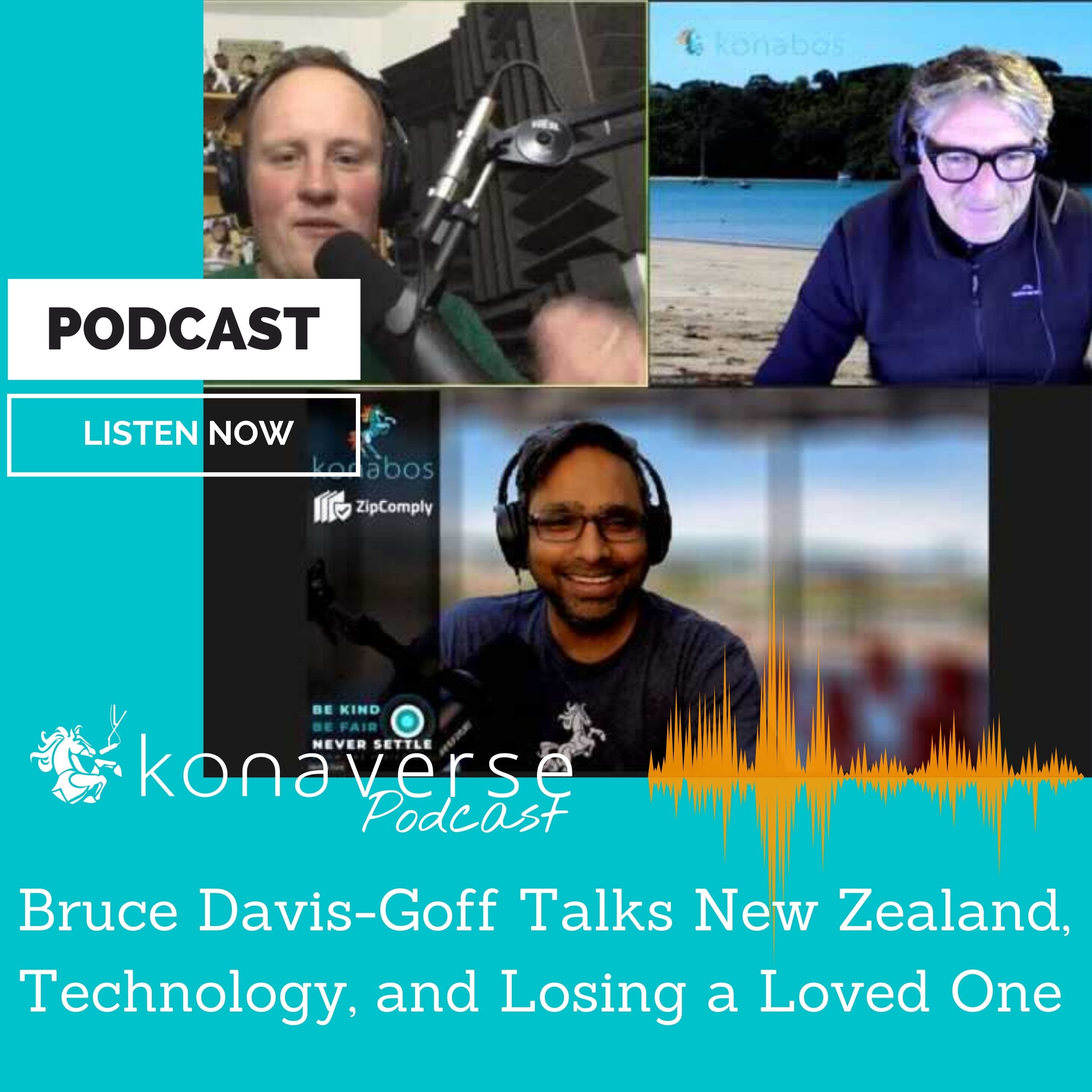
Bruce Davis-Goff is APAC Operations Director at Konabos Consulting Inc. In this episode, Bruce discusses growing up and life in New Zealand, odd jobs, finding his way into technology, losing a loved one and working through profound grief.
Akshay Sura
Welcome to the Konaverse podcast. This is Akshay Sura
Matthew McQueeny
and this is Matt McQueeny.
Akshay Sura
And with us today is Bruce Davis-Goff. Bruce works with us here at Konabos and he is one of two unique people. So Andrew was one who we interviewed a couple of days ago and Bruce is another one who brings cheer to any conversation always laughing. And what's funny is you never know if he's sad or is mad. Something horrible is happening in his life. He's always like smiling and always cheery is the biggest cheerleader for Konabos ever we've ever had. Even before he worked with us. He was the biggest cheerleader. So that's a long introduction, Bruce. So how's everything going?
Bruce Davis-Goff
It's good, its good, Aksha. Interesting, you should say that. The Buddhists have philosophy around what they call a cup of sorrow, which is basically that your capacity to be happy is only as big as the sorrow that is filled your cup. And again, this ties into like Eastern philosophies of ying and yang, where you've got to balance in the universe between those two things. So I thought that was quite an interesting introduction.
Matthew McQueeny
Nice. Well, Bruce, I'm getting to know you a little bit. We'll get to know each other a lot more in 40 minutes, but it's very intriguing that I know it's the obvious thing when we're here over on in North America, but it's tomorrow there. You're in New Zealand. What does that come from?
Bruce Davis-Goff
I come from the future.
Matthew McQueeny
You come from the future. Yeah, our first podcast from the future. So why don't we talk a little bit about did you grow up in New Zealand?
Bruce Davis-Goff
Yeah, look born and bred Kiwi. I grew up in the south side. South Auckland, which is you know, kind of a traditionally is kind of the rough neighborhood, working class neighborhood. And so yeah, I grew up in South Auckland, left home when I was quite young to go and live on a farm in the middle of the Urewera National Forest, which is kind of down on the east coast in New Zealand. Pretty remote place. Pretty amazing.
Matthew McQueeny
Wow. So what is that, I mean I think what a lot of people think of New Zealand it's like there is a remote aspect to it. I think it's probably served the country well in COVID in some ways, and we'll talk about that in the future or in the future of this podcast. But what was it like as we tie in the technology thing to what was it like growing up in in a remote place like you did? And and for one and then how did how to technology catch ya
Bruce Davis-Goff
Well, it was choice bro as we say New Zealand. Are sweet errs because there was not so many people, you know, the population density here is pretty kind of light. Well, it used to be Auckland's getting kind of dense now. But um, yeah, you know, I had a great childhood in the respect that you know, we're raised on the streets really our parents basically "all right, it's it's, you've had your breakfast now get out of here." And they'd chase us outside we would hop on our bikes and go riding. You know, I used to go fantastically long bike rides with friends, when we're young, we used to go out to the airport and lie down and watch the planes fly over us and then bike home again. And I think it was safe. It was safe. And I think that's probably one of the things I really love about living on Waikiki island. You know, I can let my daughter's Oh, just go wandering off up the road and go to the library and go shopping and do things and come back. And I feel safe. I think if I look, you know, in Auckland, I'd probably be following them and a bush with a sniper rifle. What is he doing? What is he doing? He's talking to them. He's That's it. That's it. So it's a wonderfully Safe, safe environment over here, which I really love and you know, very, very close to nature. You know, I'm not I'm not a hippie, he says, prefacing, some thing he's gonna say which sound really hippie-ish. But it just was the story when we went to Orlando for Sitecore, what did they use to call them... symposium, I remember we went to the symposium and you know, I've been wearing shoes all day and walking between these places. And there was some grass here and I thought, Man, I just have to do this. So I took off my shoes and was walking in the grass. And it's it's I actually believe this to you know, some physics behind it because as we were out fakie clothes made out of nylon we rushed around rub against things, we generate static electricity. And I think you know we're electro chemical beings such so if you start to get out of balance with the electricity in your body you need to ground. And so I love being able to walk on the sand walk in the water walk on, you know, and, and I think it brings you back to a balance point heavy enough for you.
Akshay Sura
Maybe. We're still we're still trying to peel the peel the onion that is Bruce, we'll never get to the core of it. I know.
Bruce Davis-Goff
I know. Look you'll peel couple layers down and be like six weeks later, he's still going on about the walking in the water thing.
Akshay Sura
So Bruce, you had an interesting childhood, as you said, really nice, fun one safe one. So where did you go to school? What kind of thing? Well, I know the answers to this. But you know, the reason I have to ask is that one the audience to know where to go to school? What did you major in?
Bruce Davis-Goff
So here's the fascinating thing. I left school at what would call the end of the fifth form, which is when I was 13. That was the end of my any formal education. That's it, I'm out of here. And so I've never never been to university, never done a masters or a BA or any sort of thing like that. I've really, you know, been a stout advocate of the University of life. So yeah, I left at 13. The internet turned up in my life through music, around about 16 I decided that I was going to learn to play instruments. I learned on the bass guitar and then lead guitar, then keyboards. In fact, I spent quite a lot of my teenage years from like 16 onwards doing classes training on things so I opera trained, trained in the theater as an actor improvisation training that's that's still a big passion now I love the other wing and on the fly is my thing. I'm the fly guy. And so that inevitably led when when Yamaha in, oh, in the 80s Honestly, this is going back so far released a device called the Yamaha cx five M, which was based on the Sinclair ZX 80 chip, you may recall that. "My god back in the days of the ark, I remember when we discovered lightning." And it was Sinclair ZX 80 chip. So this is the very first music computer and it was it was kind of primitive you put cartridges in and you know you did the keys on the keyboard. Is that's that's a quaver, oh no wait, it's not a quaver. And you type it onto this stuff, and, and then you can play it, but it was the first looper as well. So I could write a bar, which was eight bars long and then write a write a bar, which was 17 bars long, and get them both looping. And so you get the do these beautiful effects of different musical phrases shifting in and out of sync. And that was really exciting. But it was same time as first Mac's came out. And I was looking at the graphical interface was just you know, pure envy go "oh, man, wish I had one of those." So I taught myself to write machine code. So it could make the Yamaha CX 5 M do stuff that it couldn't. And so that got me into music. But then of course, Atari came along with its beautiful interfaces. So they weren't beautiful then. But they looked they were Mac like, right, so you had a mouse. And that was I worked with Atari for quite a number of years, and then made the move to PC, but it was all up to that point focused on music. And then of course, the internet turned up in New Zealand around 1994. Last millennium, you may remember, it was you know, 1000s years ago.
And I bought my first PC it at this auction for like, I don't know, I think it was $10 or something. And it wasn't starting up and stuff that's really kind of a good story. I went and to visit this company, as soon as I said they knew about these things. Like I said, Oh yeah, it just needs to you a battery for the sea moss, as I okay learning new terms as we go. So and it went in and it was my first computer running on dos. And so I discovered DOS and started programming in those languages and things like that. All really just through wanting to do music, because I was still at the stage working as an actor and getting bit parts on TV shows. But of course it is Zealand again, this is back to it's a tiny place. There's not a whole if you can be an actor in New Zealand and make a living but the level of dedication required to actually get there is huge. You have to be relentlessly self promoting and just pushing yourself out there. And as it turned out, I really wasn't that kind of guy. The same reason why I sort of gave up playing in bands. I thought you know, I'm not going to be Pop Star, I'm not going to be a rock star, I just I don't have that level of, I'm going to grind out every second in my life to be doing this, I was kind of more more of a renaissance, I like to have little fingers and lots of pies, like you're doing some theater over here writing some poetry here, you know, doing those things. So, what I did was I started my own company. Well, that was a bit more than that. I worked for this other company, it was one of those part time jobs, you know, say, you know, singer wanted for doing singing telegrams, and the sister company called Flim Flam Singing Telegrams, and really, look, it's a whole ---- load of fun, because basically, you get people telling you a whole lot of information about themselves. "Oh, you know, he was born here. And, you know, only last week, you went to put the dog out" and this was happening, you know, funny situations happen, they fill you in on all this, this information about this person. And from that you write a witty ditty perhaps to a well known tune that's appropriate for the occasion. And then they're having a party you know, there's there's hundreds of people yahooing and you've got a burst and in a funny costume, get them all to shut up, and listen to you and get their attention and then launch into an act. So I worked there for a bit and then I forgot about that because I got a job as working in a dive shop. This is another story so I worked in the dive shop for a couple of years.
Akshay Sura
And before you get to that, Bruce like in that previous telegram job, something funny happened to you at one of the parties so this was the craziest story you've ever told me
Bruce Davis-Goff
There were so many Akshay, really
Akshay Sura
You jumped into someone else's car do you want to tell us really quick that story?
Bruce Davis-Goff
Oh look so I was dressed up as I used to call it the Fabulous Fury because it managed to offend pretty much everyone. So what it was was an All Blacks jersey, you know our symbol of macho New Zealand, paired with a tutu, pink tights and gumboots which sort of like oh my god that's just melting my mind. And so I just come bursting out doing this singing telegram and there was my car packed with my driver waiting for me because i got someone to drive. So sort of leapt into the passenger seat. Well, that was a good one. Well, I turn around those this guy just sitting there with his jaw dropping. He didn't know what to say and I realized there was my car pack two up identical car, same color everything. So I sort of kind of Oh, sorry, apologize and leaped out. But I mean, there was there was always there was always a good story to be had with doing singing telegrams. Once I was just about to leave from our house dressed up as Rambo is to love Rambo, "you don't know what it was like it was hell you weren't there" and you know burst in with a gun and peopel used to go nuts for that stuff. And I was just I came back inside to pick up something as I was going down to the theory and in between that someone had shut the sliding door. And I turned without even thinking and just put my head straight through this huge plate glass wasn't safety glass either. And I remember was just it was fun. The second one my head was like outside this big hole with all these jagged bits of glass around my neck. And I don't remember too much about it I was probably concussed and I pulled my head back out. Oh, ---- "sorry, hon. Do you mind cleaning this up while I go do this telegrams?" And she's like, "Look, you're not going anywhere you obviously concussed as I sort of staggered round and a half, you know, Arghh. And so we got one of my backup singers to do that particular job. used to dress up as Blackadder as well which is always fun. People love Blackadder. And you know why? Because of the codpiece. There's nothing like wearing you know, phallic symbols that people can grab. They love it. They can't get their hands on this right? So I used to go through I had a friend who made them for me and I had to replace them every six months because they get grabbed and pulled in squeeze so much. You can make jokes like do you know what's inside that but it was really quite a fabulous, fabulous job. But that was came after I worked and I worked as a diver diving instructor so with through my Petit training, rescue diving night diving cave diving, then works to dive master and then went on to become an instructor specializing in teaching students from Asian nations. And so I did that for ages. But then I realized you know, I really didn't want to be keeping getting wet like this all every day endlessly, you know, you'd be soaking in pools how we go and again our puppy fingers. And so I started my own company, the singing detective telegram agency, based on you know, from the name of the TV show the singing detective, which was like a detective story, but with lots of good tunes. And, and so just started with just one character, which is Sherlock Holmes, you know, big pipe. "Yeah. So I understand you're having a 40th birthday. I'm curious. My deduction leads me to believe you're an old bastard" sort of thing. So I did that actually for about 10 years because it was, again a great lifestyle, I just work evenings and weekends and the rest of the time was mine. But then around in my late 30s, I got my first proper job, woo hoo, employed! When extra came to New Zealand, which was an arm of Telecom, it was the the internet arm which started delivering internet. Of course, it had a portal called Expo very scary, the graphical thing hard to load. So I started working the entertainment producer on a story server, again, another blast from the past, I remember stories. And of course, story servers, you have to like come to learn how to do HTML to get anything decent out. Otherwise, it's just, you know, boilerplate stuff. Um, so that got me started learning HTML, then, of course, once learned HTML, all the other languages that I've learned that as well and blah, blah, blah, blah, blah, blah. And so I did all that, and then progressed through a number of companies working as you know, web producer and then bumped into Sitecore dun dun, dun when I was working at datacom, and Auckland, and I thought this is the shizz this product. So I took took an opportunity where there was a local real estate company who needed a new website. Because they are on I think they will, they will end up there weighing up whether they should look at Sitecore or whether they should go with with Microsoft. I can't remember what the Microsoft things called anymore.
Yeah, SharePoint head Page Designer, and all sorts of fun stuff. And I thought I thought Sitecore was so brilliant. So I went and applied for the job and convinced them to buy Sitecore, which had never touched before. Again, this is, you know, just just doing things without thinking through the long term consequences of them, and taking advantage of a moment. And it worked brilliantly. I learned how to install Sitecore. My first install, I think, took three days. Because I had no idea what I was doing. But got that up and running. And then and then oh, this is another funny story. So they, the Sitecore rep in New Zealand was this party boy, who wasn't really doing much selling, but he was running around buying lots of E, and doing DJing sessions. And that was his whole gig, you know, not selling any Sitecore. And because I'd worked with this one real estate company, this other real estate company called me and said, Hey, can you tell us about this Sitecore thing. Yeah, sure. So I went and did a demo and a presentation for them. And the rep was honestly man, have you ever seen someone deliberately try and, you know, sort of block a deal. He was raising objections, the customers like rah, rah rah, the rep was like, Oh, I don't know what to do. And it's kind of putting them off. And I was like, afterwards, I was like, holy crap, that was the worst rep I've ever seen, you know? So I knew Phil Helfurvick, who was the managing director of Sitecore, Australia. Because of my dealings, I've been over there. And he trained me and as the Sitecore developer, and I said, Hey, really, you should do something about your guy here. He's, um, he's like a blocker. He's like an impediment. You know, I could have nailed that sell myself. And I'm not even a salesman. And you know, Phil held a big head away of just being very, when you went to Phil, if you had a problem, you'd always take a solution with you, you'd never go and say, oh, I've got this problem. He'd be like, you know, get out of here come to me with the solution, you know? So I told him that and he said, Okay, thanks, Bruce. That's great. Good to know. Good to know. Anyway, two weeks later, I get a call saying hey, Bruce, you want to do be the Sitecore rep for New Zealand and I said why what happened to the other guy? I fired him he was hopeless and he just boom boom there and put me in the role the next week. So I ran around for five years selling Sitecore in New Zealand so I sold most of them quite a lot of the customers in New Zealand and bi this thing about you sale you have to be it's really the jack of all trades sort of deal. Sure, maybe you can master a few but you have to be you know, versatile and be able to turn your hand really to anything so whether it's developing whether it's you know, selling whether it's all of these things because there's there's only there was only one of me.
Matthew McQueeny
Hey, Bruce, I want to ask something about the New Zealand piece. Specifically as we head into the technology, and it relates to something you said earlier one, the the All Blacks, right. That's what that's what the name is. So I there's a phenomenal Amazon series where they followed them for a season. I want you to talk a little bit about how it's a crazy cultural event basically for all of New Zealand, right and then two I want to know when you were on TV is that like Regional like to the, you know, is it just in New Zealand like this when you were doing TV and stuff like that, or did it spread around the area?
Bruce Davis-Goff
Okay, so we'll start with the All Blacks. Um, so yeah, it's Look, I mean, it's, I think it's the same phenomena you'd see around any sporting sort of thing, right? So you know, in America, you've got what you call it. Football, American football, gridiron. Football over here is normally referred to soccer. So it'll get a bit confusing. But it's just that it's we've got a quite a big macho history around that whole thing. And I don't necessarily a lot of it doesn't particularly appeal to me. For example, you know, it used to be the case of if the All Blacks lost wives used to be getting beaten all over the country, that sort of thing. Yeah. So that's the sort of the negative, you know, toxic masculinity angle, that sort of thing. I used to really love the sport. I don't watch it so much anymore. It was time where I could name every member of the team. Yeah. But I don't really don't really follow it anymore. It's, it's in the professional era now. So before it was they, they came basically from being amateurs, and extremely good amateurs. And that means there's a lot of manner, which is a Modi word for, you know, prestige, around being an All Black and New Zealand the whole All Black culture. But yeah, not so much anymore. I mean, there's other sports, which is sort of come to the fore, I'm not a big big sporty guy. In that respect, you know, don't have the T shirt and certainly with the giant hands in the stands,
Matthew McQueeny
you don't do the mayoria dance or whatever it is.
Bruce Davis-Goff
Well, that pronunciation was shocking. Shocking, maori. It's almost like you're saying moldy, but it's maori m-a-o, maori. So yeah, I mean, they adopted that's the hacker would say you'll see them do at the start, which is a really, really interesting story is this Maori warrior was on the run, getting hunted. So we hidden the Coomer pit, and a woman crouched over him. And when he realizes he, you know, he's down there, and these guys are hunting and this woman's crouched over hiding him and the committee committee is, you know, I'm alive, I'm alive, I'm dead, I'm dead. And then at the end, he, he looks up. And he sees tangata to Hulu, Hulu, which is the hairy man, which is a euphemism for seeing the vagina where the woman is hiding him. And then when she moves away at last, he sees the sun and he knows he's going to look. And so it's a story of, you know, desperation and hope and finally, victory. But yeah, they brought that to the and I liked it. You know, we've we've had some changes, of course, you probably, compared to Australia, don't take this personally, Australians. But they've been as far as civil rights and racial rights go for the indigenous people in Australia, the aborigines have been a pack, right? They're really, really, we've had racism in New Zealand, we've had, you know, we still do theres small pockets of it. But the Australians for a whole whole heap worse. And some, some reasons, you know, I think kind of it's, it's a little bit like a cultural appropriation, but then, you know, you've got to face it with the All Blacks, the majority of the players are either going to be Maori or Pacific Islanders, because these are the big strong guys with fast muscle Twitch, you know, and who can who can, can power through it. So we've we've had that evolution in New Zealand, where Toreo become important at one stage kids would get whacked over the knuckles if they spoke Toreo at school, Toreo is a native, you know, indigenous Maori language
Akshay Sura
brucey, I'm going to cut you off because I know you can you can go on and on. Let me look, how did you end up on the island, like what made you guys move to the island?
Bruce Davis-Goff
Again, look, just one of those funny things in life. You know, when you just follow a thread from the smallest thing can come the biggest thing we were living in town and again, in this, this was like a industrial building. And we had the whole top floor and had beautiful parquet floors and a view out over Auckland. Fantastic and super cheap as well. But unfortunately, on the floor below us was some young guys, who lets just say there are amateur pharmaceutical importers. And so they used to go all night for hours, and Angela was just starting to write her master's thesis, here's another one of those funny things. She's incredibly overqualified and I've got none at all. And so we some friends of ours had a little batch over here on the waterfront and they're like why don't you go over there and write your thesis. So we'd sort of decamped over here for three months and while we're here we sort of came to the conclusion that would we like to buy our first house, woohoo, go us. And we looked at houses in town, they were, you know, just outside our price range, and we didn't have any savings or anything. And we looked over here and we found this beautiful half acre with a little one bedroom and carry cottage on which is going for $65,000. So we big stole and borrowed the deposit and got guarantors and did a Riga's I was thinking, I had no money, I'd like $3,000 in debt, and was earning money running around in a tutu. We should I swore to myself at the time, I don't want to be doing this. And I'm 40 Oh, heck no. So yeah, we got our first house here, and then just just carried on up the property ladder, you know, and that was, thank my parents for begging us to do that. And so that's how we ended up here. And the beautiful thing is that, you know, it seems to suddenly have come into its own because now remote remote working has become okay. Remember, remote working used to be frowned on, you know, you never know what they're up to. But now it's de rigueur and we're just as fantastic so it seems to just again worked in my favor, but that was just from a chance conversation again, where we you know,
Akshay Sura
and you seem to be lucky that way, Bruce, a lot of things just kind of slot in at certain point in your life,
Matthew McQueeny
synchronicity maybe
Bruce Davis-Goff
synchronicity, I don't, I don't believe someone can have good luck and someone can have bad day, I don't think there's like a luck gene or there's there's a luck force of the universe, which can make you unlucky. I personally believe it's around allowing yourself to be open to opportunities, and just letting the river flow, man, it's, it's like a river is gonna let it flow. Let it flow through you, you know.
Akshay Sura
So how did you like, you have a radio show, which you run on the island? How did you come about getting into the radio show starting it or even the idea? I mean, you've been doing this stuff all your life, right? How did you come up with the idea?
Bruce Davis-Goff
Well, I didn't actually the show was pre existing. There was always been a kid show on Sunday morning. But the people that Matthew Tilly Jones, Mr. Fox who was running it had to leave the island. So he asked me if I'd take over the show. And, and that's it. It's and work with the radio station previously doing their website and helping them with technology and stuff. It's a volunteer organization. We've just got a it's a little island. There's maybe 8000 people here now. But we've got our own radio station. Yes. And it's really fun radio stations, and staffed by volunteers. And it's really good. You know, we get kids from the high school going, can I try out a radio show? And you go absolutely. And they get trained up on the desk and, you know, running it and before you know, it, there's, there's, you know, they're running the show, my Jemima, my, my daughter was started first started doing our own show solo at 13. So, you know, it's pretty incredible. She'd go up there, set up the desk, get all everything ready, and then go live. And I think and now my other daughter, Lucinda, she's doing a radio show as well. And she's immensely confident. She's just, you know, she'll chat away for hours about things she's been up to. But the whole idea is just stories, poems, and much, much more. That's the tagline. But what we do is try and do a mixture of like New Zealand stories and really old stories. Do you guys grow up? You know, listening to the radio with children's stories on the morning?
Akshay Sura
Yeah,
Bruce Davis-Goff
Yeah. So probably a lot from your generation. You know, I don't know if you've heard of little toot or Won't you ever grew up little toot and you know, little flick the fire engine. I'm a little fire engine
Matthew McQueeny
Akshay is dancing though, so
Bruce Davis-Goff
Yeah. And so that's really how that evolved. And it's just, it's just carried on.
Matthew McQueeny
Bruce, do you you have siblings?
Bruce Davis-Goff
I do. I've got two sisters. An older sister and younger sister. Yeah, they're both wildly different because we're all adopted. We're all adopted from different families Really? So yeah, yeah, my older sister and I sort of get on like a house on fire. She's a bit of a hard case and my younger sister is more sort of, you know, kind of middle of the road stable accountant kind of person, you know. And my oldest sister's kind of the other end of the scale which is like a wild Nomad, you know, driving the van rounds living here and they're having a great time,
Matthew McQueeny
They're in New Zealand too?
Bruce Davis-Goff
Yeah, they are. Yeah, we've really wanted to live really well. So I've I mean, I've I've traveled the world and the seven seas and you know, they are some great place in the world. But New Zealand's really just got it all. It's you know, it's remote. It's got a great climate subtropical where we live. Safe, you know, crimes, not a big issue. Although heavens forbid, somebody went round, some kids went round and tag some cars the other night there was outrage. But again, Really good example, community policing. They didn't push them through the courts. They got them to do some tidying up and community service and pay a bit of reparation and you know, face up and talk to the people that they've dont it to. Anyway, I'm surely I'm going tangent or the carry on as you are.
Matthew McQueeny
Yeah. So the one that we have asked for obvious reasons about COVID-19 and, you know, experiences of folks who have been on so from everything. I think I've read that we've read that New Zealand's done quite well, almost like in a Galapagos effect, right? Like you just kept everyone out. So yeah, what does it been like to see the world experiencing this? And then your experience, actually in New Zealand with how things have gone?
Bruce Davis-Goff
makes much makes me shake my head, sadly. Especially America's just nut sick. You know, people are the tinfoil hat wearing conspiracies that Bill Gates has put 5g microchips into the vaccine. So you can control our thoughts "I'm not having a vaccine?" The whole anti masks and how bizarre is that? New Zealand just went Oh, yeah, that makes bloody sense and put the masks on and carried on. It's pretty practical. Lets get on with that? For me, actually, I feel guilty because it made the whole lockdown thing made virtually no difference to me at all. It's like, well, it's just life just carries on the same. You know, go for a walk on the beach and oh look the parks closed or put tape around it oh yeah that's because you could pass on germs on that pack? Oh, yes. sensible. And Kiwis are just very practical about it and got on with it. It was there was a few winjirs. And then we went through a couple of cycles of lockdown. But yeah, no risk to reward. I really, really feel sorry, I really feel sorry for countries like India, which, which, you know, it would be virtually impossible to do the same sort of lockdown in the country with that population size. I think once you get to a certain population size, you get their proportion of dare I say nutters and the bigger the country the more nutters you're gonna have and the nutters make a lot of noise, right? squeaky wheels gets the oil and so even it wasn't too bad. It's not it's just the flu right now. That's not that was bolson arrow from from Brazil.
Matthew McQueeny
Yeah, well, Jacinda Ardern seems like she's done pretty well. with it. I wanted to ask you. One thing that interests me about kind of, you know what you were talking about with remote work, the future of work and all that. You have a pretty nice setup, where you are, but I'm interested in how you go about your work day. Being on like, you're probably on the most far flung timezone from, you know, the home office, if you will, how do you? How do you go about your work day?
Bruce Davis-Goff
Well, that's right. So I mean, generally the morning is given over to meetings with with people who aren't in the same timezone. Because we get them at the end of the day around the rest of the world. So I normally kick off about, you know, eight or nine, usually about nine because like, if I get these I'll be able to drop the kids to school, which is always fun, because you know, you get them in the car and they'll open up and start chatting about their worldand ge t good insights as to what's happening with them. So do that get back here, you know, grab a big thing of miso soup, so like my Miso, and, and just rip into the day. Normally, I'd sort of about 10:30 I'll go you know, with meetings work I'll go up and Angela I'll take the dog for a walk on the beach we find that's a really a daily ritual we do where we can talk about stuff and it gives us the opportunity to just you know, be at the beach doesn't matter what the weather is just a walk along. try and stop those boy dogs from humping our dog because she's on heat at the moment.
Dirty mongrel. look at you you're not even attractive. So we go for that walk in the morning and that's really really it's a spiritual and physical and mental thing you know, and you come back over refresh and going yeah, I could do another hours work today. Actually, I can see Akshay I'm not hiring that guy. Lazy yes. And then you know work through to I try and finish well last night I finished like 5:30 because I was doing I had actually work I needed to do so I got stuck in and did it. But normally I like to knock off a little bit earlier in the in the afternoon about two and go and pick the kids up from school and and then come home and then maybe do another couple of hours just work through dinner time. But it's you know, what I like is the ability to I used to really think you know, we had this thing of no don't disturb me. I'm in the zone, man. I'm in the zone. Yeah, you'd think it would take you 20 minutes. That whole thing about taking 20 minutes to get back. I don't believe in that anymore. I like just being relaxed enough that I can play up and pop out, I wouldn't be doing no zone and ---. And I can, you know, go and do things and keep that connection between what is real life and what is just work. You know, because then the order their priorities You know, it sets, wife, kids maybe work there's probably a few things that are bump work. And then work down there you know, goes I say Happy wife happy life.
Akshay Sura
Yes. So, so Bruce, from what I know of you, and I know know you a little bit more than quite a few people, but you're a very jolly guy, I always end up laughing when I'm with you. From what I know, you guys are very tight knit family, right. So like taking the girls to school, seeing them swim going to the beach every day for a walk. You guys are super close. And a little while ago, I heard that this is when I found out something horrible had happened. And I actually called you I don't know if it was a day or a couple of days after the moment I found out. I was not in the country. But I did call you. To my surprise, it was a pretty horrible news. And I couldn't believe that it happened. And I did ask you before you came on here if you were comfortable sharing it, because I think a lot of people can see how you guys recovered from it or recovering from it in order for them to help them right. So could you share us share a little bit of information on that event? How it exactly happened? How did you guys find out? And then I'll follow up with a couple more questions.
Bruce Davis-Goff
That was so sensitively asked, so I'm sure you're going to burst into tears. I'm not going to go into too many details about what actually happened. But suffice to say that we lost a family member or a close family member passed. And I guess you know, the thing is, when it happens, something like that happens to you. It's the worst thing in the world, right? You can't imagine how anybody in the whole world could understand how what you're experiencing what you're feeling. And it's deeply personal, incredibly powerful. But the fact of the matter is, as time passes, you realize that these things happen all the time to families everywhere. And to people everywhere, you know, there's there's things happening all over the world now, which we just can't comprehend. You know, if you're a Palestinian, for example, and your family just got bombed to smithereens, and you lost all your children, you know, I think that's a few orders of magnitude way above what I've experienced. But as far as getting through and moving on, Akshay. It's again, it's griefs are really interesting based, it behaves a little bit like light, it comes in waves, and it can build in waves. And the only way to really deal with it is to be able to talk about it and process it. And you've got to go through feeling those horrible times when you know, those overwhelming waves of of just hardness wreck through your body, when you are totally depressed when the world you're seeing the world completely through --- colourd glasses, and everything's bad, just the important thing to realize is that again, is you know, transient and will pass. And you what's interesting about these things, people who bottle up grief, it comes up with them later. It's like when you when you try to deal with grief, it's like trying to hold if you're trying to push it down, it's like trying to hold basketballs down in a swimming pool, right. And the more basketballs you get, eventually things are gonna pop up to the surface. And the only way to do it is to allow it to sit up there in the open. And, you know, your instinct is to resist wanting to talk about it. But through acknowledging and talking about you go through the you process that and allows you to move on because life goes on right end of the day, we know that life goes on and, and and even though terrible things happen. And communication really is you know, I'm blessed for that, an amazing wife. And she you know, she won't allow any of that, stuffing it down and suppressing it to go on. And I'm not saying he's like a grief ambusher but she does, you know, naturally encourage it to be processed. And that's, you know, I'm truly blessed to be in that position. But, you know, to anyone that that that has experienced that, it will pass you know, it does pass and it does it does change. You know, it's the the police officer who we're dealing with, you know, say oh, you never get over it. But yeah maybe you don't, but you find a way to accommodate it and integrate it back into your own life. And and that's the important thing.
Matthew McQueeny
Yeah, and Bruce's Interesting in the last two episodes we've done as we've launched this, like, I feel like we've had so many deep conversations, but one was Mark Servais. who, who cares for I think, a teenager or almost adult, maybe Akshay right. To Shane's muscular dystrophy, and, and then yesterday, we had Andrew who works with us, and in both cases, talking about, in their own ways, coming back from their own issues, what they have to deal with that point of talking, and just how important it is. And I think, especially maybe on the male point, we were talking about the, you know, the Maori warriors, right, but especially on the male, if can say it right. But especially I think on the male part, we often think, Hey, we just got to, we got to be the stoic, we just got to keep it in and all work itself out. And I think some things are just so overwhelming, that we have to fight that urge that like, it's just it has to be especially initially it has to be talked about some you got to get some of these things out, right, in whatever the gamut of emotions are experiencing.
Bruce Davis-Goff
Absolutely, yeah. And that's the key thing. Yeah, you hinted on that on the head, you know, toxic max masculinity is not necessarily a necessarily a New Zealand phenomenon. You know, you see it all around the world. And, and that's, that's as much as you know, talking about female liberation, and I'm, I'm a strong feminist as well. But there's also should be male liberation. And we need to liberate ourselves from the ideas that we need, that we shut these things down, that we don't talk about emotional stuff that we don't, you know, hug each other and cry on each other's shoulders. And, you know, even the very idea of men crying is still, you know, sort of like a big kind of deal. But there's no difference between males and females, I don't think in that respect, you know, we have emotions, and they need to be able to flow out of our bodies. And, again, just going heavy on you for a moment, because if you block those emotions, they become like physical, hot points in your body, where you're carrying a ball of negative energy, and that negative energy will, you know, it'll translate into something like cancer or other sorts of sicknesses. So you because your body and your brain are very much connected, I believe. And you can affect one with the other, for example, walk on the beach, affects your mental state makes you feel much better, you know, and conversely, suppressing something like that is going to have a bad physical effect on you. And again, that'll, you know, negative feedback loop into your, into your, your psyche, and yeah, so it's again, it's just that letting those things naturally flow out
Matthew McQueeny
because they need to Bruce, you just hit something. I don't think I've ever even told Akshay, this, you know, we're divulging the podcast, everyone. But I, several years ago, my wife and I experienced a miscarriage. And you know, you're never, you're never expecting it, it comes as a shock. And then as the male I felt, alright, let's keep this together. Plus, I felt like I almost couldn't emote for for whatever reason, she had no problem, emoting I just couldn't. And I was sad. But what I found is that days later, I felt like I broke my back. And I didn't, I didn't do anything to make it happen. Literally, it was the worst back pain I've ever had in my life. When I was sleep at night, I'd wake up with almost contractions in my back, that would keep me up and it lasted. It lasted literally a month, a month and a half, you go to the doctor, there's nothing there. And that was the first time where I went, Whoa, I you know, experienced my form of kind of at the time up to that point, you know, very heavy loss. You know, knock on wood haven't experienced a ton with like, very close family, but it just it finds you and I think you gotta just, you have to find a way to to get that out. Because otherwise it gets it gets in you like you said, no, that just triggered something in my mind a lot with that.
Bruce Davis-Goff
Yeah, look, absolutely. I believe that's true. You know, I mean, I think that's why we have these all these old wives saying like, oh, that person's pretty Beloved, you know, because anger will will can provoke that response and the digestive tract, the stomach and the liver and all those things quite susceptible to suppressed anger. Just as an example,
Akshay Sura
to Bruce, again, I don't want to prod too much more than what..
Bruce Davis-Goff
Yes. Yes, you do, because you're prefacing it with a here's a disclaimer,
Matthew McQueeny
Akshay, Akshay Winfrey
Akshay Sura
well asked a very pointed question, right? Because I know a lot more than I'm asking but how have you guys dealt with it? So it's one thing you and Angela dealing with it? But it's another when two siblings deal with it who are younger, right? How did you guys go about dealing with it as a family? Did you reach out for help? Did you have to get like family therapy? Or like, how did the girls deal with it? Because, you know, I get emotional talking about this, because I can't picture it. But if something had happened, I wouldn't know how I would deal with it. Or how I would console my child about dealing with it. Right. So how did you guys deal with that aspect of it?
Bruce Davis-Goff
Oh, again, Akshay, it's just about communication. You know, it's about talking to them honestly, about what's happened. talking to them honestly, about what their responses might be what they might be feeling, you know, of course, survivor guilt is a big thing, right? So when someone passes you, like, how could it be that I'm still alive, I'm unworthy. There's a whole lot of things come into play. It's just this just wild, crazy soup of conflicting emotions and, and, and, and different feelings tearing it, you know, from from contrasting and sometimes contradictory angles. But again, I'd say, you know, just just keeping your eyes open, watching what's happening with them, talking to them about stuff, you know, getting them to understand the process and talk and just basically stay on the same journey. You know, it's actually pretty simple. It's like the Marines, mate, we donb't leave anyone behind.
Akshay Sura
I don't know if I agree with you on that. Right. So I, I, it's great that you're talking about emotion, and you're talking about dealing with it. But I, you know, we suffered losses, too, but not as critical as either of you. But I can tell you with even that loss, there would be times where I would just get emotional really quick, like at an at the oddest point, when you're thinking about that person, and you just burst into tears. It's just only normal human thing to do, right? So again, I can't imagine what the two girls went through the adults I can imagine because, you know, you guys have each other to deal with. But at different points in the day, the girls are separated either at school or doing other things and thoughts come up. So that's why I was kind of curious to see how they, and you guys as a unit dealt with it
Bruce Davis-Goff
Well, they didn't really go to school for quite a while. After that, and then just as almost ready to go back to school lockdown struck, so we're fortunate that we're all together for that time. No, I think Akshay, you've got to realize that indeed, there is no scale of, of grief. Because it's all intensely personal. There's these things about, you know, the our backstory, which, you know, if I was the fill you in would make a lot of sense. And you'd go "ahh okay, all right I understand, you know" so I think everyone's everyone's got their own journey, everyone's got their own pain. And people respond to things differently. So I don't think you can, you know, put it on a scale of like, you know, lost a child lost both my parents lost my whole family. My whole football team got destroyed in a plane crash, you know? Again, it's all you know, individual circumstances. And, and this I think, that's, you know, one of the things is, I know, it's a cliche, but you'll see this thing posted on Facebook regularly, you know, you know, don't don't judge anybody because you don't know the journey they've been on you don't know their story. And the the best and only thing you can really do in life is try to be kind. And everything else is just
Akshay Sura
Yeah, yeah, no, I know. I know. It's it's hard to talk about these things. But we truly, truly appreciate and I didn't know about Matt and Melanie so it's it's really nice of you guys to share that it isn't easy we have another team member who recently had some horrible news as well. So this is like hitting home like there's no tomorrow. You guys trying to hold it together. It's it's hard, but trying to try to wrap up. Thanks again for sharing a very personal story, Bruce, I really hope it helps someone same with Matt as well.
Bruce Davis-Goff
That that's exactly my my motivation for doing this as that you know, that there may be some gems that we've discussed, which someone will be able to grab onto and go Yeah, that's right. I can use that to get through this. And that's again, yeah, basically
Akshay Sura
All right. So last question. Knowing what Bruce knows now, which is Bruce is a millionaire. And yes, everyone says on island off on paper, he is a millionaire, he cannot refute it. You won't even say anything but knowing what you know now, what would you advise your 25 year old, Bruce?
Bruce Davis-Goff
Oh, do you know what I'd go. Honestly, dude, have more fun, seize more opportunities. You know, I think we all everyone suffers from some form of esteem issues and in some way, shape or form, right? Whether it's imposter syndrome, we can't believe they'll let me do this job. They really think I'm confident. I'm not really but and we all get there to some degree, you know, no matter what situation you get dumped into. And I mean, my my character arc, if you will, has been from being adopted and having low self esteem to, you know, realizing through my life that actually I'm pretty competent. Pretty Okay, human being, you know. So, you know, I don't have to go through the grandi grandiose stuff I'm amazing. I'm amazing because human beings by very definition are out there you know, we're we're complex subsystems of bacteria which have managed to scale the heights of of intelligence to the point where we're building artificial intelligence. So we're pretty unique. We haven't bumped into the aliens Mind you, did you see the UFO coming out of the water? Who, dude. So you know, the chances of being life in the universe pretty quite high, considering there's so many damn planets if it happens randomly. And of course, there's not some great guy sitting up in the clouds responsible for, you know, sitting and standing. Okay, ready sit goes 4000 years ago, when I'm creating human beings, Adam, go, don't touch the apple. So the chances of intelligent life out there pretty, pretty high, really, because the universe is a vast place. I'm into Astro, well, astronomy, I guess you'd call it right and astrophysicists sort of stuff. I love that because it's just so amazing. Bloodmoon the other night incredible. But it just gives you a sense of perspective. You know, there's that lunacy hundreds of 1000s of miles away and it's just like, it's next door and scale of of the universe, which we haven't mapped the eges of so far, could still be expanding does i think you know, might be an edge out there but there's a lot of questions unanswered around that and then we turn around go back into the questions we haven't answered on the on the micro level you know, quantum physics, how will we ever match that up with traditional Einstein theory relatively and Newtonian physics Will we ever get there is your unified field you know, unified theory of everything which could explain a whole lot of stuff which you just don't know about it? So yeah, these are the questions which I kind of ponder around
Matthew McQueeny
Bruce to as we right before saying goodbye I want to ask I've only seen you through video but do people say you look like Robin Williams?
Bruce Davis-Goff
Yeah, that or Rowan Atkinson? And I think I mean, I've got some some traits with Robin Williams. You know, we share in common who's you know, it's again, it's the Buddhist cup of sorrow was sad as you have been this is how happy you maybe
Akshay Sura
Alright. Thanks again for taking the time for this podcast, Bruce. Hope you have a greaty day.
Bruce Davis-Goff
They're like can I ever shut him up? No, I wanna talk more
Akshay Sura
No, we'll we'll definitely have you over again. There's a lot more to you, which is interesting, especially your like the career part the arts. There's like so many stories. I know you have so many stories, so we'll definitely have you on again.
Bruce Davis-Goff
My pleasure. Thank you so much. Akshay. Thank you so much, Matthew. You guys beautiful and love you. Muah muah. Bye. Talk soon.
Outro
Thank you for entering the Konaverse. We hope these discussions gave you something to think about, helped you learn something new and provided a window into someone else's story. Everyone's story is worthy and important. Until next time, remember to be fair, be kind and never settle.

