
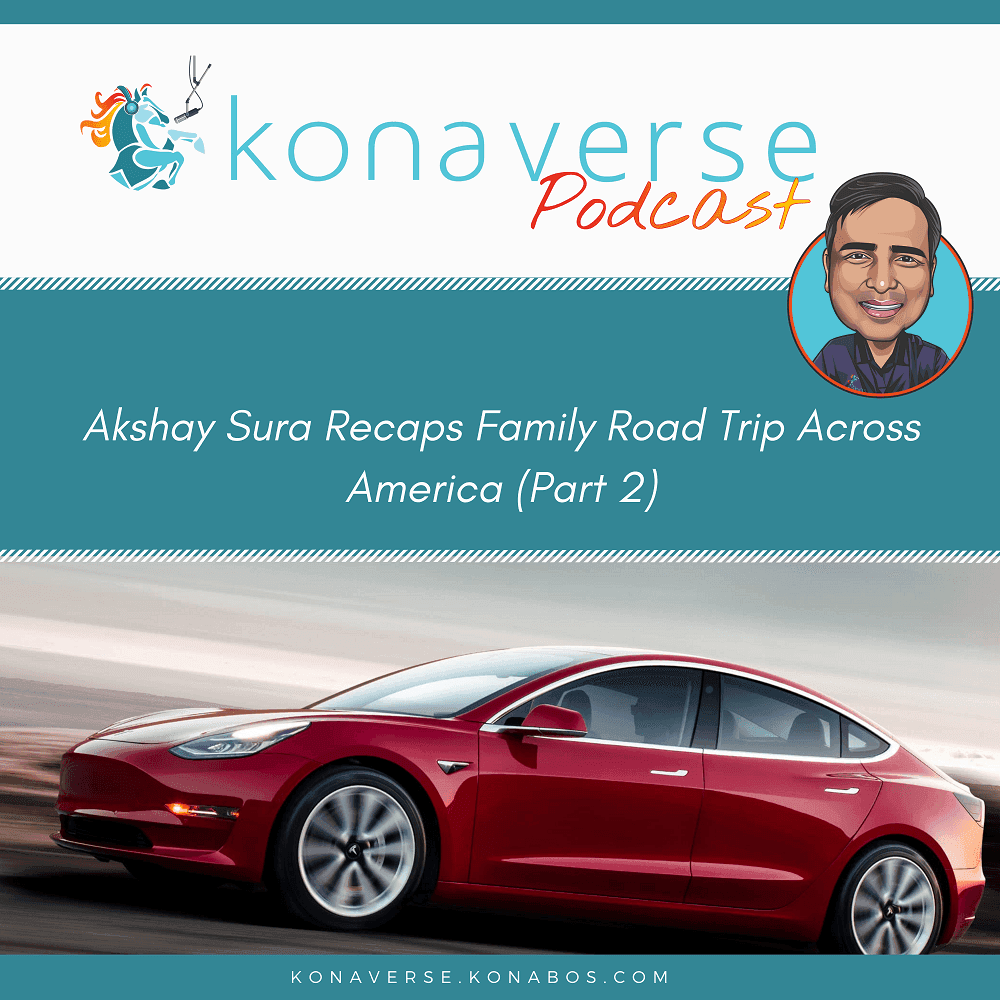
Konabos Consulting Inc. Partner Akshay Sura recaps his early summer family road trip from California to Florida and back. Akshay talks about how the Tesla held up, crazy rain showers, conversations on the road, close calls, family, unplugging from work, good food, and so much more.
Intro
Welcome to Konaverse, a conversation experience platform
hosted and curated by Konabos Consulting. Konabos, is a global technology leader and while this podcast will be connected by technology,
Matthew McQueeny
the glue is human stories and narrative technology can bring us together, it can make our lives better and more efficient in myriad ways. But it cannot replace human discourse and the magic that can happen by the interchange of ideas. Hope you enjoy our podcast.
Welcome to the Konaverse. This is Matthew McQueeny.
And this is Akshay Sura.
And that's interesting, Akshay, because you always start and I always go second. Doing this, because we're doing our follow up episode about your road trip across America, in your electric vehicle, your Tesla. And so we're gonna do a little recap here. So you're the guests. Akshay, how are ya?
Akshay Sura
I'm doing well.
Matthew McQueeny
And you're now back for about two weeks.
Akshay Sura
Yeah, about two weeks. Yeah.
Matthew McQueeny
And how are you feeling now at the end of two weeks?
Akshay Sura
Much better. well rested
Matthew McQueeny
Yeah. And I was that a surprise for you? You know, when you plan a trip like that you just take for granted I think the the fatigue factor and the energy factor. Was that the biggest surprise of the trip is how much just driving takes out of you?
Akshay Sura
Yeah, it is. I mean, especially with the heat, changes in temperatures is sitting right there at the end of the day. And even like, once you're done with the trip, it's actually exhausting. It takes a few days for you to get back to normal.
Matthew McQueeny
And how I mean, you're already in Southern California, which can be pretty hot. But you were going across deserts, you were going across the by you, you're going across Texas. Isn't interesting to, to experience the different levels of heat?
Akshay Sura
Oh, yes, dry heat, as opposed to wet heat, as I call it. So like when we were going through Arizona, some parts of Texas, it was like 105-110 at points. And then you get into the eastern part of Texas, and then you start to feel the the humidity. So the wet heat, as I call it, so it's hot, and it's extremely humid. And then you know, go to Florida, and it rains every day for a little bit. But it wasn't new. Florida wasn't too bad. It was actually pretty pleasant when we were there.
Matthew McQueeny
Did your did your bodies have trouble? Like adapting across those things in rapid succession across the the kinds of heat and the kinds of humidity and all that, like did you notice anything about the experience that in your, you know, within yourself?
Akshay Sura
No, except that you on the days when we were just driving in the middle of nowhere with like 110 degree heat, no matter how much AC you blast, I could actually feel the heat from the glass above my head from the from the roof. So it does exhaust you. So like at the end of the day, all you want to do is just shower, eat and just go to sleep. But some days are better than the other. So one of the days he was actually raining, so it wasn't as hot. So it felt like you had enough energy to do things in the evening.
Matthew McQueeny
Where you were, because I mean, I drive a Tesla as well. And even in the heat here in the east coast where it might be like 90 degrees. There's just a different feeling to like what the heat does to the car. And you know, I get nervous when car does all the time you know when the heat? Yeah. Did you ever have a concern that maybe you hadn't thought of going into this about heat on the electric vehicle?
Akshay Sura
Yeah, so the biggest issue is the heat which is generated where the battery is right? So I wasn't like while driving, when you're moving I'm not too worried because there's airflow, right. So the temperature is maintained in a certain way. But where it was is I think we were in like western, no sorry, eastern Texas. And we were charging at this stop and I go to just unplug, and I couldn't touch the handle. That's how hot the handle got. So that kind of worried me a little bit because if I can't even touch it, I can't imagine how hot or how dangerous it's going to be. So I like I had to use a couple of napkins and hold it and then take it out which I was able to but the battery and the charging it does get pretty hot. But it didn't like that was the only time I noticed it the rest of the time. It didn't really matter.
Matthew McQueeny
What were some of the high level things you learned about the Tesla, the electric vehicle going across the country on a trip like that, that you only could have learned by doing this.
Akshay Sura
Yeah, so one thing is, I think, the grid for the electric vehicles, they're doing a good job. So most of the places you would see, obviously, the Tesla's superchargers. But they were also like electrify America chargers. So you started to I know, we noticed that there were quite a few different electric chargers available. That was one, but none to be the, the grid of Tesla, though, they were very consistent. We never had to look for it. Like, you know, obviously, the map tells you when when to start, where to start, how long to stop. So that was really good. Learning to trust what your car is telling you, it took me like three days of driving to trust it. Because you're always scared range anxieties is true, right? So you're always scared, am I gonna make it to the next top. And I think that was one of my biggest problems is, I wish I had gotten a car with a bigger battery capacity, a longer range. But even remember, I told you last time, even when we were doing the trial of like a four hour drive, we figured 1% was giving 1.8 to two miles of range. Well, on this trip, because we were fully loaded with like four people a bunch of luggage a bunch of crap, because it's a family. And you're going across, and you need a bunch of things, right. So it's almost like five people traveling in the car. With the extra load, we were doing about 1.6 miles for every percentage we had. And what was happening that is, you know, the longest we could probably go was 166 miles is what we calculated, we never had to do that. So some of these places are extremely remote, and you don't want to be there's really literally nothing for miles around. You don't want to be stuck. Of course you can call them and thankfully the cell service was there. But it's an inconvenience, right. So that was was kind of scary. But after like two three days, once you start trusting the calculations a lot more by the car, it became a lot easier. So sometimes we didn't even charge as much as we needed to, we would just charge for like 5-10 minutes and then hit the next one. So it became a little bit easier. So longer range car would have been really good. The other one is the autopilot. So the autopilot was really good. But what I realized is it actually consumes a lot more energy from the car to run autopilot. So when we were running on such thin margins between charger to charger, sometimes what I did is I just did use the regular cruise control. It's an adaptive cruise control, it's still better than nothing, but I would use cruise control and just steer the car myself and because it would break by itself anyways, and not use autopilot. And then there were some instances where the the speed was so high was like 85 miles, which was awesome and the middle of nowhere. So it was tricky to think or do I just go 85? Do I go 90? you know, what would be the best energy efficient way for me to get there was also tricky. So yeah, and then the projections by the car so if it's a nine hour drive, it would give you around 11 hours 11 and a half hours including the charging, they were pretty on the on the spot so like you know I like I said once you trust it, it becomes easier once you know you know your route, it becomes easier having a car with a longer range would have definitely helped some of the anxiety but coming back we didn't go through any of those troubles because we knew where we were going to stop. We trusted the car could do that. So it became a little bit easier.
Matthew McQueeny
Well I thought it was kind of funny when saying that you're almost like a traveling caravan with all the other electric cars like you would stop and there would be all the other same people there.
Akshay Sura
Yeah, that was the funny part. So like, you know, at first I thought yeah, going there. I'm like, you know, maybe I wish I had gotten a car with a longer range but then I you know, ended up seeing people who had S's and x's and y's and you know you can read by the bag the deal motor so obviously they are have much more range than I do. And I'm thinking these guys are stopping the same time I am. If anything, they don't sit at the charger for longer than I would but it's and you compare that to like the the motorcycle groups, right? So it's kind of funny where you would stop at the charger and you'd see like three or four other cars and then you'd stop at the next one and then slowly they all start coming back and charging at the same time. So going and coming back that was kind of interesting.
Matthew McQueeny
I also found it funny you said how Many Miles did it add to your car doing this trip?
Akshay Sura
6000 and change
Matthew McQueeny
that was like this to me that you went that far. And I was thinking of the fact that in a normal month in my old days of commuting, I would do like, 6000 a week. You get to like, it's amazing. It's a lot of miles, but also almost not a lot of miles when you really like look at the total.
Akshay Sura
Yeah, yeah, no, I mean, I remember going there. And the final rating was 2900. And something for the trip. I was like, holy crap, that's a lot. And like we the drives were fairly decent. I would say like, I'm obviously the roads were all major highways. So we didn't have any issues. But you always have to watch out right. So going there we had like an incident which could have been life threatening. And coming back, we had another incident and all because you know, you're traveling on the road. So it's all the unexpected is just crazy. So one of them. And I've lived in the northeast for what, like 14 years and my wife has been there for like 20 odd years. So we are used to the rain. But the rain, which we saw in eastern Texas to Louisiana, was like nothing I've actually seen in a long, long time like this was like pouring to the fact that you wouldn't be able to see the car in front of you. So one of the mornings when we were going from San Antonio, we just left in the morning, pretty dark ish out. And all I see in front of me is the truck in front of me, the guy immediately pulls out to the left, its a two lane highway, I couldn't get on the left lane. I see a car parked right in front of me like full stop, and the driver is on the curb trying to stop people. So I stopped in time, which is great. It was an 18 Wheeler right behind me. coming at me at full force, right. So I'm like, Oh crap, the kids are in the back. I just hope it's okay. So I still can get into the left lane because I'm on stop. And this traffic. Thankfully, the truck driver was careful enough to stop but that was going they're coming back. There was this guy. So we are going up a mountain. So you go from zero elevation to about 4000 feet elevation when you're entering California on the southern side, and we're going up this mountain, there was no one in the left lane. So I'm in the left lane. overtaking like two people. And we were not at a huge speed, we were going almost like at a 45 degree angle, right? So you're probably going at like 45 to 50 miles an hour. I'm right next to the guy and the guy wants to come into my lane. And he was I had to like break to let him in and then go but that was kind of scary because you were not expecting this person. So maybe I guess I was in the blind spot or the guidance aid. But other than those two instances, it was fairly fairly decent. I got stopped a couple of times, which was kind of interesting. So like, going there, there was a gentleman in Arizona who quizzed me about a Tesla. Why did I get it? The range and all of the funds that we ended up getting talking about engines. Coming back there was another gentleman in Arizona so actually both Arizona then yeah, and in Tucson who stopped me and he wanted to have a conversation about the Tesla so that was kind of nice.
Matthew McQueeny
Nice. Yeah, no, a cross country is something I think everyone should do. It's hard to get the time now and probably was the hardest thing because you were the sole driver? Right for for the trip.
Akshay Sura
Yeah so I drove the entire way there and back
Matthew McQueeny
isn't the hardest thing that like, some random day, like two days, three days in. Sometimes you wake up just dead. Yeah, you have to find a way. You're like, wow, we got like 10 hours to the next stop though. Like you have to you have to find a way to do it. You're like, Whoa, I mean, were you like how did you get through those cause you don't even drink caffine anymore, right?
Akshay Sura
Yeah. So I mean going there. We kind of had like six days. So it was kind of nice. We did about most days, maximum like eight and a half hours including charging. One day it was I think six hours I forget. So it was pretty relaxed. It wasn't as bad coming back. We were a little bit ambitious and real. You know what, we'll do it in four days. So day one we flew through Florida like we just because it was, not the turnpike, what did they call it? Something I forget. Oh, yeah, they do call it the turnpike. So it was a paid highway super fast. I mean, we just rip through it finished. Pretty much the whole thing in nine hours. So we stop Crestview, I think Florida. The next day, we're supposed to cross Louisiana, Alabama, what else? Texas, right, Mississippi and Texas. were like, Oh, yeah, we can do it. On paper, it looked fine. But they were like such severe rain and thunderstorms. We barely did. So in the first day, we did about I think 600 something miles in night nine, something, I didn't have 10 hours. And that's including stops and charging. So you can imagine that in the second day, we barely did like 312 to 13 hours. It was just rain we couldn't. So what we had to do is we just had to cut our losses, we canceled all the rest of the sequence of hotels because we couldn't make it to San Antonio, we would have had to make it there by like, two o'clock in the morning and wake up at five and go again. So what we decided is, you know what, let's just crash in Houston for a day, relax, rest up and then go. And I think that made a huge difference for us. That just one day of break. And the rest of the days we just did quite long days. But we were able to get home at a pretty pretty decent time. Like around seven o'clock in the evening.
Matthew McQueeny
Isn't kind of cool and rad to just be like yeah, we're in Houston for a day.
Akshay Sura
Yeah. Yeah. No, I mean, it was it was it was good. It was good. It was a good rest day. We got some good food it was it was an interesting food journey as well. Because we love food more than any touristy place we just love eating food so we did not eat any fast food I'm happy to say the only fast food we ate in the entire trip there and back was on the last day. We were trying to get to we're trying we were trying to get to a spot I forget through Arizona and California and it was gonna be a long time before we got to the place where we were going to eat and the kids were extremely hungry so we stopped at chick-fil-a. Other than that there was no fast food so every stop was planned. We went to an actual like proper place to pick up food made sure we had like all the you know, fruits and vegetables for all of us because we're trying to eat healthy but it was it was interesting driving through we had the best barbecue on the planet. wagon wheel barbecue in the middle of Texas I can't even remember the name I can look it up but gosh man the ribs were fall off the bone, they were beef ribs not pork ribs, but fall of the bone. The brisket was, Texas is known for brisket, but brisket was amazing.
Matthew McQueeny
How did the kids do?
Akshay Sura
Oh the kids loved it so like we gave them a you remember I told you they we gave them a choice we have a GMC SUV I'm like do you want to go in the SUV or the Tesla they think it's much more comfortable in the Tesla I actually like sitting in the GMC because of the sitting position in an SUV is more conducive to long drives because of the way your feet are right? Yeah. But they chose this they had a lot of fun. I mean both them took turns in playing music, we went through all kinds of music it really fun. We went through Kpop, a lot of Korean music, Thai music, Japanese music, a lot of the oldies rock music all curated by the two girls which was kind of fun. So we just you know they ended up playing all the music for the for the car ride once you like after the first day we got into the rhythm, right so we in order to save time as well as just make sure for the cleanliness purpose, we would pick a restaurant order the food about 30 minutes ahead, we would pick up the food go plug it in for charging eat while it's charging because you have to use the time. Once that's done, usually the charging spaces have access to restaurants and stuff so you would take care of the business get on the car and go to the next one. Some states did follow masking, some didn't, some laughed at us, some you know didn't laugh at us kind of thing. So once they got into the rhythm, the kids were totally into it, they they appreciated going there. Like I said, it wasn't as strenuous coming back, they appreciated that extra day off. So everyone slept in. But they, they just loved it. And I think I don't know if we'll ever get to do another one like this, especially with Megan going into high school, but I think it's like the one in once in a lifetime kind of experiences they will talk about to their kids and to their friends.
Matthew McQueeny
And then they'll do it. They'll do it in like hover cars or whatever.
The interesting thing when we talked on the front end of it was the idea of like work right and stress testing the company without really being in you know, it wouldn't be what it was but you we're interested to see. How did the evolution of the trip and your professional responsibilities how that all play out? I mean, the consul still standing and doing well.
Akshay Sura
It was a very big shock. And I say this as a person who is used to working like a dog day in, day out. So as you know, it took like six days for us to get there. Two of them were, you know, weekend days, so we left on a Wednesday. So I basically told the team Wednesday, through Friday and Saturday, Sunday, you know, I'm not doing anything come Monday, I will get on the call. So came Monday, nothing, no one bothered me. I'm like, "Oh, that's odd." And I'm I was driving anyways, so the kids were having fun. We were talking so I was like, no one needs me I'm fine. You know, Tuesday comes I'm a bit tired. So I just got on just for a little bit, attended a few things. And come Wednesday, I realized, Oh, my gosh, no one needs me. So that's a very. So for me, that's a very strange feeling. Because I'm always in things 100 things at one time. And I realized, wait, it's a good thing that no one needs me. But I feel like I'm not needed. So it took me like a couple of days to get adjusted. I did work while I was in Florida, but not as much as I usually do. So I was prepared to put in, you know, at least five hours worth of work. But I didn't have to do five hours worth of work, I probably did like couple hours worth of work, just did what I needed to but not what I was asked to do. So it was a pleasant surprise that I was not needed, which is a good end result. I guess, in a way, if you really look at it, the team was able to do what they needed to do. And more. They finished a huge portion of the site we were working on, they were on top of it, they were managing it and like that was fine. And then on the drive back, I didn't do anything at all. I would just check my emails in the evening, as usua but nothing which was on fire and if there was a fire, someone had already put it out. So that was really nice. And then I came back and I've been back for a couple of weeks. So my daily workload, believe it or not, has dropped 50%. I mean, that's to do with a couple other things, because Mr. Edwards, also had joined, right when I was leaving. So it's a combination of him. And it's a combination of the team coming through and picking up. So now it gives me enough breathing space for me to do things which will help us grow as a company. So it was a really positive experience. I would definitely say.
Matthew McQueeny
Yeah, I mean, on that point, I think going into you're probably doing you're probably going at like 150% Yeah, for a handful of reasons. And then what they almost feel like a new life for a minute to like that it's almost like a fever break in a way you know, and yeah, out of the trip, and you're back home in the same place. But it was almost like a metamorphosis to a degree doesn't mean it's not gonna come right back at some point, you know, in growth stages where it was, but it must be almost a little weird. I don't even want to use the word guilt. But like it does feel a little weird to be in your spot. And things like changed positively.
Akshay Sura
Yeah, no, I truly, it took me a day or two to accept it that Oh, okay. I feel odd. I feel weird, but this is exactly what we've been striving for. Right. So we've been trying to get to a point where it gives gives me enough space to breathe and do other things manage more rather than being in the weeds and this actually gave me that chance. I'm going to take full advantage of it.
Matthew McQueeny
So, yeah, kind of the final question I'd ask is to do that trip and then to be kind of like settled in Florida for weeks. You got to, as you said, your workload down a bit, but you were still working. Did that take that take some getting used to?
Akshay Sura
Yeah, because the last time I was on a true vacation was two years ago. And before that, I was on a true vacation for God knows how long because my vacations are usually accompanied by my laptop. Which this one did do a couple of years ago, we actually did a trip to Europe without any laptop, trust me, it was it was the hottest thing on the planet, while travel without a laptop. And it felt really weird. But yeah, I mean, it was it was different, right? Like not always knowing that you have a stack, full of work for you to get to is one thing. And when you know that one, there isn't really you could pretty much do whatever you want, is a different feeling. So yeah, it was a little bit different. I tried finding things for myself to do, but it just gave me a chance to catch up on a few things, set a couple of things in motion and prepare for the next step for us. So it was it was a good, good feeling.
Matthew McQueeny
Yeah, it's, um, it's almost like it's like a train that's moving. And if you, you step off of it, it'll keep moving. Yeah. And then like, to get back on, it's moving fast, like you can do it. But sometimes you're like, well, it's kind of moving. So, you know, figuring out I think that's the beauty of vacations and things like that is it takes away the urgency of, you know, when you're in mode of like, work, work work, like every task. every task is in your brain. Yeah. And almost vacation and weekends do this to a degree sometimes. But they kind of like remove a lot of things just by nature, from your, from the front burner in your head. Yeah. And you you come back seeing what the important things actually are? I don't know. That's what I've seen.
Akshay Sura
No, I absolutely agree with you. So everyone needs a few days break where they don't really do anything. It'll actually give you more clarity, you'll come back with a lot more ideas and be more efficient, for sure.
Matthew McQueeny
Cool. Well, it was great to recap here, is there anything that thing missed? You wanted to hit on?
Akshay Sura
No I mean, I think if you can, or if you can afford to do it, if you want it to do it. I really think anyone who has access to having solar panels and electric cars, I would definitely look into them especially even for not long drives but even for your day to days. It's much more energy efficient, and it's actually cheaper if you really look at it from a long term perspective, so I would I would definitely advocate for that and depending on the state you're in so some states nowadays mandate that newer houses come with a certain percentage of their electrical usage from installed solar so that it helps us right so i would definitely advocate for renewable energies and I actually have to look I'm talking about electric but even for the regular vehicles. I know we don't use diesel quite a lot here in the US. But in Europe they they're all about diesel I ended up the gentleman I ended up speaking with in Arizona coming back has a diesel engine and he a it's it's a byproduct of petroleum, or petrol, right. So it's it's a little bit cheaper, but it's much more energy efficient, and you can get a lot more mileage out of it. So you know, just do your part to make the world a better place I think for our kids and our grandkids.
Matthew McQueeny
Well, that was a great way to end it Akshay always with a with a happy, forward looking notion. So thank you.
Akshay Sura
No worries, bye Matt.
Outro
Thank you for entering the Konaverse. We hope these discussions gave you something to think about helped you learn something new and provided a window into someone else's story. Everyone's story is worthy and important. Until next time, remember to be fair, be kind and never settle.

